

Author: Adil Ahmad
Summary
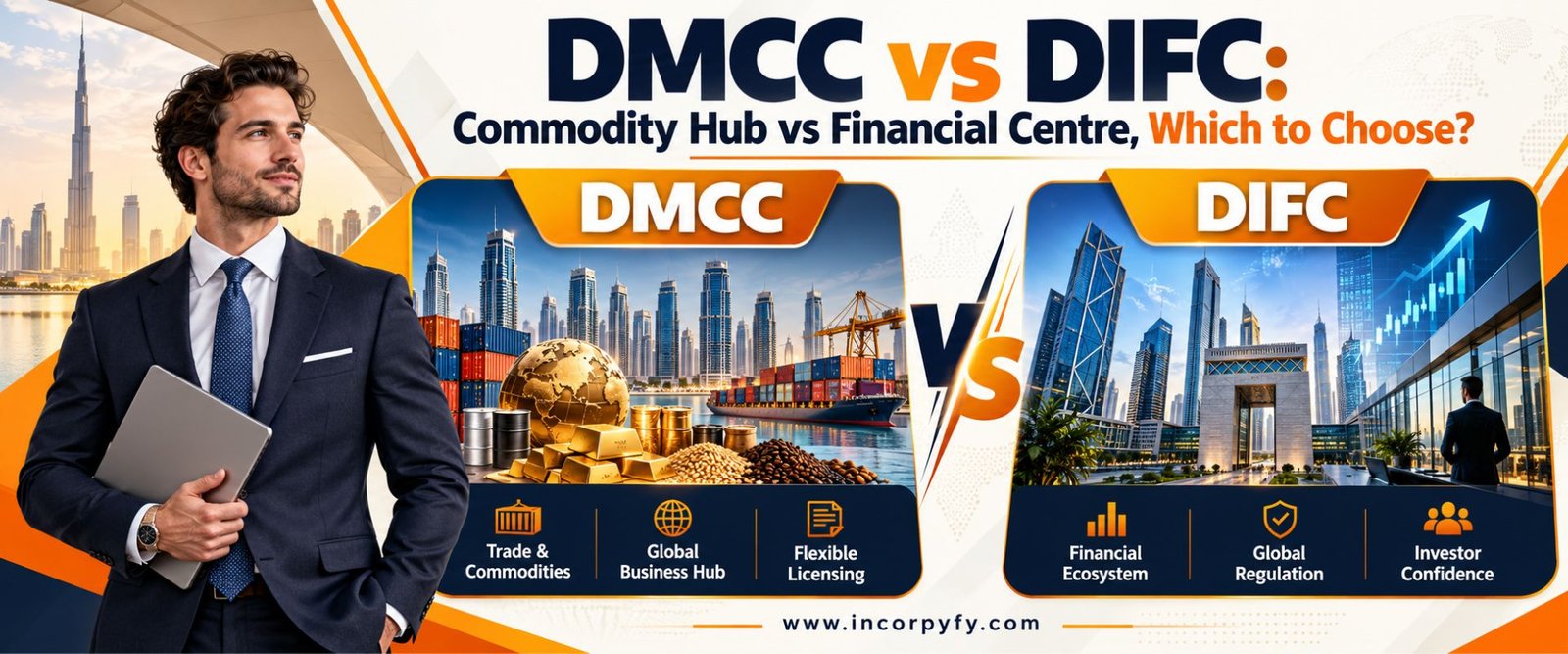
DMCC and DIFC are two of Dubai’s most respected free zones, but they serve different businesses. DMCC is built for commodity trading, precious metals and trade-related companies. DIFC is the UAE’s financial free zone for banking, fund management and fintech, regulated by the DFSA. The simple rule is that commodity trading points to DMCC, and financial services point to DIFC.
DMCC vs DIFC: The Core Difference
Founders often put DMCC and DIFC side by side because both are prestigious Dubai addresses with strong reputations. In practice they solve very different problems.
- DMCC (Dubai Multi Commodities Centre) is a trade and commodities free zone based in Jumeirah Lakes Towers. It covers commodity trading, precious metals, tea, coffee and a wide range of trading and service activities.
- DIFC (Dubai International Financial Centre) is a financial free zone in the Gate District on Sheikh Zayed Road. It operates under English common law, has its own courts and is regulated by the Dubai Financial Services Authority (DFSA).
A quick way to remember it: commodity trading belongs in DMCC, financial services belong in DIFC. Many groups end up registering in both, using DMCC for trading and DIFC for holding, funds or regulated activity.
Both zones offer 100% foreign ownership and UAE residence visas that work nationwide. Corporate tax follows federal rules: 9% above AED 375,000 of profit, with 0% only for Qualifying Free Zone Persons on qualifying income. So tax rarely decides the choice. Activity, regulation and cost do.
For related comparisons, see our guides to DMCC vs IFZA and DIFC vs ADGM.
DMCC: A Leading Free Zone for Commodities
DMCC was built around commodities and has become one of the UAE’s best-known free zones, repeatedly ranked among the world’s top free zones in industry surveys. Rankings change by year and by publisher, so treat any “number one” label as a reputation point rather than a permanent title.
Why traders choose DMCC:
- A deep commodity ecosystem covering gold, diamonds, precious metals, tea, coffee and other goods
- More than 600 approved business activities, including trading, services and holding
- Digital trade tools such as DMCC Tradeflow, which supports trade documentation and commodity financing
- A regulated Crypto Centre for digital asset businesses, supervised by VARA
- A recognised address that helps with banks and international counterparties
What to expect:
- Year-one costs of roughly AED 18,000 to 25,000, with higher renewals
- AED 50,000 deposited share capital for General Trading licences
- A mandatory annual audit
- Physical premises in Jumeirah Lakes Towers
Importantly, DMCC is not a DFSA-regulated financial centre. Its company licences are issued by the DMCC Authority, and regulated financial services need a separate route.
Read our guides to the DMCC trading licence, DMCC licence types, DMCC precious metals and stones licence and our DMCC free zone page.
DIFC: The UAE’s Premier Financial Free Zone
DIFC is the UAE’s leading financial free zone and one of the region’s most established financial hubs. It combines common law courts, an independent regulator and a dense network of banks, funds and professional firms.
Why financial firms choose DIFC:
- English common law and independent courts that international investors recognise
- DFSA regulation, giving institutional credibility
- A large ecosystem of financial institutions, advisers and law firms
- Licences for banking, asset management, wealth, insurance, fintech and advisory
- An innovation licence and fintech support for earlier-stage firms
- Foundations and holding structures for succession and asset protection
What to expect:
- Higher costs than most free zones, varying widely by licence type
- DFSA authorisation for regulated activities, which takes time and capital
- Office-based presence in the Gate District
Non-regulated companies can also register in DIFC, but for most trading or general businesses the premium is hard to justify.
Read our guides to how to start a business in DIFC, the DIFC licence, the DIFC innovation licence and our DIFC free zone page.
Cost: DMCC vs DIFC Annual Fees
Published figures vary by provider, licence type and package, so treat these as indicative and request a written quote.
| Cost factor | DMCC | DIFC |
|---|---|---|
| Typical year-one cost | About AED 18,000 to 25,000 | Higher, varies widely by licence |
| Renewal | About AED 34,500 to 42,000 | Varies by licence type |
| Share capital | AED 50,000 deposited for General Trading | Varies, higher for regulated firms |
| Regulated financial licence | Not applicable | Roughly USD 10,000 to 70,000 application depending on category |
| Innovation or fintech licence | Not the core offer | Roughly USD 8,000 initial, USD 12,000 to 15,000 annual |
| Audit | Mandatory annual audit | Required for many licence types |
| Premises | Jumeirah Lakes Towers | Gate District |
Beyond the licence, budget for:
- Visas, medical, Emirates ID and establishment card
- Office or desk rent, which is often the largest ongoing cost
- Audit and compliance, especially for regulated activity
- Renewals, which can be much higher than year one
For wider price context, see our guides to the cost of setting up a business in DIFC and the best free zones in the UAE.
Regulation: DMCC Authority vs DFSA for Regulated Activities
Regulation is the clearest dividing line between the two.
- DMCC Authority issues and supervises company licences for trading and general business activities. DMCC does not regulate banking, asset management or insurance. Crypto and virtual asset businesses in DMCC fall under VARA as well.
- DFSA regulates financial services in DIFC, including banking, wealth, asset management, insurance and fintech. A DIFC licence for these activities is not just a trade licence. It requires regulatory authorisation, capital, compliance staff and ongoing reporting.
What this means in practice:
- If you trade goods or commodities, you do not need DFSA approval and DMCC’s regulatory load is lighter.
- If you give financial advice, manage funds, deal in investments or run a bank-like business, you need a regulated route such as DIFC or ADGM.
- If you do both, a two-entity structure is common: a trading company in DMCC and a regulated or holding company in DIFC.
Regulated activity needs more than a licence application, so plan time, capital and compliance. Our guide to how to set up a DIFC holding company and our guide to how to set up a holding company in the UAE explain how group structures work.
Who Should Choose DMCC vs DIFC?
Choose DMCC if:
- You trade commodities, metals, gold, diamonds, tea, coffee or other goods
- You want a recognised address for banks and counterparties in trade
- You run a digital asset business that benefits from a VARA-regulated environment
- You can absorb the audit and premises requirements
Choose DIFC if:
- You run a bank, fund, asset manager, insurer, wealth adviser or fintech
- You need English common law and DFSA credibility
- You want a foundation or holding structure with strong banking access
Consider both if:
- You trade physical goods and also manage investments or hold group assets
- You want a trading company in DMCC and a holding company in DIFC
Quick decision guide
| Your business | Likely best fit |
|---|---|
| Gold, metals or commodity trader | DMCC |
| General trading with global counterparties | DMCC |
| Hedge fund or private equity | DIFC |
| Fintech or wealth adviser | DIFC |
| Crypto and Web3 | DMCC or DIFC, depending on activity |
| Group with trading and holding | Both |
If trading is your focus, see our best UAE free zone for trading companies guide too.
How Incorpyfy Can Help
Choosing between DMCC and DIFC means matching your activity, regulation and budget to the right authority, then handling visas, banking and compliance. Incorpyfy compares real quotes and manages setup end to end. Explore our Dubai freezone business setup service, or visit the Incorpyfy homepage to speak with a consultant.
For official references, see DMCC, DIFC, the DFSA, the UAE Government business portal and the Federal Tax Authority.
FAQs
What is the difference between DMCC and DIFC?
DMCC is a commodities and trade free zone, while DIFC is a financial free zone regulated by the DFSA with English common law courts.
Which is better for financial services, DMCC or DIFC?
DIFC, because it offers DFSA regulation, common law courts and a large financial ecosystem.
Which is better for commodity trading?
DMCC, thanks to its commodity ecosystem, licences for metals and other goods, and trade tools.
Is DMCC regulated by the DFSA?
No. DMCC licences are issued by the DMCC Authority. DFSA regulates financial services in DIFC.
Which is cheaper, DMCC or DIFC?
DMCC is usually cheaper for trading companies, while DIFC costs more and rises sharply for regulated financial licences.
Can I have a company in both DMCC and DIFC?
Yes. Many groups use DMCC for trading and DIFC for holding, funds or regulated activity.
Do both zones require an audit?
DMCC requires an annual audit. DIFC requirements depend on the licence type, and regulated firms face extensive reporting.
Can I run a crypto business in DMCC or DIFC?
Yes, in both, but under different regulators. DMCC’s Crypto Centre falls under VARA, and DIFC virtual asset activity falls under the DFSA regime.
Do both zones pay 0% corporate tax?
Not automatically. 0% applies only to Qualifying Free Zone Persons on qualifying income. Otherwise 9% applies above AED 375,000.
Can I live in Dubai with a DMCC or DIFC licence?
Yes. UAE residence visas work nationwide regardless of the issuing emirate.