

Summary
DMCC offers ten distinct license categories, from Trading and Service licenses through Holding Company, SPV, and Crypto/VASP structures, with costs commonly ranging AED 15,000 to AED 50,000 depending on activity and office type. Contrary to some guides, DMCC companies aren’t automatically tax-free, corporate tax applies unless specific qualifying conditions are met.
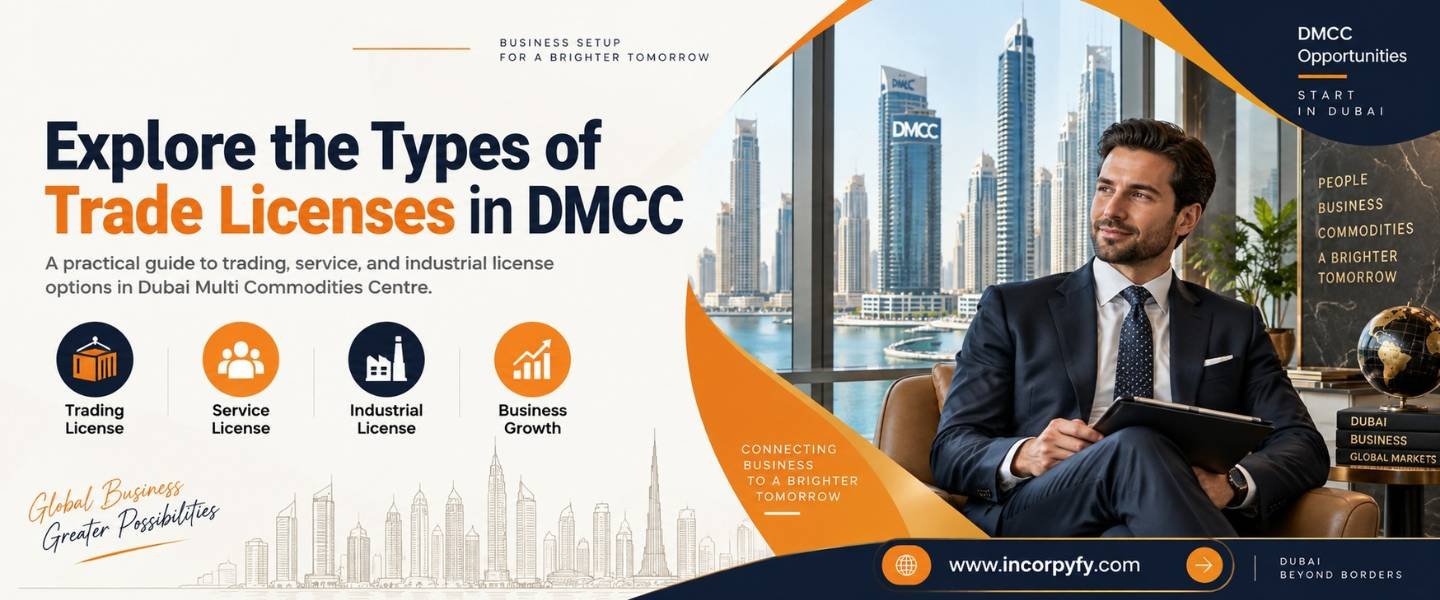
When it comes to starting a business in Dubai, Dubai Multi Commodities Centre (DMCC) stands out as one of the most prestigious and versatile free zones in the UAE. Located in the heart of Jumeirah Lakes Towers (JLT), DMCC offers a world-class business ecosystem, modern infrastructure, and a robust regulatory framework for entrepreneurs, investors, and international corporations.
A meaningful share of existing content on this topic covers the various license categories well but skips actual cost figures and repeats a blanket “tax-free” claim that doesn’t reflect the UAE’s current corporate tax framework. Getting both details right matters considerably for anyone actually comparing DMCC against other free zones or planning their financials around a specific license type.
Whether you’re launching a trading business, a consultancy firm, or a crypto startup, understanding the types of trade licenses in DMCC is the first step toward success. This guide walks through each DMCC license type, their features, eligibility, real costs, and use cases, so you can choose the one that genuinely aligns with your business goals.
Overview of DMCC Trade License Categories
DMCC offers different license types to suit various business activities, including trading, services, industrial operations, crypto, holding entities, and more. Each license comes with specific conditions, scope of business, and benefits. Choosing the right one helps avoid compliance issues and opens up genuine growth opportunities.
Trading License in DMCC
A Trading License in DMCC allows companies to engage in buying, selling, importing, and exporting goods. It covers a wide range of commercial trading activities, both within the UAE and internationally.
Activities Under Trading License
Import/export of consumer goods, wholesale and distribution, product resale, online or e-commerce trade, and general trading with an upgraded license.
Benefits of a Trading License in DMCC
Access to global trading networks, a structured tax position for qualifying income, warehousing and logistics support, and multi-currency business transactions.
Types of Trading Licenses
The Standard Trading License covers specific goods, while the General Trading License covers a wide variety of products across different sectors under a single license.
Service License in DMCC
The Service License is designed for businesses that offer professional or specialized services, covering everything from consulting to marketing, IT, and business support.
Activities Covered
Business consultancy, IT services, digital marketing, creative design, HR solutions, and legal and accounting services.
Why Choose a Service License?
Low-cost setup for professionals, no physical inventory or warehousing required, easy visa allocation, and full foreign ownership, ideal for freelancers, agencies, and professional service providers.
Industrial License in DMCC
An Industrial License in DMCC allows businesses to carry out light manufacturing, packaging, and assembly operations, suitable for companies processing goods for resale.
Activities Allowed
Food packaging, assembling electronics, light equipment manufacturing, cosmetic or fragrance production, and material modification.
Requirements
A warehousing or industrial facility within DMCC, compliance with safety and health regulations, and environmental permits for specific industries.
General Trading License in DMCC
The General Trading License is a sub-category of the Trading License but offers considerably greater flexibility, letting businesses trade in multiple, unrelated product categories under a single license, genuinely attractive for wholesalers, distributors, and exporters who’d otherwise need separate licenses for each category.
Holding Company License in DMCC
A Holding Company License is ideal for managing assets, investments, intellectual property, and other companies. These entities don’t conduct actual commercial transactions but own and control other companies or assets, offering genuine asset protection, tax-efficient structuring, and easy financial and legal management without requiring operational staff or office space in the traditional sense. This structure is suited for investors, multinational business owners, or those managing real estate portfolios or intellectual property specifically, rather than a day-to-day operating business.
SPV (Special Purpose Vehicle) License in DMCC
A Special Purpose Vehicle (SPV) is a passive entity created for risk isolation, asset protection, or financial structuring. The DMCC SPV offers a genuinely simple and private way to hold and manage assets, commonly used for real estate investment, family wealth management, IP rights holding, business acquisition vehicles, and succession planning. Key advantages include no minimum capital requirement, no physical office needed, 100% foreign ownership, and fast, cost-effective setup, making DMCC’s SPV model widely used specifically in real estate and investment sectors.
National Industrial License in DMCC
This license is specific to manufacturing entities with 51% or more UAE national ownership, qualifying businesses for benefits reserved for local manufacturers under UAE federal law, including preferential government contracts, lower utility and labor rates, and access to industrial incentives.
Dual License (Onshore Branch) in DMCC
The Dual License allows a company registered in DMCC to operate a branch on the mainland under DET (Dubai Department of Economy and Tourism), formerly the DED, without needing to form an entirely new entity, genuinely useful for expanding to mainland markets, bidding for government tenders, and serving clients outside free zones.
Process to Apply
You must first have an active DMCC license, apply to DET for branch establishment, and provide an NOC and relevant documentation.
Crypto License / Virtual Asset Service Provider (VASP) in DMCC
The Crypto License or VASP License allows businesses to deal in digital assets, including buying, selling, storing, and managing cryptocurrencies and tokens, covering OTC crypto trading, digital asset advisory, custody and wallet services, and blockchain development services.
Regulatory Oversight
DMCC partners with VARA (Virtual Assets Regulatory Authority) and requires strict KYC/AML compliance, making it a genuinely well-regarded zone for crypto startups seeking regulatory credibility.
Industry-Specific License Options in DMCC
DMCC also offers licenses tailored to niche sectors: a Real Estate License for agencies, brokers, and property management firms; a Food and Beverage License for restaurants, catering, and packaged food trading; an E-Commerce License for selling products online; and a Healthcare or Wellness License for fitness studios, therapy centers, or beauty salons in JLT towers. These licenses may require external approvals, such as from RERA or Dubai Municipality.
Real Cost Comparison Across DMCC License Types
This is worth stating clearly, since a lot of general coverage of DMCC licensing skips actual cost figures entirely, leaving founders unsure how to compare categories against each other or budget accurately before committing to a specific structure.
| License Type | Typical Cost Range (AED) |
|---|---|
| Trading or Service License | 15,000 to 25,000 |
| General Trading License | 20,000 to 30,000 |
| Industrial License | 25,000 to 50,000, plus facility costs |
| Holding Company License | 15,000 to 25,000 |
| SPV License | 8,000 to 15,000 |
| Crypto/VASP License | 50,000 and above, given the compliance and regulatory review involved |
| Dual License (Onshore Branch) | Additional AED 15,000 to 30,000 on top of your existing DMCC license |
Costs vary by specific activity, office type, and visa quota, so treating these as a general planning range rather than an exact quote for your specific business is the more reliable approach. The SPV license’s notably lower cost reflects its passive, no-office nature, while the Crypto/VASP license sits considerably higher given the additional regulatory scrutiny and compliance infrastructure genuinely required for that specific activity.
The Tax Question Worth Getting Precise About
This is genuinely one of the most commonly misstated facts about DMCC specifically. DMCC companies are not automatically exempt from all tax. Every UAE company, including those registered in DMCC, must register for corporate tax with the Federal Tax Authority, generally facing the standard 9% rate on taxable income above AED 375,000. DMCC companies can access 0% specifically on qualifying income if they meet Qualifying Free Zone Person (QFZP) conditions, including genuine substance in the zone and staying within defined qualifying activity categories, not simply by holding a DMCC license.
This distinction matters considerably for planning purposes, since a company assuming automatic exemption can face a genuine surprise if a portion of its income falls outside the qualifying categories. Personal income tax genuinely doesn’t apply in the UAE, so that part of the tax position holds regardless of your specific license type, but the corporate side deserves this precise treatment rather than the blanket claim that circulates in a lot of general DMCC coverage.
How to Choose the Right DMCC License for Your Business
Choosing the right DMCC license starts with understanding your business model, target market, and future goals.
Align with Your Business Goals
Pick a license that fits your current operations and future plans. A trading business may evolve into manufacturing, so choosing flexibility from the start genuinely pays off later.
Consider Your Client Base
Will you be serving UAE mainland customers directly? If yes, consider the dual license or look at mainland setups specifically rather than assuming a standard DMCC license covers this access.
Review Legal Requirements
Check for any third-party approvals, minimum capital, or office requirements tied to your chosen license category.
Talk to Experts
Work with business setup consultants familiar with current DMCC licensing to avoid errors or rejections that a mismatched application can cause.
Conclusion
Choosing the right license in DMCC is more than just a legal requirement, it’s a strategic decision that affects your operations, brand reputation, scalability, and tax position. Whether you’re a trader, consultant, manufacturer, or crypto entrepreneur, DMCC offers a license category tailored to your needs. The key is understanding each type, aligning it with your goals, and setting up with an accurate picture of real costs and tax treatment from the start. If you’re ready to launch, our free zone company formation services and dedicated DMCC Free Zone guidance can help you choose correctly the first time. Explore our full company formation services or visit Incorpyfy to get started.
FAQs
What is the most common DMCC license?
The Trading License and Service License are the most commonly issued, since they suit a wide range of commercial and professional business activities.
Can I hold multiple activities under one DMCC license?
Yes, you can add multiple activities to your license as long as they fall within the same license category, such as all commercial or all service-based activities.
Is the DMCC Crypto License regulated?
Yes. The Crypto License is regulated in partnership with VARA and comes with strict KYC, AML, and financial compliance standards.
Do I need office space for a DMCC license?
Yes. DMCC requires an office lease or flexi-desk agreement within its jurisdiction to issue the license.
Can a DMCC company trade with mainland UAE businesses?
Not directly. You’ll need a dual license or mainland distributor arrangement to operate within the mainland market.
How long does it take to get a DMCC license?
Typically 5 to 10 working days, depending on documentation and any activity-specific approvals required.
Are DMCC licenses renewable?
Yes. Licenses are valid for one year and must be renewed annually along with office space and relevant documentation.
Do DMCC companies pay corporate tax?
Yes, generally. Every UAE company must register for corporate tax, though DMCC companies can access 0% specifically on qualifying income if they meet Qualifying Free Zone Person conditions, not as an automatic blanket exemption.
Can I convert a DMCC license to a different type later?
Yes, but it may involve license cancellation and re-application, so choosing the correct type from the start genuinely saves time and cost compared to converting later.
Which DMCC license is cheapest for a solo founder just starting out?
The SPV license carries the lowest typical cost range, though it’s specifically built for passive asset holding rather than active trading, so a Service License is generally the more practical starting point for a solo consultant or freelancer wanting to actively operate a business.
Can I combine a Trading License with a Service License under one DMCC company?
Generally each license category has a defined activity scope, so combining fundamentally different activities like trading and services often requires confirming with DMCC directly whether your specific combination fits within one license or requires a separate structure.
Does the DMCC SPV license let me hire employees?
No. An SPV is a passive holding structure by design and doesn’t sponsor employees or conduct active business operations, so a founder needing staff should look at Trading, Service, or Industrial license categories instead.
How does DMCC’s Crypto/VASP license compare to getting a VARA license directly in Dubai?
DMCC’s Crypto/VASP license operates within its own free zone framework in partnership with VARA, offering DMCC’s broader business ecosystem alongside crypto-specific compliance, while a standalone VARA license through onshore Dubai targets businesses needing direct UAE market access for virtual asset services specifically.