

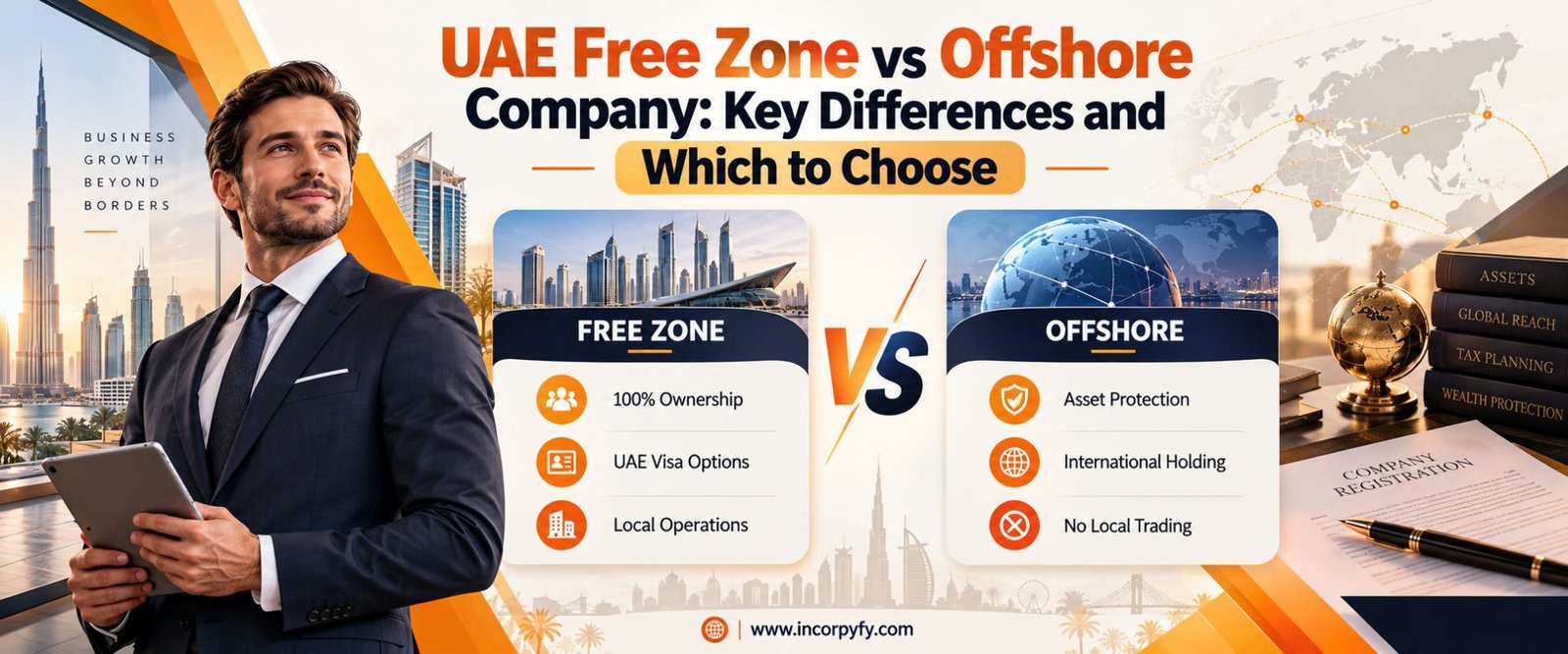

Author: Adil Ahmad
Summary
A UAE free zone company has a physical UAE address, can sponsor residence visas, open UAE bank accounts and trade within its licence. An offshore company has no UAE address, cannot sponsor visas, finds banking harder and is mainly used to hold assets. Offshore does not mean hidden, because beneficial ownership disclosure applies. This guide compares cost, banking, visas and when to choose each.
UAE Free Zone Company vs Offshore Company: The Core Difference
International investors often ask the same question: should I set up a free zone company or an offshore company in the UAE? The two are easy to confuse, because both are registered outside the UAE’s mainland system and both allow foreign ownership. But they do very different jobs.
- A free zone company is an operating business. It has a licence, a UAE address, the ability to sponsor residence visas and the right to trade within its licensed activities.
- An offshore company is mainly a holding or asset vehicle. It has no UAE office, cannot sponsor visas and is generally not allowed to do business with persons inside the UAE.
A simple way to remember it: free zone is for running a business, offshore is for owning things. If you need staff, clients, an office or a UAE visa, you need a free zone or mainland company. If you only need a vehicle to hold shares, investments, intellectual property or certain assets, offshore may be enough.
One more point matters up front. Offshore does not mean hidden. UAE offshore companies are registered with authorities, must keep records, and are subject to beneficial ownership (UBO) disclosure and anti-money-laundering rules. Treating offshore as a secrecy tool is a mistake that can cost you banking access.
If you are still deciding between UAE structures in general, see our guides to free zone vs mainland setup and how to open an offshore company in the UAE.
Free Zone Company: Trading, Service, With UAE Address
A free zone company is licensed by a specific zone authority such as IFZA, DMCC, DAFZA, JAFZA or RAKEZ. It is the right choice for most operating businesses.
What a free zone company can do:
- Trade, provide services or run e-commerce within its licensed activities
- Lease an office, flexi-desk or warehouse and hold a UAE address
- Sponsor residence visas for the owner and employees
- Open a UAE corporate bank account
- Sell internationally and, in many cases, serve B2B customers in the UAE
What to watch:
- Free zone companies are generally restricted from direct mainland retail sales, which usually requires a mainland licence or a distributor
- Corporate tax is 9% above AED 375,000 of profit, and the 0% rate applies only to Qualifying Free Zone Persons on qualifying income
- Each zone has its own fees, rules and activity lists
For popular options, read how to register a company in IFZA, our IFZA free zone page, our JAFZA free zone page and our roundup of the best free zones in the UAE.
Offshore Company: Holding, Assets, No UAE Address
A UAE offshore company is registered with a specialist registry such as RAK International Corporate Centre (RAK ICC), JAFZA Offshore or Ajman’s offshore regime. It exists on paper rather than in an office.
Typical uses:
- Holding shares in other companies
- Holding investments and international assets
- Holding intellectual property or royalty arrangements
- Holding Dubai real estate through JAFZA Offshore, subject to Dubai Land Department rules
- Estate and succession planning in some cases
What an offshore company cannot do:
- Sponsor residence visas or employ staff in the UAE
- Lease a UAE office as its own operating base
- Carry out commercial activity with persons inside the UAE
- Easily open a UAE bank account (it is possible but harder)
Transparency matters. Offshore companies are registered, supervised and subject to beneficial ownership disclosure, and banks apply close due diligence. Plan for full transparency, not privacy.
Read our guides to Ras Al Khaimah offshore company formation, Ajman offshore company formation, the cheapest offshore company formation in the UAE and our offshore company formation service page. If your goal is to hold assets, our best UAE free zone for holding companies guide compares the main jurisdictions.
Cost: Free Zone vs Offshore Fees
Offshore companies are usually cheaper to start and cheaper to keep, because there is no office or visa quota to pay for. But they are not always cheaper in total once banking friction is counted.
| Cost factor | Free zone company | Offshore company |
|---|---|---|
| Entry cost | Roughly AED 5,500 to 25,000 depending on zone | RAK ICC from roughly AED 3,000 |
| Annual renewal | Higher, includes licence and often office | Lower, roughly AED 3,000 to 7,000 per year |
| Office | Usually required (flexi-desk or more) | None |
| Visas | Available, extra cost | Not available |
| Banking effort | Standard | Harder, can take weeks or months |
| Typical total first year | Roughly AED 12,000 to 35,000 with a visa | Often under AED 10,000 |
Published figures vary by provider and structure, so treat these as indicative and request a written quote.
For free zone price comparisons, see our guides to the cheapest free zones in the UAE and Dubai freezone company setup cost.
Bank Account: Can Offshore Companies Open UAE Accounts?
Yes, it is possible, but it is harder than for a free zone company, and many founders underestimate this.
Why banks are cautious with offshore entities:
- No local office, staff or operations to verify
- Anti-money-laundering and beneficial ownership scrutiny
- Compliance concerns around cross-border holding structures
What helps:
- A clear purpose for the structure, such as holding shares or property
- Transparent ownership documents and source of funds
- A realistic expectation of weeks, sometimes months, to open an account
- In many cases, banking outside the UAE or with banks that specialise in international clients
Free zone companies generally find banking more straightforward, because they have a real address, a licence, activity and often staff. The strength of your business plan and documents matters more than the zone name.
If banking is central to your plan, a free zone or a financial free zone structure often saves time compared with offshore.
Visas: Free Zone Has Them; Offshore Does Not
This is one of the clearest dividing lines.
- Free zone companies can sponsor residence visas, usually tied to an office or flexi-desk package. That means you can live in the UAE through your company, bring family and employ staff.
- Offshore companies cannot sponsor visas. Owning an offshore company does not give you UAE residency.
If your goal is to live in the UAE, offshore is the wrong tool. Residency routes include a free zone or mainland company, employment, property-linked visas or the Golden Visa for qualifying investors. Read our guide to the Golden Visa in the UAE if long-term residency is part of your plan.
Remember that a UAE residence visa works nationwide, regardless of which emirate issued the licence.
When to Choose Each Structure
Choose a free zone company if:
- You will run a real business with clients, staff or a UAE presence
- You need a residence visa for yourself or your team
- You need a UAE bank account for day-to-day operations
- You want to trade within a defined licence scope
Choose an offshore company if:
- You mainly want to hold shares, investments, intellectual property or assets
- You do not need a UAE office, visas or local trading
- You accept stricter banking scrutiny and full transparency
- You want a low-cost holding vehicle
Consider a regulated structure such as DIFC or ADGM if:
- You want English common law, strong banking and long-term credibility for a holding or fund structure
Often the best answer is both: a free zone company to operate and an offshore or holding company above it to own the shares. This is common in group structures. Our guide to how to set up a holding company in the UAE explains how that works.
Our guide to corporate tax for mainland and free zone companies explains what applies.
How Incorpyfy Can Help
Choosing between a free zone and an offshore company means matching your purpose, banking needs and tax position to the right structure. Incorpyfy compares real quotes and manages setup end to end. Visit the Incorpyfy homepage to speak with a consultant.
For official references, see the RAK ICC, JAFZA, the UAE Government business portal and the Federal Tax Authority.
FAQs
What is the difference between a UAE free zone company and an offshore company?
A free zone company operates a business with a UAE address, visas and bank account. An offshore company mainly holds assets and has no UAE address or visa sponsorship.
Can an offshore company open a UAE bank account?
Yes, but it is harder and can take weeks or months because banks apply close scrutiny.
Does an offshore company give me UAE residency?
No. Offshore companies cannot sponsor residence visas.
Is a UAE offshore company anonymous?
No. Offshore companies are registered and subject to beneficial ownership disclosure and anti-money-laundering rules.
Is offshore cheaper than a free zone company?
Usually yes at the start, with RAK ICC from roughly AED 3,000, but banking effort and agent fees can add cost.
Can an offshore company trade in the UAE?
No. Offshore companies generally cannot do business with persons inside the UAE.
Do free zone companies pay corporate tax?
9% applies above AED 375,000 of profit. 0% applies only to Qualifying Free Zone Persons on qualifying income.
Can an offshore company own Dubai property?
JAFZA Offshore is commonly used for this, subject to Dubai Land Department rules. RAK ICC generally cannot hold Dubai property directly.
Can I have both a free zone and an offshore company?
Yes. Many groups use a free zone company to operate and an offshore or holding company to own the shares.
Which is better for an international investor?
It depends on purpose. Choose a free zone company to operate, an offshore company to hold assets, or a DIFC or ADGM structure for regulated, high-value holdings.