

Summary
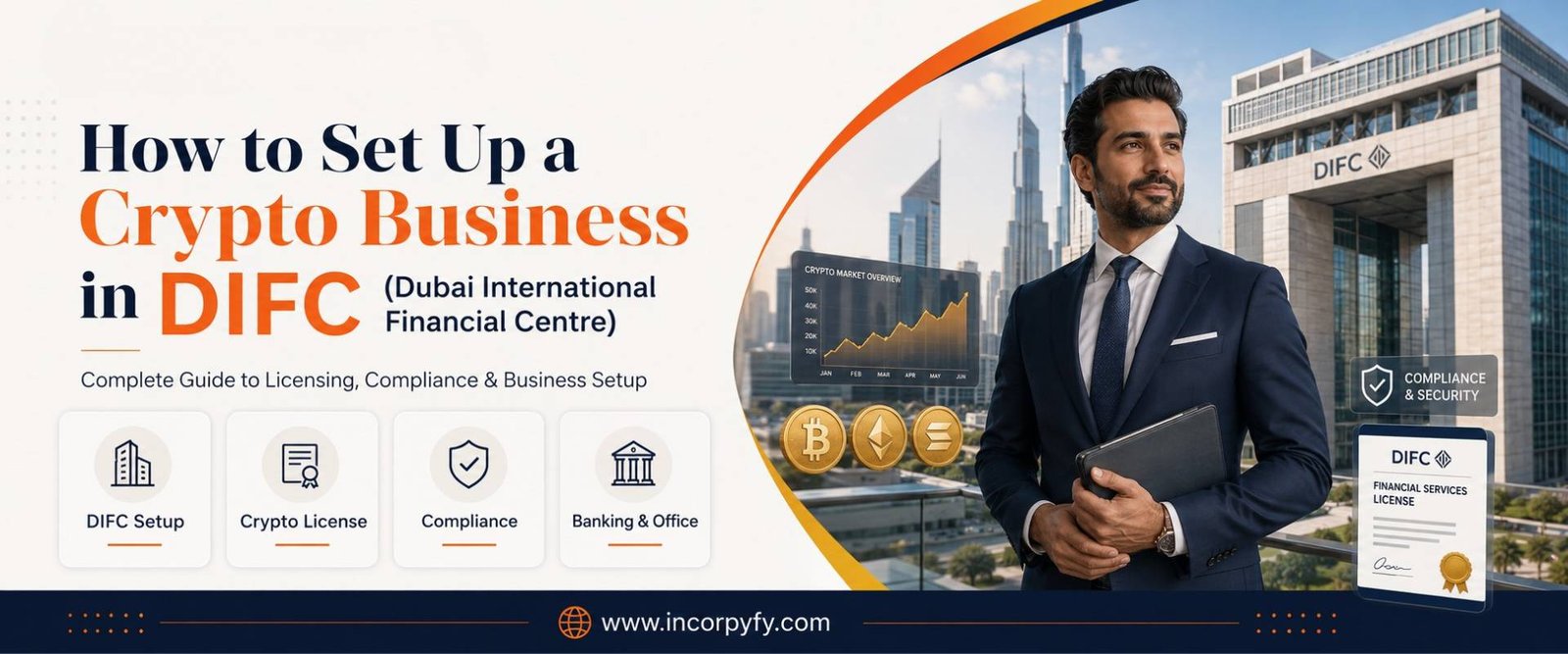
A DIFC crypto license is issued by the Dubai Financial Services Authority (DFSA), independently of VARA, and suits institutional-grade digital asset businesses seeking global regulatory credibility. DFSA updated its Crypto Token framework in January 2026, shifting more suitability-assessment responsibility onto firms themselves. Capital requirements range from roughly USD 30,000 for advisory activities to USD 2 million or more for operating a regulated exchange, with total first-year investment typically USD 200,000 to 500,000. This guide covers the current framework, real costs, and the full setup process.
Dubai has become one of the fastest-growing hubs for blockchain and digital asset ventures globally, and the Dubai International Financial Centre (DIFC) stands out as the jurisdiction built specifically for institutional credibility rather than low-cost entry. For entrepreneurs building a crypto exchange, custody platform, or advisory business aimed at institutional clients, a DIFC license under the Dubai Financial Services Authority (DFSA) is the route that opens doors DMCC or IFZA licensing generally can’t, at a cost and compliance burden that reflects exactly that difference.
What Is a DIFC Crypto License?
A DIFC crypto license is an authorisation issued under DFSA supervision, permitting companies to engage in crypto-related financial services: trading, custody, payment processing, advisory, and token issuance. DFSA operates independently within DIFC and applies regulatory standards comparable to the UK’s Financial Conduct Authority or the US SEC, an alignment that matters directly for banking relationships, institutional partnerships, and cross-border credibility, particularly when a bank or investor’s own internal policy restricts them to working with regulated counterparties only.
Unlike DMCC or IFZA, which primarily serve startups and early-stage ventures, DIFC caters to institutional clients and established fintech businesses. This positions a DIFC-licensed company alongside banks, asset managers, and global financial institutions already operating in the centre, a genuinely different competitive and partnership environment than a typical free zone offers, and one that shapes both your costs and your realistic client base from day one.
Important Update: DFSA’s January 2026 Framework Revision
This is the development most guides on this topic haven’t caught up with yet. In January 2026, DFSA updated its Crypto Token regulatory framework, introducing a genuinely significant shift: from a regulator-driven model to a firm-led token suitability assessment. Previously, DFSA played a more direct role in vetting which specific tokens firms could deal in. Under the revised framework, regulated firms themselves are now responsible for assessing and documenting whether a given crypto token is suitable for use within DIFC, against DFSA’s suitability criteria, rather than leaning primarily on the regulator’s own review.
Practically, this means your compliance documentation needs a genuine, defensible token-assessment methodology built in from the start, not just a policy referencing DFSA’s own list of pre-approved tokens. This shift places more direct responsibility, and more direct liability exposure, on firms than the previous model did, so it’s worth budgeting real time and expertise for this specific piece of your compliance framework rather than treating it as boilerplate. If you’re preparing a DIFC application now, build your token suitability framework as a core deliverable from the outset.
Separately, DFSA launched a Tokenization Regulatory Sandbox in March 2025, drawing expressions of interest from roughly 96 firms across the UAE, UK, EU, Canada, Singapore, and Hong Kong, a signal of how central DIFC has become to institutional tokenisation activity specifically, beyond crypto trading and custody alone. Together, these two developments point in the same direction: DIFC is positioning itself for sophisticated, institutional-grade digital asset activity, not the lighter-touch model some other free zones use.
Activities Covered Under a DIFC Crypto License
Your application requirements vary meaningfully depending on which activities you select, so defining scope precisely at the outset matters:
- Trading and brokerage: buying, selling, and trading digital tokens as principal or on behalf of clients, including OTC and institutional trade facilitation.
- Custody and wallet services: secure storage of digital assets for clients, requiring multi-signature security, cold storage, insurance coverage, and rigorous cybersecurity protocols.
- Payment solutions: crypto payment gateways and settlement platforms, subject to both DFSA and UAE Central Bank AML/CFT requirements.
- Advisory and consulting: investment advisory, tokenisation consulting, and blockchain strategy work, typically the lowest capital-threshold category.
- Regulated token issuance: Security Token Offerings, tokenised real estate, and other digital securities, subject to detailed disclosure and legal review.
- Market making and liquidity provision: subject to specific conduct requirements given the role in maintaining efficient markets.
- Asset management: managing crypto funds or investment portfolios, with ongoing reporting and governance obligations.
Step-by-Step Process to Get a DIFC Crypto License
- Define your business activity precisely. DFSA tailors requirements to the specific activity; vague scope at this stage causes delays later, and misclassifying “trading” versus “operating an exchange” specifically can mean budgeting for the wrong capital tier entirely. Early pre-application consultation with DFSA is worth using to surface issues before formal submission.
- Prepare comprehensive documentation. A detailed business plan, corporate structure, compliance manual, AML/CFT policies, risk management framework, technology and cybersecurity documentation, capital adequacy calculations, and personnel backgrounds, comparable in depth to a traditional financial services application rather than a typical free zone license form.
- Apply for initial DIFC approval. Submit to the DIFC Registrar of Companies with your business plan, shareholder details, and compliance strategy. The application fee varies by the specific activity licensed rather than a flat crypto-business fee.
- DFSA review and approval. DFSA assesses your financial model, governance, risk management, and fitness and propriety, including background checks on shareholders and key personnel. This stage commonly takes 8 to 12 weeks, longer if clarifications are requested, so build buffer time into your launch timeline rather than assuming the fastest-case scenario.
- Meet your activity’s capital requirement. Capital must be deposited with an approved bank and maintained on an ongoing basis, not just at the point of approval, and DFSA can revisit the requirement if your business model or risk profile shifts materially after licensing.
- Incorporate in DIFC. Once approved, you receive your Certificate of Incorporation and license specifying permitted activities.
- Secure DIFC office space. A substantive physical presence is mandatory, not optional, ranging from serviced offices to dedicated premises depending on team size and client-meeting needs.
- Set up corporate banking. DIFC licensing improves banking access relative to less-regulated jurisdictions, though the process still requires patience and full compliance documentation, worth starting in parallel with later licensing steps rather than after your license is issued.
- Obtain visas. Investor and employee visas, with your office lease size determining sponsorship capacity.
- Establish ongoing compliance operations. Appoint a compliance officer, and prepare for regular reporting, annual audits, and periodic DFSA inspections from day one of operations, not as a task to formalise once the business is already running.
Capital Requirements: Get This Distinction Right
This is where most guides on this topic, including generic cost tables, understate reality for one specific activity. DFSA applies an expenditure-based capital test: your firm must hold the higher of a fixed base requirement or a set multiple of annual expenditure, and the 2026 framework update tightened these thresholds further across the board.
- Advisory services: base capital commonly starts around USD 30,000 to 70,000, the most accessible entry point for consultancy-style activities.
- Asset management and custody: generally USD 100,000 to 150,000, scaling with assets under management or custody.
- Trading with your own capital (principal/proprietary trading): commonly cited in the USD 150,000 to 250,000 range, since the firm is only bearing its own market risk rather than client exposure.
- Operating a regulated crypto exchange (a trading facility serving clients, not just your own book): a materially different, higher category, with capital requirements commonly cited around USD 2 million or more, subject to DFSA’s prudential assessment of your specific business model and risk exposure.
Confirm your exact activity classification and current threshold directly with DFSA or a DIFC-licensed advisor before budgeting, since conflating “trading” with “operating an exchange” is the single most common, and most costly, assumption founders make when researching this jurisdiction on their own.
Realistic Cost Breakdown
Initial setup:
| Cost Component | Approximate Range (USD) |
|---|---|
| Application fee | Varies by activity licensed |
| Annual license fee | 15,000 – 25,000 |
| Office lease (annual) | 15,000 – 30,000 |
| Capital deposit | 30,000 – 2,000,000+, activity-dependent |
| Company formation | 5,000 – 8,000 |
| Legal and consulting support | 20,000 – 50,000 |
| Visa processing (per visa) | 3,000 – 5,000 |
Ongoing annual costs: license renewal (USD 15,000-25,000), office rent, audit fees (USD 10,000-20,000), a compliance officer’s salary (USD 60,000-120,000), legal and regulatory support, banking fees, and technology/security spend.
Total first-year investment for advisory or lower-tier activities typically runs USD 200,000 to 500,000; exchange-specific setups with the higher capital threshold run considerably beyond that range. The cost only makes sense measured against what it unlocks: institutional client access, stronger banking relationships, and credibility that’s difficult to build through a lower-cost jurisdiction alone.
Why Choose DIFC Over DMCC or IFZA?
- International regulatory recognition. DFSA’s standards align with the FCA and SEC, which matters directly when courting institutional partners, banks, or investors with internal policies restricting them to regulated counterparties, a filter that quietly excludes companies licensed in less-recognised jurisdictions before conversations even begin.
- A genuine institutional ecosystem. DIFC hosts over 4,000 firms, including global banks and asset managers, creating partnership opportunities that a startup-focused free zone doesn’t offer in the same way, simply through physical proximity and shared regulatory standing.
- Stronger banking access. DFSA-regulated entities generally find UAE and international banks more willing to open accounts, given the comprehensive compliance framework behind the license, a persistent pain point for crypto businesses in less-regulated jurisdictions globally, not just in the UAE.
- A platform for institutional scale, not just low-cost entry. Many companies deliberately start in DMCC or IFZA, then upgrade to DIFC once they’re targeting institutional clients or larger capital raises, rather than starting at DIFC’s cost and compliance level before they have the client base to justify it. Our guides to a crypto license in DMCC and an IFZA crypto license cover those lower-cost starting points directly.
DIFC vs. DMCC vs. IFZA: Quick Comparison
| Jurisdiction | Regulator | Typical First-Year Cost | Best Suited To |
|---|---|---|---|
| DIFC | DFSA | USD 200,000 – 500,000+ | Institutional and enterprise-grade businesses |
| DMCC | DMCC Authority, with VARA for certain regulated VA activities | USD 80,000 – 200,000 | SMEs, traders, and blockchain/DLT businesses |
| IFZA | IFZA Authority | USD 15,000 – 50,000 | Startups and early-stage founders |
Who Regulates Crypto Across Dubai and the UAE
| Authority | Jurisdiction | Focus |
|---|---|---|
| DFSA | DIFC | Financial services involving Crypto Tokens conducted in or from DIFC |
| VARA | Dubai mainland and free zones other than DIFC | Regulated virtual asset activities: exchange, custody, broker-dealer, advisory, and related services |
| ADGM (FSRA) | Abu Dhabi | Digital assets within Abu Dhabi’s own financial free zone |
| Central Bank of the UAE | Nationwide | Payments, AML/CFT oversight across the wider financial system |
| Securities and Commodities Authority | Nationwide | Tokenised securities and commodities at federal level |
DIFC and VARA operate as genuinely separate regulatory perimeters; a DFSA license doesn’t substitute for VARA authorisation outside DIFC, and vice versa. If you’re weighing DIFC against a mainland or other free zone route more broadly, our UAE crypto license overview covers how the full landscape fits together.
Post-License Compliance Obligations
Receiving your license is the beginning of your regulatory relationship with DFSA, not the end of it:
- Regular reporting: quarterly and annual submissions covering financial position, transaction volumes, and compliance activity, with late or incomplete filings treated seriously rather than as a minor administrative lapse.
- Annual audits by DFSA-approved auditors, submitted within specified timeframes.
- Ongoing capital adequacy, reassessed if your business grows or your risk profile changes, meaning your initial capital deposit isn’t necessarily your permanent requirement.
- Record keeping for at least 7 years, accessible for regulatory inspection at any time without extended notice.
- Incident reporting for cybersecurity events, compliance breaches, or significant operational issues, promptly rather than after the fact, since delayed disclosure is often treated more seriously than the underlying incident itself.
Frequently Asked Questions
How long does it take to get a DIFC crypto license?
Typically 8 to 12 weeks from application to issuance for straightforward cases, extending to 3 to 6 months for complex applications or those requiring significant modification.
What is the minimum capital requirement?
It depends heavily on activity: roughly USD 30,000 for advisory services, up to USD 150,000-250,000 for proprietary trading, and around USD 2 million or more for operating a regulated exchange specifically, under DFSA’s expenditure-based capital test.
Can foreigners fully own a crypto company in DIFC?
Yes, DIFC permits 100% foreign ownership with no local partner or sponsor requirement.
What changed with DFSA’s 2026 framework update?
DFSA shifted from a regulator-driven token review model to a firm-led suitability assessment, meaning regulated firms must now independently assess and document whether a given crypto token meets DFSA’s suitability criteria, rather than relying primarily on DFSA’s own review.
How does DIFC compare to DMCC or IFZA for a crypto business?
DIFC offers the strongest institutional credibility and regulatory recognition at the highest cost. DMCC provides a moderate-cost middle ground with an established crypto cluster. IFZA is the most affordable entry point, best suited to early-stage founders.
Is a DIFC crypto license recognised internationally?
Yes, DFSA’s alignment with international standards means the license is generally well-regarded by regulators, banks, and investors evaluating cross-border partnerships.
Can I start in DMCC or IFZA and upgrade to DIFC later?
Yes, this is a common path. Many companies build initial traction on a lower-cost license before investing in DIFC once they’re targeting institutional clients or larger capital raises.
Get Expert Support for Your DIFC Crypto License
DIFC represents the institutional-grade end of Dubai’s crypto licensing landscape, genuinely powerful for the right business model, and genuinely expensive for the wrong one. Getting your activity classification, and the capital requirement that follows from it, right before you apply is the single biggest factor in whether your DIFC setup goes smoothly or stalls on a misjudged budget.
Incorpyfy supports founders comparing DIFC against other Dubai free zone business setup options, helping you structure the right activity scope, prepare DFSA-ready documentation, and plan realistically for the capital and compliance investment your specific business model actually requires.