

Summary
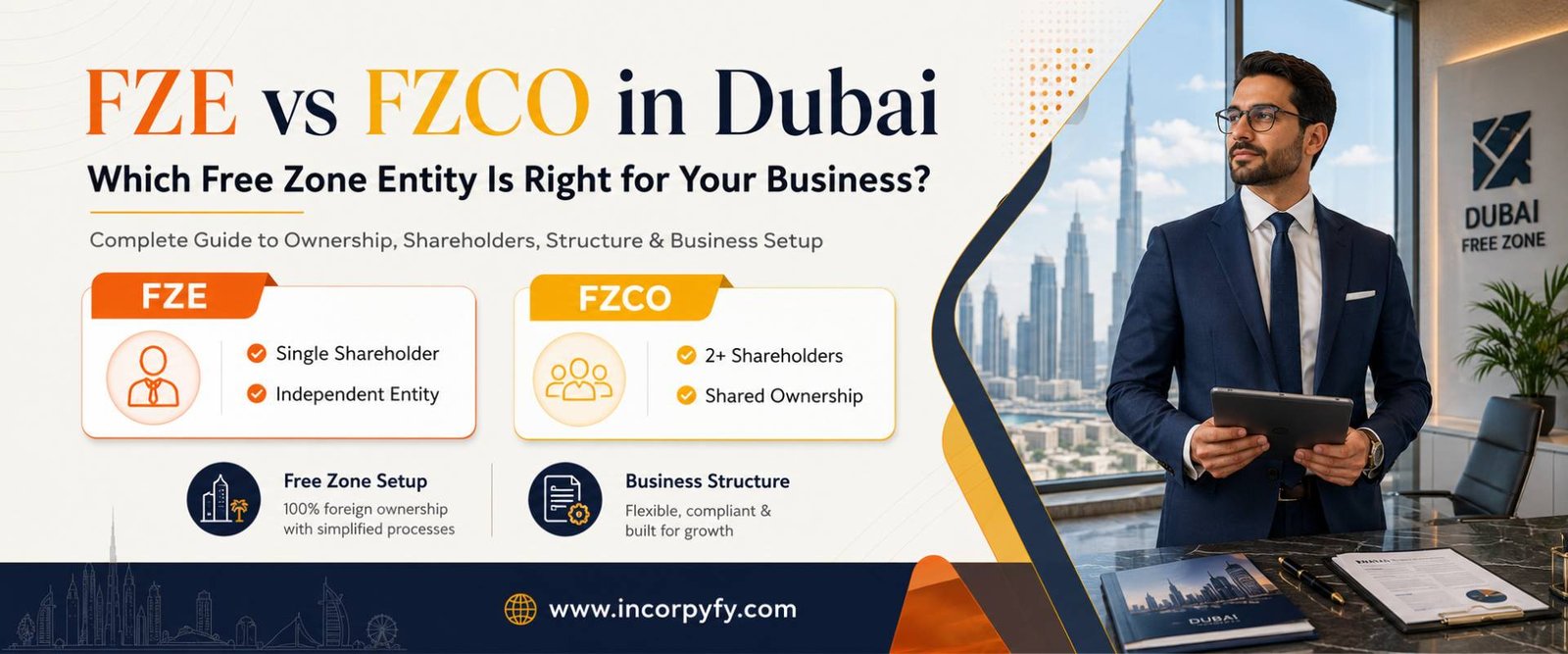
FZE (Free Zone Establishment) and FZCO (Free Zone Company) are the two standard entity structures across Dubai’s free zones, differing primarily in shareholder count: an FZE has exactly one shareholder, while an FZCO allows two to fifty. Both offer 100% foreign ownership and limited liability, so the right choice comes down to your ownership structure and future investor plans rather than cost or licensing scope, which are largely identical between them.
Dubai has become one of the most attractive destinations in the world for entrepreneurs, startups, and global corporations, and its free zones offer genuine advantages: 100% foreign ownership, tax exemptions, simplified setup, and full repatriation of profits. But when it comes to choosing the right structure, many business owners face a specific decision between FZE (Free Zone Establishment) and FZCO (Free Zone Company).
Both are legitimate, capable structures, but they suit genuinely different ownership situations. This guide breaks down what actually distinguishes them, where each free zone stands on offering both, and how to make this decision correctly the first time rather than needing to restructure later. Our wider Dubai coverage can help with the broader business setup picture alongside this specific structural decision.
Understanding Free Zone Entities in Dubai
Dubai’s free zones support international trade, technology, manufacturing, services, and innovation, and investors establish companies under two main structures: FZE or FZCO. Both operate under their respective free zone’s own regulations, independent from mainland business structures, and both give foreign investors full control without requiring a local partner, which is exactly why they remain the default choice for entrepreneurs entering the UAE market.
What Is an FZE (Free Zone Establishment)?
An FZE is registered with exactly one shareholder, who can be either an individual or a corporate entity. It carries the legal status of a limited liability company within its free zone, meaning the shareholder’s liability is limited to their investment in the business rather than extending to personal assets.
Advantages of an FZE:
- 100% ownership by a single shareholder, with no need to coordinate decisions with co-owners on day-to-day operational matters
- Limited liability protection, keeping personal assets separate from business obligations
- A streamlined registration and documentation process, generally faster given the simpler ownership structure and fewer parties to document
- Full repatriation of capital and profits, without restriction
- A natural fit for solo entrepreneurs and small to medium-sized businesses wanting complete control without answering to co-owners
What Is an FZCO (Free Zone Company)?
An FZCO, sometimes referred to as FZ-LLC in certain free zones, allows two to fifty shareholders, which can be individuals, corporate entities, or a mix of both. It operates as a limited liability company just like an FZE, with the key difference being multiple ownership rather than any fundamental difference in legal status or protection.
Advantages of an FZCO:
- Support for 2 to 50 shareholders, genuinely suited to partnerships and joint ventures rather than requiring a workaround structure
- Flexibility for bringing in co-investors or partners from the outset, rather than restructuring later once the business has already grown
- Limited liability protection for each shareholder’s personal assets, applied identically to how it works for an FZE
- Often perceived as a more structured, established entity, which can matter for strategic partnerships or larger contracts where counterparties look closely at company structure
- A better fit for growing businesses anticipating multiple stakeholders from the start rather than a single founder scaling alone
Key Differences Between FZE and FZCO
Number of shareholders. An FZE has exactly one; an FZCO supports 2 to 50, a distinction that shapes nearly every other structural decision that follows.
Business flexibility. FZE suits single-owner businesses wanting maximum simplicity, with no need for shareholder agreements covering multiple parties. FZCO suits partnerships, joint ventures, and businesses with multiple investors from the start, requiring more upfront governance documentation but offering genuine flexibility for shared ownership.
Market perception. FZCO structures sometimes read as larger and more established given their multi-shareholder nature, which can matter in specific B2B or partnership contexts where counterparties research your company structure before committing to a deal. FZE structures are seen as agile and entrepreneur-driven, which carries its own credibility in founder-led businesses where clients specifically value working directly with the decision-maker.
Legal Structure and Liability
Both FZE and FZCO operate as limited liability companies within their free zone jurisdiction, meaning shareholders aren’t personally liable for company debts beyond their invested capital. This protection applies identically regardless of which structure you choose, so liability protection itself isn’t a differentiating factor between them.
Business Activities and Licensing
Both structures can carry out a wide range of activities, trading, consultancy, services, manufacturing, logistics, and technology, though specific free zones may apply their own rules regarding activity scope. Free zones like JAFZA, DMCC, IFZA, and RAKEZ each maintain their own activity lists, so confirming your specific activity’s availability under either structure in your chosen zone matters before committing.
Both FZE and FZCO can apply for the same license categories: trading licenses for import, export, and distribution; service licenses for professional and consultancy work; industrial licenses for manufacturing; and e-commerce licenses for online trading, depending on the specific free zone.
Which Free Zones Offer Both FZE and FZCO?
Most major Dubai free zones offer both structures, including JAFZA, DMCC, IFZA, DIFC (specialized for financial services), Dubai Airport Free Zone (DAFZA), and Dubai Silicon Oasis. Beyond Dubai specifically, zones like SHAMS in Sharjah offer a similar FZE/FZCO-equivalent choice at a notably lower cost point, worth comparing if budget is a genuine factor in your decision alongside structure. Each zone applies slightly different requirements around share capital, documentation, and approval timelines, so the specific zone matters as much as the entity type itself.
Capital Requirements
Minimum share capital varies by free zone rather than by entity type specifically. An FZE requires its single shareholder to contribute the full capital amount, while an FZCO divides this among its multiple shareholders according to their agreed shares. Many Dubai free zones now apply genuinely low minimum capital requirements, making both structures accessible for startups rather than only larger, better-capitalized businesses.
Step-by-Step Process to Set Up an FZE or FZCO
Step 1: Choose the free zone that aligns with your specific business activity and budget, since activity lists and costs genuinely vary between zones, and this decision shapes everything else that follows.
Step 2: Decide the entity type. Choose FZE if you’re a sole shareholder wanting maximum simplicity, or FZCO if you have partners or plan to bring in co-investors, since retrofitting this decision later costs more time than getting it right initially.
Step 3: Submit your application, including passport copies, a business plan, and standard application forms, with completeness at this stage genuinely shortening your overall timeline.
Step 4: Obtain initial approval from the free zone authority reviewing your application, confirming your proposed activity and structure meet their specific requirements.
Step 5: Register and pay fees, completing the formal registration process and finalizing your entity’s legal existence.
Step 6: Collect your license and begin operations, typically within a few weeks of a complete, well-documented application, though this can extend if your specific activity requires additional regulatory approval.
Which Is Better: FZE or FZCO?
The right choice depends entirely on your actual ownership situation, not on cost or licensing scope, which are largely equivalent between the two:
- Choose FZE if you’re a single entrepreneur wanting full, uncomplicated control of your business without needing to coordinate with co-owners
- Choose FZCO if you have partners, investors, or a joint venture structure, or genuinely expect to bring in co-owners within the near future rather than years down the line
Both structures provide the same core benefits: tax exemptions, full foreign ownership, and business flexibility. The decision is fundamentally about ownership structure, not about which one is inherently “better,” and treating it as a simple cost comparison misses the actual factor that should drive your choice.
Common Mistakes to Avoid
- Choosing FZE when you’re planning to bring in investors soon. Converting later is generally possible but adds real time and paperwork you could avoid by starting with the right structure from day one
- Picking a free zone without checking activity restrictions first, only to discover your specific business activity isn’t available under your preferred structure in that zone, forcing a rethink after you’ve already invested time in the application
- Ignoring capital and future expansion needs, treating the initial setup decision as permanent when your actual business plans call for growth or additional shareholders down the line
- Assuming cost is the deciding factor, when FZE and FZCO pricing is largely comparable and the real decision should rest on ownership structure instead
Consulting with a business setup expert in Dubai genuinely helps avoid these mistakes, since the cost of correcting a structural mismatch later usually exceeds the cost of getting advice upfront.
Conclusion
Deciding between FZE and FZCO in Dubai is one of the more consequential early decisions for entrepreneurs entering the UAE market, and the choice comes down to your actual ownership situation rather than cost, tax treatment, or licensing scope, all of which are essentially identical between the two structures. Choose FZE for a simple, single-owner setup with full control, or FZCO if partners or future investors are genuinely part of your plan.
For professional guidance matching your specific ownership situation to the right structure, our free zone company formation in Dubai team can walk through your options, and our wider company formation coverage spans the rest of the region if Dubai is one part of a broader plan.
FAQs
What is the main difference between FZE and FZCO in Dubai?
An FZE has exactly one shareholder. An FZCO allows two to fifty shareholders, individuals, corporate entities, or a mix of both.
Can foreigners own 100% of an FZE or FZCO in Dubai?
Yes, both structures allow full foreign ownership without requiring a local partner.
Which is cheaper to set up: FZE or FZCO?
Costs are generally similar, though an FZCO may involve slightly more documentation given its multiple shareholders.
Can I convert an FZE into an FZCO later?
Yes, in most free zones, by adding shareholders and completing the relevant conversion process, though this adds time and paperwork compared to choosing the right structure from the start.
Do FZE and FZCO have different licensing options?
No, both can generally obtain trading, service, industrial, or e-commerce licenses depending on the specific free zone’s offerings.
Which is better for startups in Dubai?
Solo founders often choose FZE for simplicity, while startups with co-founders or early investors typically choose FZCO from the outset.
How long does it take to set up an FZE or FZCO in Dubai?
Most free zones complete the process within 2 to 4 weeks with a complete application, though this varies by zone and activity complexity.
Does the choice between FZE and FZCO affect my tax treatment?
No, both structures are treated identically for UAE corporate tax and VAT purposes, since tax treatment depends on your activity and qualifying income status, not your shareholder structure.