


Summary
Visa designation in the UAE refers to the specific immigration category assigned to your status, employment, investor, family, student, freelance, or retirement, each unlocking different rights and obligations. Processing typically takes 3 to 4 weeks for employment visas and longer for investor or Golden Visa categories, with total government fees generally running AED 800 to 2,000 depending on visa type. This guide covers every major category, real timelines, and current fees.
Navigating visa designation in the UAE is a key step for anyone planning to live, work, or study in this vibrant country. Whether you’re hiring staff, relocating your family, or investing, understanding the visa application process ensures you stay compliant and avoid delays. This guide walks through the types of visas, requirements, timelines, and practical guidance to make your journey smoother. Our wider Dubai and company formation coverage can help if visa planning is part of a broader business setup.
Why Visa Designation Matters in the UAE
Visa designation assigns a specific immigration category to your status in the UAE, determining what you’re actually permitted to do: work, live, invest, or study. Getting the right designation matters beyond legal compliance alone, since it directly affects access to services like bank accounts, healthcare, schooling, and property. It’s genuinely the foundation of a legally sound life or business presence in the UAE, and mismatched designation, working under a visa that doesn’t authorize your actual activity, creates real legal exposure rather than a minor technicality to sort out later.
Each visa type unlocks different opportunities specifically: a work visa allows employment with your sponsoring employer, a resident visa supports family sponsorship, an investor visa qualifies you to hold shares in a UAE company, and a student visa enables academic study. Understanding which category actually matches your situation, rather than assuming any residency visa functions the same way, sets up the rest of your UAE journey correctly, and avoids the kind of mismatch that surfaces unexpectedly at a bank, school, or government office months later.
Types of UAE Visa Categories
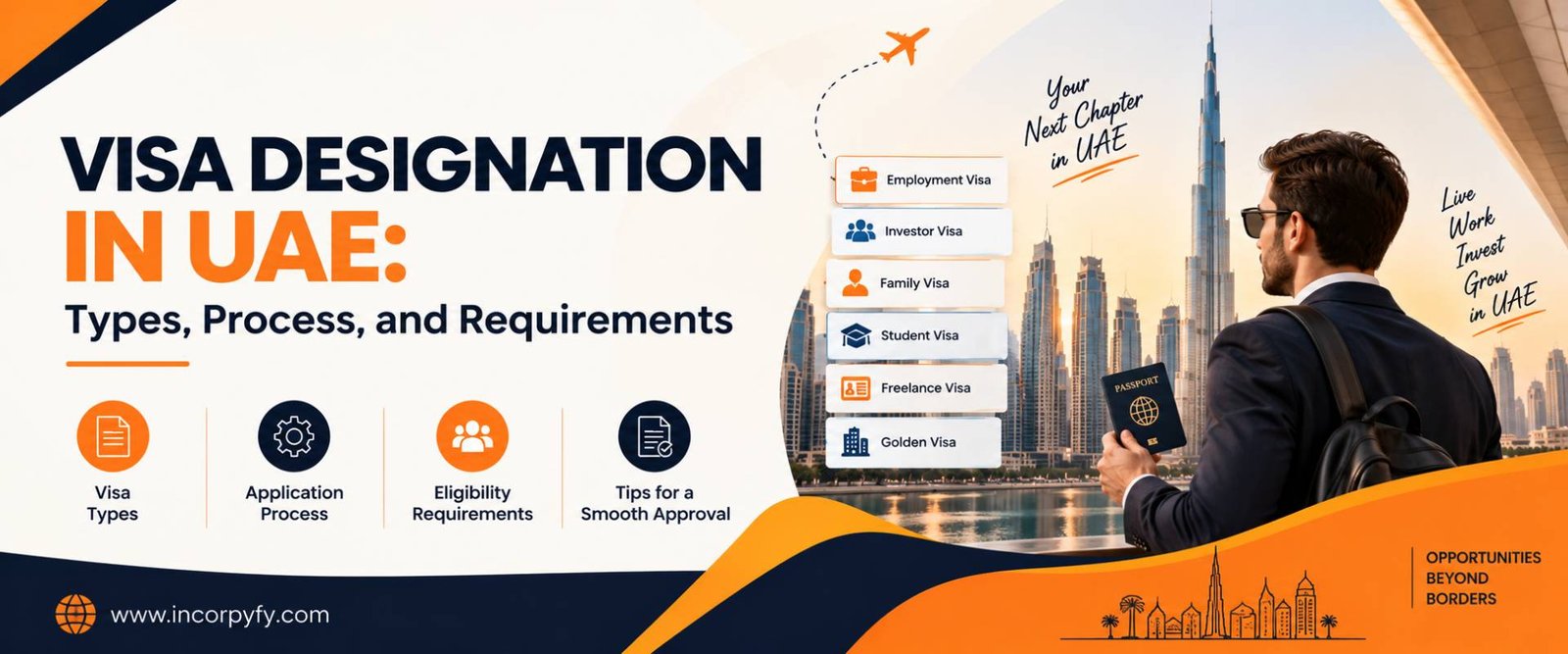
Employment Visa
For individuals hired by a UAE company, tied to your labor contract and used to obtain your Emirates ID. You must work for the sponsor named on the visa specifically, not just any UAE employer, and switching employers generally requires visa cancellation and a fresh application rather than a simple transfer.
Investor/Partner Visa
For entrepreneurs holding shares or ownership in a UAE company, enabling residence and family sponsorship tied to your business stake rather than employment. This category suits founders and shareholders who need residency status specifically linked to their company rather than an employment relationship.
Family Sponsorship Visa
Allows resident visa holders to sponsor family members, spouse, children, and in some cases domestic staff, provided the sponsor’s own income and housing meet the relevant thresholds.
Golden Visa
A long-term residency visa, typically 5 or 10 years depending on category, for investors, entrepreneurs, experts, scientists, and outstanding students, offering genuine flexibility and security beyond standard residency visas, including reduced dependency on continuous UAE presence to maintain validity.
Student Visa
Issued for individuals enrolled in UAE universities and approved educational institutions, generally tied to continued enrollment status throughout the visa’s validity.
Freelance and Remote Work Visa
Covers freelancers, remote workers, and digital nomads, allowing self-employment under regulated sectors or continued employment with a foreign company while residing in the UAE, a genuinely newer category reflecting how work patterns have shifted.
Retirement Visa. For retirees aged 55 and above who meet specific income or savings criteria and wish to stay long-term in the UAE without needing an employer or business sponsor.
Step-by-Step Guide: Employment Visa Application
Step 1: Job offer and labor contract: Your employer sponsors the visa and applies for a labor contract with the Ministry of Human Resources and Emiratisation (MOHRE), the foundation document the rest of the process references.
Step 2: Entry permit application: Your employer applies for an Entry Permit, typically valid 30 to 60 days, through GDRFA or MOFAIC, allowing you to enter the UAE specifically for the purpose of completing your residency process.
Step 3: Travel and medical test: Once approved, you arrive in the UAE and complete a mandatory medical fitness test, including a blood test and chest X-ray, required before your residency application can proceed further.
Step 4: Emirates ID and biometrics: After medical clearance, you submit your Emirates ID application, complete fingerprinting, and provide passport photos, generating the identification document you’ll use for virtually every subsequent UAE transaction.
Step 5: Residency visa stamping: Your passport is stamped with the residence visa, and you receive your Emirates ID, completing the process and giving you full legal residency status tied to your employer.
Investor and Partner Visa Applications
Step 1: Register your business. Whether mainland, free zone, or offshore, your trade license needs to show your name as investor or partner. Our guide to business setup in Dubai covers this registration process in full, since your visa application can’t proceed until this foundational step is complete.
Step 2: Apply for entry permit. Once your company is active, apply for your visa’s entry permit through GDRFA or MOFAIC, following broadly the same process as an employment visa but tied to your company rather than an employer.
Step 3: Complete medical and Emirates ID processes. Similar to employment visa rules, covering medical testing, Emirates ID enrollment, and status stamping.
Step 4: Sponsor family on your visa. With an active investor visa, you can sponsor dependents by providing your trade license, proof of income, and suitable housing documentation, following the same general family sponsorship rules that apply across visa categories.
How the Golden Visa Works
The Golden Visa provides long-term security for investors, entrepreneurs, and outstanding professionals across science, technology, and education.
Who is eligible? Entrepreneurs with funded startups, investors holding property or business stakes above the required thresholds, and innovators recognized in AI, science, medicine, or education.
Application process. This runs through relevant authorities, including free zone bodies like DMCC or ADGM depending on your specific category, involving background checks, business plans, and eligibility documentation.
Golden Visa benefits:
- 5 or 10-year residency depending on category, renewable
- No local sponsor required
- Ability to sponsor family members
- A genuinely more secure, longer-term status than standard residency visas
Family Sponsorship Visa Explained
Who you can sponsor: spouse, children (generally under 18, or 21 for students), and in some cases domestic staff under UAE regulations.
Basic requirements: a valid sponsor visa, adequate income meeting emirate-specific thresholds, suitable housing documentation (typically an Ejari tenancy certificate), and the dependent’s own entry permit and medical clearance.
Renewal. Family visas are generally renewable every 1 to 3 years depending on the underlying sponsor visa type, and tracking expiry dates closely avoids fines from an inadvertent lapse.
Student Visas
Step 1: Secure admission from a UAE Ministry of Education-approved university.
Step 2: Apply for a student entry permit, typically valid 30 days, through your institution.
Step 3: Complete medical fitness testing and Emirates ID application.
Step 4: Receive your visa stamping once all prior steps are complete.
Freelance and Remote Work Visas
Freelance permits are available through free zones like Dubai Media City and other specialized zones, allowing self-employment in approved sectors like media, design, and IT without needing a full company structure.
Remote work visas let professionals reside in the UAE while working for an employer based elsewhere, generally requiring proof of employment, a minimum salary threshold, and valid health insurance.
Retirement Visa Process
Eligibility generally requires proof of savings (commonly around AED 1 million), a long-term pension, or monthly income around AED 20,000, alternatively satisfied through a property investment of roughly AED 2 million.
Application runs through GDRFA or specialized service providers, involving health screening and standard Emirates ID documentation.
Residency Visa Renewal and Cancellation
Validity ranges. Most standard residency visas run 1 to 3 years, with Golden Visas running 5 or 10 years depending on category. Tracking your specific expiry date is worth building into your calendar rather than relying on memory.
Renewal generally requires updated medical tests, Emirates ID renewal, updated sponsor information, and a current Ejari certificate where applicable.
Cancellation. If leaving the UAE permanently, cancellation runs through GDRFA, with your sponsor closing the labor contract and returning your documents as part of the process. Our detailed guide to cancelling a UAE residence visa covers this specific process in depth.
Common Challenges and Solutions
Changing visas or sponsors. Understand the rules before switching jobs or sponsors, since this typically requires visa cancellation and a new entry permit application, handled through MOHRE.
Exceeding visa validity. Overstay fines commonly run around AED 200 per day, so using any available grace period to renew or exit avoids fines that accumulate quickly.
Incomplete documentation. Missing items like job offer letters or tenancy certificates are a common cause of delay, so double-checking requirements before submission genuinely saves time.
Expert Resources and Support
Business setup consultants can walk you through licensing and visa processes together, often saving real time compared to navigating each separately. Certified visa typing centers assist with accurate data submission and biometric processing, and government apps like UAE PASS and individual free zone portals let you track application status directly.
Visa Application Timelines and Fees
Timeline summary:
- Entry Permit: 5 to 10 days
- Medical and Emirates ID: 5 to 7 days
- Visa Stamping: 3 to 5 days
Typical fees:
- Entry Permit: AED 200 to 400
- Medical Test: AED 250 to 500
- Emirates ID: AED 100 to 300
- Visa Stamping: AED 500 to 1,000
Confirm current fees with the relevant authority before budgeting, since these are periodically adjusted.
Conclusion
Applying for the right visa designation in the UAE is a strategic first step toward living, working, or investing here. Each category, employment, investor, family, student, remote work, or retirement, serves a genuinely specific purpose, and choosing correctly from the start avoids the delays and complications that come from a mismatched designation discovered later.
Get expert help with licensing and visa services from our business setup team in Dubai, and our PRO services can handle the government liaison work directly to keep your application on track.
FAQs
How long does a UAE work visa take?
Typically 3 to 4 weeks, depending on employer readiness and entry permit processing speed.
Is the Golden Visa available to freelancers?
Yes, if you meet innovation, business, or income criteria under the relevant entrepreneurial or professional category.
Can I sponsor family on a remote work visa?
Often yes, depending on your salary level and the specific visa’s dependent quota, though this varies by case.
What happens if I exceed my visa expiry?
You’ll face fines of roughly AED 200 to 400 per day until renewal or exit, so using any grace period promptly is worth prioritizing.
Can I switch visa types without leaving the UAE?
Yes, in many cases, though this typically requires cancellation of your current visa and a fresh application, coordinated through MOFAIC and GDRFA.
How long does a Golden Visa last?
Typically 5 or 10 years depending on your specific eligibility category, renewable rather than a one-time grant.
Do I need to cancel my current visa before applying for a new type?
Generally yes, most visa transitions require cancelling the existing visa before or alongside applying for the new category.
What’s the fastest visa category to process?
Business visit visas and straightforward entry permits typically process fastest, while Golden Visa and investor categories generally take longer given the additional eligibility verification involved.