
Summary
Company registration in Dubai Silicon Oasis (DSO) now runs through the Dubai Integrated Economic Zones Authority (DIEZ), which absorbed the old Dubai Silicon Oasis Authority in 2021. The process covers activity selection, trade name reservation, office leasing, and licensing, typically completed in 5 to 10 working days. This guide covers current entity types, real costs, required documents, and where DSO fits against other Dubai free zones.
Dubai Silicon Oasis is one of the UAE’s most distinctive free zones: a genuine technology park built into a residential and commercial community, rather than a standalone office district. For entrepreneurs weighing company registration in Dubai Silicon Oasis, that integrated model, combined with flexible licensing and competitive costs, is exactly what draws IT firms, fintech startups, and R&D-driven businesses here rather than to a purely commercial free zone.
This guide covers everything involved in Dubai Silicon Oasis company setup, including a governance change that most existing guides on this topic still get wrong, current licensing options, documentation, real costs, and how DSO stacks up against other UAE free zones. We also maintain a shorter overview of Dubai Silicon Oasis free zone company setup if you want the quick version, and our wider business setup team can help if a different free zone or jurisdiction turns out to be a better fit for your activity.
Why Choose Dubai Silicon Oasis for Business Setup?
- A genuine technology hub: DSO is purpose-built for IT, R&D, and innovation-driven businesses, with AI, blockchain, robotics, fintech, and app development companies clustered around a ready ecosystem
- Strategic connectivity: positioned at the intersection of Dubai’s main highways, with straightforward access to Dubai International Airport and Jebel Ali Port, useful for both client meetings and physical logistics
- An integrated lifestyle: DSO combines residential villas, apartments, schools, and a hospital with its business district, which appeals to founders who want to live where they work rather than commute across the city
- Investor-friendly policy: 100% foreign ownership, full profit repatriation, no currency restrictions, and no personal income tax
- Competitive licensing costs: generally more affordable than Dubai Internet City or DIFC for a comparable tech-focused setup, without sacrificing the infrastructure that a hardware or data-heavy business actually needs
An Important Governance Update: DSOA Is Now Part of DIEZ
This is worth getting right, because a lot of content online still hasn’t caught up. Dubai Silicon Oasis Authority (DSOA) no longer operates as an independent regulator. Since 2021, DSO has been consolidated, along with Dubai Airport Free Zone (DAFZ) and Dubai CommerCity, under the Dubai Integrated Economic Zones Authority (DIEZ). Licenses for companies in Dubai Silicon Oasis are now issued and registered through DIEZ’s registrar function, not a standalone DSOA.
In practice, this doesn’t change much for a new applicant: the physical zone, the tech-focused ecosystem, and the DSO brand remain exactly as they were. What has changed is the paperwork trail behind the scenes, some fee schedules, and which portal handles applications. If you’re confirming requirements directly, look for DIEZ’s current regulations rather than older DSOA-branded material still circulating online. You can confirm current details directly through Dubai Silicon Oasis’s official site, which now operates under DIEZ and reflects the current structure.
Types of Licenses in Dubai Silicon Oasis
- Service License: for IT consultancy, legal advisory, marketing, training, and other professional services
- Trading License: covers import, export, distribution, and storage of goods, suited to e-commerce and trading firms
- Industrial License: for manufacturing, light production, assembly, or packaging
- Specialized technology licenses: tailored for startups and R&D firms working in AI, cloud computing, and data analytics
DIEZ generally allows you to combine closely related activities, such as software development and IT support, on a single license. Mixing genuinely unrelated activities, like IT consultancy and garment trading, usually forces a separate license or a General Trading License, which costs meaningfully more, so it’s worth grouping your activities deliberately rather than defaulting to the broadest option available.
Some activities also trigger an external approval before your license can be issued: crypto and blockchain activities need clearance from the Virtual Assets Regulatory Authority (VARA), telecommunications equipment needs type approval from the TDRA, higher education or training activities need KHDA sign-off, and engineering consultancy needs Dubai Municipality classification. Confirming which of these applies to your activity early avoids a late-stage delay that catches a lot of first-time applicants off guard.
DTEC: Dubai Silicon Oasis’s Startup Ecosystem
One of DSO’s genuine differentiators is DTEC (Dubai Technology Entrepreneur Campus), the region’s largest tech co-working campus, physically located inside the free zone. For startups specifically, DTEC combines flexible workspace with access to accelerators, mentorship, and a startup-dense community that a standard office lease elsewhere in DSO doesn’t offer on its own. It’s a meaningfully different value proposition from a plain flexi-desk: you’re buying into a network, not just square footage. If you’re an early-stage founder rather than an established company, our dedicated guide to company formation at Dubai Technology Entrepreneur Campus covers that specific route in more depth.
Legal Structures Available in Dubai Silicon Oasis
- Free Zone Establishment (FZE): a single-shareholder structure, ideal for solo entrepreneurs or small startups
- Free Zone Company (FZC): requires 2 to 50 shareholders, suited to SMEs and joint ventures
- Branch Office: for existing UAE or international companies expanding into DSO under the parent company’s name
Documents Required for Dubai Silicon Oasis Company Registration
For individual shareholders:
- Passport copy valid for at least 6 months
- Visa copy or entry stamp, if applicable
- Passport-sized photographs
- CV or business profile
- A business plan, for certain regulated activities
For corporate shareholders:
- Certificate of Incorporation
- Memorandum and Articles of Association (MOA/AOA)
- Board resolution approving the DSO setup
- Shareholder passport copies
- Authorized power of attorney
Corporate documents originating outside the UAE typically need attestation and legalization before submission, which is one of the more time-consuming steps if you’re setting up remotely rather than in person. Accurate, complete documentation at this stage is what keeps the 5 to 10 working day licensing timeline realistic rather than aspirational.
Step-by-Step Process to Register a Company in Dubai Silicon Oasis
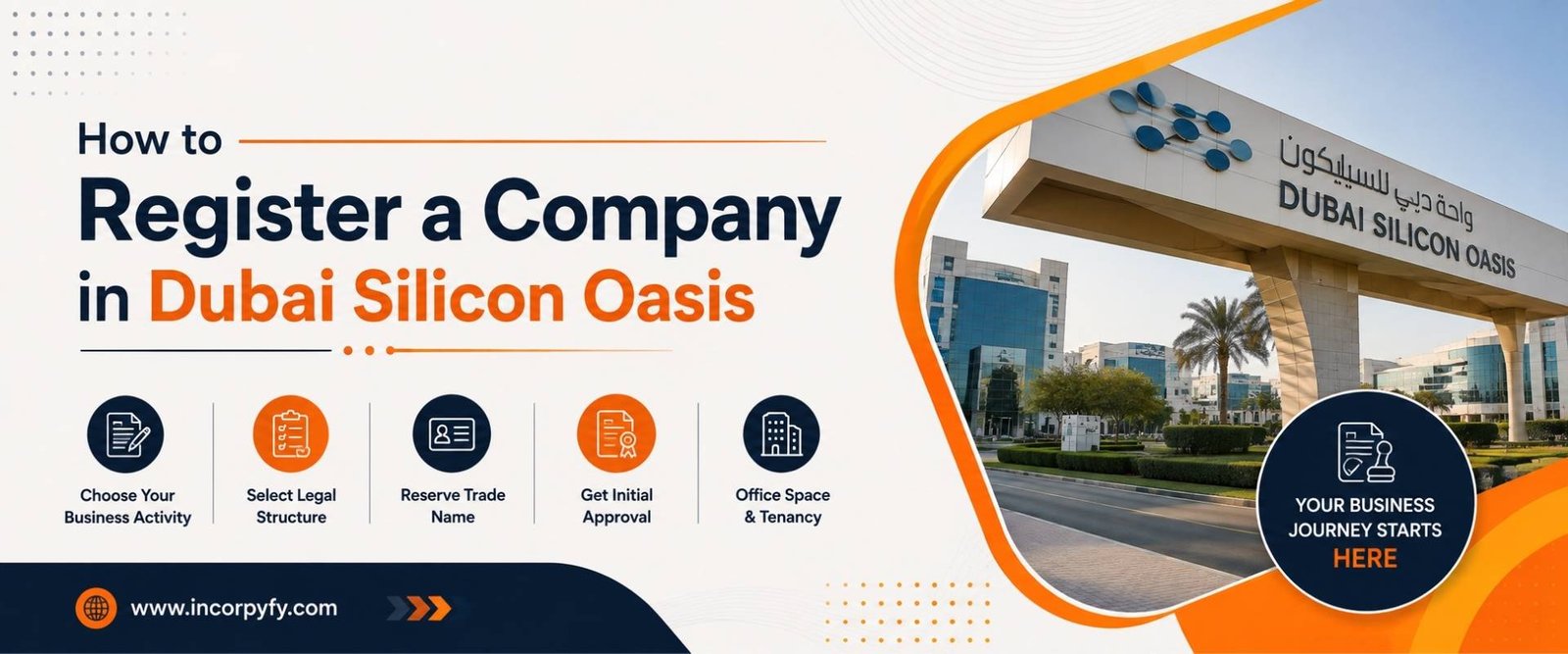
Step 1: Choose your business activity. DSO approves well over 150 activities across service, trading, industrial, and technology categories. This choice determines your license type, required approvals, and eventual visa allocation, so it’s worth getting right before moving forward.
Step 2: Select your company structure. Decide between an FZE, FZC, or branch office based on shareholder count and ownership needs.
Step 3: Reserve your trade name. Submit 3 to 5 name options that comply with UAE naming rules, avoiding religious references or names that could be considered offensive.
Step 4: Apply for initial approval. Submit your passport copy, shareholder details, and business plan for preliminary clearance from DIEZ.
Step 5: Lease your office space. Choose from flexi-desks, co-working space, or a dedicated office; visa eligibility scales with office size, roughly one visa per 9 square meters, so decide your near-term hiring plan before signing a lease rather than after.
Step 6: Submit final documents and pay fees. Provide notarized documents and settle your license fee along with any registration charges.
Step 7: Receive your business license. Once approved, DIEZ typically issues the license within 5 to 10 working days from complete submission.
Step 8: Apply for your establishment card and visas. The establishment card is required before processing investor or employment visas, and it’s the document most banks will ask to see before opening a corporate account.
Step 9: Open a corporate bank account. With your license in hand, you can open an account with a local or international bank operating in Dubai, though compliance checks for free zone companies can take longer than a mainland equivalent.
Cost of Setting Up a Business in Dubai Silicon Oasis
Costs vary by license type, office size, and visa count, and published figures shift periodically, so treat the numbers below as planning estimates and confirm current fees with DIEZ before budgeting.
| Expense Category | Estimated Cost (AED) |
|---|---|
| License fee | 11,900 – 15,000 |
| Minimum office space (flexi-desk) | 16,000 – 28,500 |
| Dedicated office | 30,000+ |
| Office security deposit | 2,000 – 3,000 |
| Visa per person (including medical and Emirates ID) | 3,500 – 8,500 |
| Establishment card | 2,000 – 3,000 |
| Other government fees | 1,000 – 2,500 |
Putting it together, a realistic first-year budget for a single-founder setup with one visa typically runs from around AED 30,000 up to AED 55,000 or more once office space and visa costs are fully accounted for. For a broader comparison across Dubai’s free zones, our guide to company formation costs in Dubai breaks this down further.
Benefits of Setting Up a Business in Dubai Silicon Oasis
- 100% ownership: foreign investors retain full control with no local sponsor required, across every standard entity type available in the zone
- Tax advantages: no personal income tax and full profit repatriation, with UAE corporate tax applying only above AED 375,000 in net profit
- Advanced infrastructure: smart offices, data centers, and strong IT connectivity built for tech operations specifically, which matters more than it sounds for hardware, IoT, or data-heavy businesses
- A ready ecosystem: access to accelerators, incubators, and a genuine network of tech startups and investors, especially through DTEC
- A skilled talent pool: visa quotas that scale with office size support hiring as you grow, without the visa caps some smaller free zones impose regardless of space
- A single-window regulator: consolidating DSO under DIEZ has, in practice, streamlined some cross-zone administrative processes for companies that also touch DAFZA or Dubai CommerCity
Common Challenges and Considerations
- Annual audits: DSO companies must submit audited financial statements every year, adding a recurring accounting cost that’s easy to underbudget in year one
- Visa quotas tied to office size: a flexi-desk caps your visa allocation, so plan headcount before choosing your workspace rather than discovering the limit after you’ve already hired
- Bank account minimums: some UAE banks apply higher minimum balance requirements for free zone corporate accounts, which can strain an early-stage budget
- Genuine competition: as a concentrated tech hub, DSO has real competitive density, so branding and positioning matter more here than in a less specialized free zone
- Mainland restrictions: a standard DSO license doesn’t let you trade directly with mainland customers without a distributor or a dual license arrangement, worth planning for if mainland UAE is part of your customer base
- Keeping compliance current: UAE-wide requirements such as e-invoicing for B2B transactions are rolling out on a schedule, and a tech company with a modern accounting stack has less catching up to do than most, but it’s still worth confirming your software meets current requirements rather than assuming it does
Dubai Silicon Oasis vs. Other UAE Free Zones
| Free Zone | Focus Industry | Approx. Cost (AED) | Distinct Advantage |
|---|---|---|---|
| Dubai Silicon Oasis | Technology and IT | 30k – 55k | Integrated live-work community plus DTEC startup ecosystem |
| Dubai Internet City | Tech and media | 35k – 60k | Home to established global IT corporations |
| IFZA | Multiple industries | 12k – 20k | Among the lowest licensing costs in Dubai |
| DIFC | Finance and banking | 50k+ | Global financial services hub |
If your business isn’t specifically tech-focused, it’s worth comparing DSO against a broader shortlist rather than assuming the tech branding automatically makes it the right fit. Our guides to the best free zones in the UAE and cheapest free zones in the UAE cover that wider comparison, and our team can also walk through free zone business setup in Dubai options more generally if DSO doesn’t turn out to be the right fit.
Conclusion
Dubai Silicon Oasis remains one of the more distinctive, genuinely tech-focused free zones in the UAE, now operating under DIEZ rather than its original standalone authority. Between flexible entity structures, DTEC’s startup ecosystem, and competitive costs relative to Dubai Internet City or DIFC, it’s a strong fit for IT, fintech, and R&D businesses specifically, less so for activities with no technology angle at all. The governance change to DIEZ is a genuinely useful thing to understand before you apply, since it affects which portal and forms you’ll actually be dealing with.
If you’re ready to move forward with company formation in Dubai Silicon Oasis, working with experienced business setup consultants in Dubai means fewer surprises through licensing, documentation, and visa processing, and a clearer sense of whether DSO or a different free zone actually matches your activity. Get in touch and we’ll map out the right structure for your business.
FAQs
Is Dubai Silicon Oasis still regulated by DSOA?
Not as an independent authority. Since 2021, DSO has operated under the Dubai Integrated Economic Zones Authority (DIEZ), alongside Dubai Airport Free Zone and Dubai CommerCity. The zone, its ecosystem, and its branding remain the same; the regulatory umbrella changed.
How much does it cost to set up a company in Dubai Silicon Oasis?
License fees typically start from around AED 11,900 to 15,000, with total first-year setup costs, including office space and one visa, commonly ranging from AED 30,000 to 55,000 depending on your requirements.
How long does it take to register a company in DSO?
Typically 5 to 10 working days once your documentation and approvals are complete.
Can foreigners own 100% of a company in Dubai Silicon Oasis?
Yes. Foreign investors can hold full ownership without a local partner, across all standard entity types.
How many visas can I get with a DSO company?
Visa allocation scales with office size, roughly one visa per 9 square meters of leased space, so a flexi-desk supports fewer visas than a dedicated office.
Is Dubai Silicon Oasis good for startups?
Yes, particularly through DTEC, which offers accelerator programs, mentorship, and flexible workspace specifically built around early-stage technology companies.
Can a DSO company trade with customers on the Dubai mainland?
Not directly under a standard free zone license. You’d typically need a local distributor or a dual license arrangement to sell directly to mainland customers.
What types of businesses are best suited to DSO?
IT companies, R&D firms, fintech startups, software developers, and technology consultancies see the strongest fit, given the ecosystem and infrastructure built specifically around that sector.
Do I still deal with the same authority if my paperwork mentions DSOA?
Effectively yes, since DSOA’s functions were absorbed into DIEZ rather than discontinued outright. If you’re working from an older document or a consultant’s template that still references DSOA, it’s worth confirming current forms and fees with DIEZ directly rather than assuming nothing has changed.
Is company registration in Dubai Silicon Oasis fully remote?
Most of the application, document submission, and license issuance can be completed remotely. Bank account opening and certain notarization steps typically still require in-person attendance or a locally based representative.