


Summary
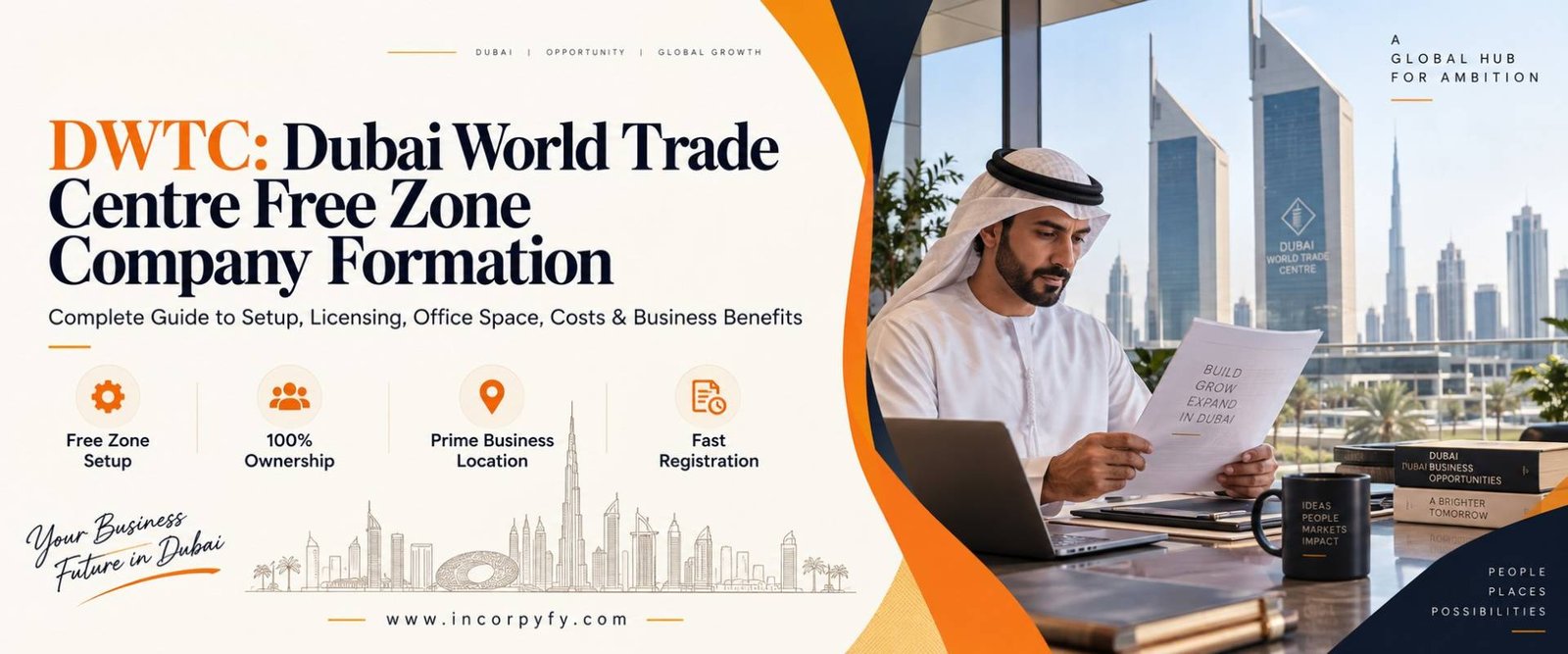
DWTC Free Zone sits in the heart of Dubai’s central business district, home to more than 2,000 companies across 40-plus industries since its 2015 launch. It offers 100% foreign ownership and 0% corporate tax on qualifying income specifically, with FZCO structures allowing 2 to 10 shareholders. License fees commonly run AED 18,000 to AED 25,000 annually.
The Dubai World Trade Centre Free Zone (DWTC) stands among Dubai’s most established business destinations. Located in the heart of Dubai’s central business district, DWTC Free Zone offers genuine access to global markets, major international exhibitions, and strategic networking opportunities that support real business growth, all built around a landmark that has anchored the city’s business scene since the Sheikh Rashid Tower opened in 1979.
DWTC company formation continues attracting entrepreneurs, multinational corporations, and startups seeking full foreign ownership, structured tax treatment, and a prestigious central address. A fair amount of circulating content on this topic overstates certain details, treating the free zone’s tax position as an unconditional exemption and occasionally citing shareholder or capital figures that don’t match DWTC’s own published guidance. This guide covers what actually applies today, including the specific ownership rules and tax conditions that some circulating content describes inaccurately.
Why Choose DWTC Free Zone for Company Formation?
Setting up a Dubai World Trade Centre company delivers strategic advantages that extend beyond a prestigious address. The free zone occupies a prime position along Sheikh Zayed Road, directly connected to the Dubai Metro and a short drive from Dubai International Airport.
Strategic Location Advantages
DWTC positions your business in Dubai’s commercial epicenter, surrounded by major banks, corporate headquarters, and government institutions. The World Trade Centre Metro Station provides direct access throughout Dubai, while proximity to DIFC (Dubai International Financial Centre) creates natural synergies with financial sector partners.
Key Benefits of DWTC Free Zone
- 100% foreign ownership across approved business activities
- Structured tax treatment, with 0% available on qualifying income for businesses meeting Qualifying Free Zone Person conditions, a distinction covered in detail below
- Full repatriation of profits and capital with no restrictions
- Access to major international events, including some of the region’s largest exhibitions and trade shows held on site
- No currency restrictions or exchange controls
- An early regulatory framework for virtual and digital assets, positioning DWTC as a genuine option for technology and crypto-adjacent businesses alongside its traditional events and professional services base
- Governed by the Dubai World Trade Centre Authority (DWTCA), owned by Investment Corporation of Dubai, the emirate’s principal investment arm
DWTC Free Zone License Types
Selecting the appropriate DWTC business license depends on your commercial activities and business model. The free zone offers several main license categories:
Service License
Designed for companies providing professional services including business consulting, legal services, accounting, IT solutions, marketing agencies, and management consultancy, covering knowledge-based industries broadly.
Commercial Trading License
Permits import, export, distribution, and general trading activities, ideal for businesses dealing in physical goods, wholesale operations, and supply chain management.
Event Management License
Specifically tailored for companies organizing exhibitions, trade shows, conferences, and corporate events, with license holders positioned to work closely with DWTC’s exhibition facilities and event infrastructure.
Freelance Permit
Enables independent professionals to operate legally in Dubai, suited to consultants, designers, content creators, and digital specialists working independently rather than through a full company structure.
Approved Business Activities in DWTC Free Zone
DWTC supports a genuinely diverse range of industries:
- Event management and exhibition services
- Information technology and software development
- Media production and marketing services
- International trading and distribution
- Legal and accounting consultancy
- E-commerce and digital platforms
- Financial advisory services
- Business management consulting
- Virtual asset and technology-related activities, supported by DWTC’s early digital asset regulatory framework
Legal Structures for DWTC Companies
Choosing the correct company structure impacts operational flexibility, compliance requirements, and growth potential.
Free Zone Company (FZCO)
Allows multiple shareholders, specifically 2 to 10 shareholders, who may be individuals, corporate entities, or a combination of both, with at least one manager and up to five directors. Suited to partnerships, joint ventures, and businesses with more than one owner.
Free Zone Establishment (FZE)
Designed for single shareholder entities, individual or corporate, with at least one manager and up to five directors. Suited to sole proprietors and entrepreneurs seeking complete ownership control. Capital requirements are determined case by case based on activity rather than a single fixed published minimum, so confirming the specific figure for your intended activity directly with DWTC avoids budgeting against an outdated or generic number some older guides still circulate as a flat requirement across every activity type.
Branch Office
Enables existing companies to establish a UAE presence without creating a separate legal entity. The parent company maintains full liability and control, suited to multinational corporations extending operations into Dubai under their existing name.
DWTC Company Formation Process: Step-by-Step Guide
Step 1: Select Business Activity and License Type
Determine your primary commercial activities and choose the appropriate license category from DWTC’s approved activity list.
Step 2: Choose Company Structure
Decide between FZCO, FZE, or Branch Office based on ownership requirements and business plans.
Step 3: Reserve Company Name
Submit your proposed company name for approval. Names must be unique, avoid restricted terms, and comply with UAE naming conventions.
Step 4: Prepare Required Documents
Gather essential documentation through DWTC’s eServices portal, including the Ultimate Beneficial Owner (UBO) details section:
- Passport copies of shareholders, directors, and managers, valid for at least 6 months
- Passport-sized photographs
- Business plan outlining activities and objectives
- Proof of address for shareholders
- For corporate shareholders: board or shareholder resolution, certificate of incorporation, organisation chart identifying the UBO, and Memorandum and Articles of Association
Step 5: Submit Application and Pay Fees
Complete the application through DWTC’s official eServices portal and pay the applicable registration and license fees.
Step 6: Receive License and Start Operations
Once approved, receive your DWTC business license, allowing you to begin operations, open a bank account, and process visas.
DWTC Company Formation Costs
Understanding the complete cost structure helps you budget accurately, though final figures depend on activity, office type, and visa count, so treat these as planning ranges rather than fixed quotes:
License fees:
- Service License: commonly AED 18,000 to AED 22,000 annually
- Commercial License: commonly AED 20,000 to AED 25,000 annually
- Freelance Permit: commonly AED 8,500 to AED 12,000 annually
Office space costs:
- Flexi Desk: AED 15,000 to AED 25,000 annually
- Private Office: AED 35,000 to AED 80,000 annually, depending on size
- Custom Corporate Suite: AED 100,000 to AED 300,000 annually
Visa costs:
- Employee visa: AED 4,500 to AED 6,000 per visa, including medical test and Emirates ID
- Investor visa: AED 5,000 to AED 7,000, for shareholders and managers
Additional costs:
- Registration fees: AED 2,000 to AED 3,000
- Document attestation: AED 500 to AED 1,500
- Optional business consultancy services: AED 5,000 to AED 15,000
Total realistic investment: commonly AED 40,000 to AED 70,000 for a straightforward small business setup, or AED 80,000 to AED 150,000 for medium-sized operations with multiple visas and a larger office footprint.
Premium Office Solutions at DWTC
Flexi Workspace
Shared workspaces with dedicated desks, high-speed internet, meeting room access, and business support services, suited to startups, freelancers, and solo entrepreneurs.
Executive Offices
Fully furnished private offices with reception services and professional meeting facilities, generally ranging from around 150 to 500 square feet depending on team size.
Customizable Corporate Suites
Large-scale office solutions for corporations requiring tailored layouts and dedicated facilities, available in larger configurations for bigger teams.
Employee Visa Sponsorship in DWTC Free Zone
DWTC companies can sponsor employment visas for foreign employees and dependent visas for family members. Visa quotas generally scale with your office space size, from a small allocation for a flexi desk through to considerably larger quotas for a full corporate suite, with exact numbers confirmed against your specific facility choice during setup.
Corporate Bank Account Opening for DWTC Companies
Opening a corporate bank account is essential for business operations. DWTC companies commonly work with major UAE banks, including Emirates NBD, Mashreq Bank, Abu Dhabi Commercial Bank (ADCB), and RAKBANK, each offering different balance requirements and service tiers suited to different company sizes. Account opening typically requires your business license, Memorandum of Association, shareholder passports, and proof of address.
Networking and Business Development Opportunities
DWTC hosts major international events throughout the year, providing genuine networking opportunities for tenant businesses, including GITEX Technology Week, one of the region’s largest technology exhibitions, Gulfood, a major global food and beverage show, and Arab Health, a premier regional healthcare exhibition, alongside numerous other trade conferences and industry summits held on site. For a business genuinely positioned in event management, technology, or a sector with a strong exhibition presence, being physically located where these events actually happen offers a networking advantage that’s difficult to replicate from an office elsewhere in the city, even a well-connected one.
The Tax Question Worth Getting Right
DWTC’s own regulatory guidance confirms it as a designated Qualifying Free Zone under UAE Corporate Tax Law, meaning members who qualify as Qualifying Free Zone Persons can access 0% tax specifically on qualifying income. This is more conditional than a blanket “zero tax” claim: qualifying activities include manufacturing and processing of goods, holding of shares and securities, ownership and management of ships, reinsurance services, fund and wealth management services, headquarters services to related parties, financing and leasing of aircraft, logistics services, trading of qualifying commodities, and treasury and financing services to related parties, among others. Excluded activities specifically include transactions with individuals and most regulated financial services activities, so the qualifying scope, while broad, isn’t unlimited. Non-qualifying income, including most direct sales into the UAE mainland, is generally taxed at the standard 9% rate above AED 375,000, and losing QFZP status can mean losing the 0% treatment on all income for that period rather than just the non-qualifying portion. Personal income tax genuinely doesn’t apply in the UAE, so that part holds regardless of qualifying status, and it’s worth treating DWTC’s own published tax guidance as the more reliable source here than a third-party summary that simplifies the position into a flat exemption.
DWTC Free Zone vs Other Dubai Free Zones
Prime Central Location
Unlike more peripheral free zones, DWTC sits in Dubai’s business epicenter on Sheikh Zayed Road, with direct metro connectivity and proximity to DIFC providing genuinely strong day-to-day accessibility.
Event-Driven Ecosystem
Few other free zones offer this level of direct access to major annual exhibitions and trade shows, creating ongoing business development opportunities that a purely office-based free zone elsewhere in Dubai simply can’t replicate.
Established Brand Positioning
A DWTC address carries real credibility given the Dubai World Trade Centre’s decades-long history as the city’s original business and exhibitions landmark, which can matter when building trust with international clients and partners.
Conclusion
DWTC Free Zone company formation is a genuinely strong option for entrepreneurs seeking a central Dubai address, established infrastructure, and access to major international events, provided you go in with accurate expectations about ownership structure and tax treatment rather than a blanket “zero tax” assumption. For end-to-end support navigating DWTC’s application process and confirming your specific QFZP position, our business setup services in Dubai team can guide you through the full process. Explore our broader free zone company formation in Dubai options or visit Incorpyfy to get started.
Frequently Asked Questions
How long does DWTC company formation take?
Processing timelines depend on documentation completeness and your specific activity, commonly running from a few business days to a couple of weeks once all requirements are submitted correctly.
Can I own 100% of my DWTC company as a foreigner?
Yes. DWTC Free Zone permits 100% foreign ownership across approved business activities and company structures, including FZCO, FZE, and branch office setups, with no local sponsor required.
Is DWTC only suitable for event-related businesses?
No. While DWTC has deep roots in event management and exhibitions, it supports diverse industries including IT, trading, consulting, media, finance, e-commerce, and professional services, alongside its early virtual asset regulatory framework.
How many shareholders can a DWTC FZCO have?
Between 2 and 10 shareholders, who may be individuals, corporate entities, or a combination of both.
How many employee visas can a DWTC company sponsor?
Visa quotas generally scale with your office space size, with exact allocations confirmed against your specific facility during the setup process.
What are the total costs for starting a small business in DWTC?
Commonly AED 40,000 to AED 70,000 for a complete small business setup, including license fees, a flexi desk or small office, one or two visas, and registration costs.
Can DWTC companies trade with mainland Dubai?
Direct mainland trading generally requires a distributor arrangement or dual licensing structure, since a standard free zone license alone doesn’t automatically permit unrestricted mainland retail.
Are there any corporate taxes in the DWTC Free Zone?
Every UAE company must register for corporate tax. DWTC is a designated Qualifying Free Zone, so companies meeting Qualifying Free Zone Person conditions can access 0% on qualifying income specifically, while non-qualifying income, including most mainland sales, faces the standard 9% rate above AED 375,000.
What is the minimum capital requirement for a DWTC company?
There isn’t a single fixed figure published across all activities. Capital requirements are generally assessed based on your specific business activity, so confirming the exact figure directly with DWTC during setup is more reliable than relying on a flat number circulated in older guides.
Does DWTC support crypto and virtual asset businesses?
Yes, DWTC has established an early regulatory framework for virtual and digital assets, making it a genuine option for technology and crypto-adjacent businesses alongside its traditional strength in events, trading, and professional services.
Who regulates and owns the DWTC Free Zone?
The Dubai World Trade Centre Authority (DWTCA) governs the free zone, which is owned by Investment Corporation of Dubai, the emirate’s principal investment arm, giving it substantial institutional backing behind the address itself.