

Author: Adil Ahmad
Summary
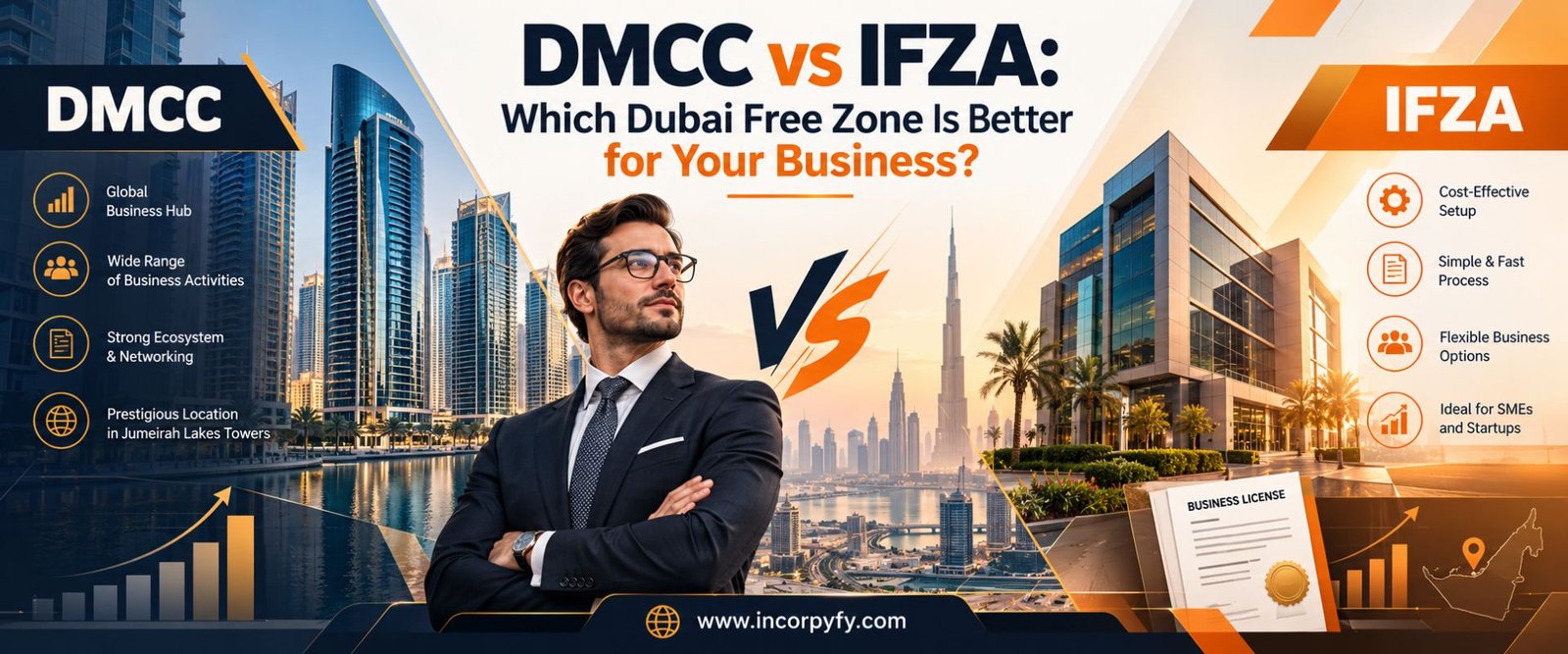
DMCC and IFZA are two of Dubai’s most popular free zones, but they serve genuinely different business profiles. DMCC offers a premium, regulated environment built for trading, commodities, and crypto businesses, while IFZA offers a lower-cost, flexible setup suited to service businesses, consultancies, and lean startups. This guide compares real costs, compliance requirements, banking credibility, and which zone fits which kind of business.
Introduction
DMCC and IFZA are consistently two of the most searched free zone names in Dubai, and for good reason: both offer 100% foreign ownership, 0% personal income tax, and a straightforward path to UAE residency, but the similarities largely stop there. Choosing between them isn’t about which one is objectively “better,” it’s about which one actually matches your business activity, budget, and growth plans.
This guide breaks down the real differences between DMCC and IFZA across cost, compliance, business activities, banking, and reputation, so you can make a decision based on your specific business rather than a generic “cheapest free zone” ranking.
What Is DMCC?
DMCC, short for Dubai Multi Commodities Centre, is a government-established free zone based in Jumeirah Lakes Towers, originally built around commodities trading (gold, diamonds, precious metals, and tea) and now covering more than 600 business activities, including a dedicated, VARA-regulated Crypto Centre for Web3 and digital asset businesses. DMCC has been consistently ranked among the world’s top free zones for several years running, and that reputation plays a real role in how banks and international partners perceive companies registered there.
What Is IFZA?
IFZA, the International Free Zone Authority, is based in Dubai Silicon Oasis and has grown rapidly as one of the UAE’s most cost-effective and flexible free zones, particularly popular with consultants, service providers, and digital businesses. IFZA operates on a B2B-focused model with a strong emphasis on affordability, remote incorporation, and bundling multiple business activities under a single license, making it a common choice for founders who want to launch quickly without a large upfront commitment.
DMCC vs IFZA: Cost Comparison
This is usually the first question business owners ask, and the honest answer is that DMCC and IFZA sit at meaningfully different price points:
| Cost Factor | DMCC | IFZA |
|---|---|---|
| Year 1 license cost | Roughly AED 18,000 to 25,000 | Roughly AED 12,000 to 15,000 |
| Year 2 renewal | Roughly AED 34,500 to 42,000 | Roughly AED 22,500 to 27,000 |
| Share capital requirement | AED 50,000 deposited, typically required for General Trading licenses | No paid-up share capital requirement |
| Activities per license | Charged per activity | Up to three activities bundled under one fee |
| Office requirement | Physical premises required, from flexi-desk upward | Digital flexi-desk included, remote incorporation available |
DMCC’s higher cost reflects its more regulated structure and premium positioning, while IFZA’s lower entry point and activity bundling make it significantly more accessible for early-stage businesses watching their setup budget closely.
Business Activities and License Flexibility
DMCC’s strength is depth within specific sectors. With over 600 approved business activities and specialized licensing categories for commodities trading, gold and diamonds, and crypto and digital assets through its Crypto Centre, DMCC is purpose-built for businesses operating in these spaces, offering regulatory infrastructure that few other free zones match.
IFZA’s strength is breadth across general business categories. Its ability to bundle up to three distinct activities under a single license fee makes it especially practical for consultancies, agencies, and multi-service businesses that don’t fit neatly into one narrow activity code, without paying separately for each one.
Audit and Compliance Requirements
This is a frequently overlooked difference that affects both ongoing cost and administrative workload:
- DMCC requires an audited financial statement every year as part of license renewal, with filing typically required within 90 days of your financial year-end. This adds both cost and compliance overhead but also reinforces DMCC’s reputation for regulatory rigor.
- IFZA does not require an audit as part of license renewal itself, though UAE federal tax law still requires businesses to retain audited financial statements for Federal Tax Authority purposes regardless of free zone. This makes IFZA’s year-to-year renewal process lighter administratively, even though baseline UAE tax compliance still applies either way.
Banking and Credibility
Both DMCC and IFZA companies can generally open UAE corporate bank accounts, but the practical experience differs:
- DMCC’s credibility comes from its regulatory weight, mandatory audits, and long-established reputation among banks and international partners, which can translate into a smoother banking experience for larger or higher-risk-profile businesses.
- IFZA’s credibility benefits from being a Dubai government-backed free zone with a recognized address, though as a newer and lower-cost zone, some banks apply closer scrutiny during account opening compared to long-established zones like DMCC or JAFZA.
For businesses in sectors that already attract more banking scrutiny, such as crypto, trading, or financial services, DMCC’s regulatory profile can meaningfully ease banking conversations. For straightforward service businesses, IFZA’s lower cost rarely creates a banking disadvantage.
Trading With the Mainland
Both DMCC and IFZA free zone companies can trade with UAE mainland clients, but direct retail operations within the mainland, such as a physical shop open to walk-in customers, generally still require either a mainland license or a local distributor arrangement, regardless of which free zone you choose. This is a common point of confusion that applies equally to both zones rather than being a specific DMCC or IFZA limitation.
Office Requirements and Physical Presence
DMCC requires businesses to maintain physical premises in Jumeirah Lakes Towers, starting at a flexi-desk arrangement and scaling up to dedicated office or warehouse space as the business grows. This adds cost but also reflects DMCC’s more established, office-based business community.
IFZA, by contrast, includes a digital flexi-desk as standard and supports fully remote incorporation, with no mandatory physical office lease required for most license categories. This is a significant practical advantage for founders who don’t need a physical presence in Dubai from day one.
Visa Allocation
Visa quotas are broadly comparable at the entry level between the two zones:
- DMCC: Flexi-desk packages typically support 3 to 6 residence visas, with dedicated office space unlocking higher quotas based on premises size.
- IFZA: Standard packages similarly include 3 to 6 visa entitlements, with additional visas available at incremental, modular pricing as the team grows.
Neither zone has a dramatic visa-allocation advantage over the other at the standard package level, so this factor rarely drives the decision on its own.
DMCC vs IFZA: Side-by-Side Summary
| Factor | DMCC | IFZA |
|---|---|---|
| Best for | Trading, commodities, crypto, established businesses | Service businesses, consultancies, lean startups |
| Cost | Higher | Lower |
| Office requirement | Physical premises required | Remote/digital flexi-desk available |
| Audit requirement | Mandatory annual audit | Not required for renewal |
| Activities per license | Charged per activity | Up to 3 bundled |
| Reputation | Premium, globally recognized | Growing, cost-focused |
| Setup speed | Moderate | Fast, remote-friendly |
Which One Should You Choose?
Choose DMCC if:
- Your business involves physical commodities trading, gold, diamonds, or precious metals
- You’re building a crypto, blockchain, or Web3 business that benefits from VARA-regulated infrastructure
- You want the credibility of a premium, internationally recognized free zone address
- Your business is established enough to absorb higher setup and audit costs
Choose IFZA if:
- You run a service-based business, consultancy, or agency
- You want to bundle multiple business activities under one affordable license
- You prefer remote incorporation without a mandatory physical office
- You’re a lean startup or solo founder prioritizing lower upfront and renewal costs
Neither zone is universally “better.” The right choice depends entirely on matching your business activity and growth stage to what each zone is actually built for.
Common Mistakes When Choosing Between DMCC and IFZA
- Choosing based on prestige alone: DMCC’s reputation is genuinely valuable for certain sectors, but paying a premium for an address that doesn’t match your actual business activity wastes budget better spent elsewhere.
- Underestimating DMCC’s audit obligations: The annual audit requirement adds real ongoing cost and administrative work that first-time founders sometimes don’t budget for.
- Assuming IFZA’s lower cost means lower credibility across the board: For most standard service businesses, IFZA’s lower cost creates no meaningful disadvantage with banks or clients.
- Ignoring office requirements until after registration: DMCC’s physical premises requirement should factor into your budget and planning from the start, not as a surprise after licensing.
- Not confirming activity-specific rules: Certain regulated activities may have additional requirements in either zone beyond the standard license, so confirm your specific activity’s requirements before committing to either.
How Incorpyfy Can Help
Choosing between DMCC and IFZA, or any other UAE free zone, comes down to matching your specific business activity, budget, and growth plans to the zone that actually supports them. Incorpyfy helps entrepreneurs compare real costs and requirements across free zones and handles the full registration process for whichever zone fits your business.
If you’re specifically considering DMCC, our overview of DMCC trading licenses in Dubai covers the activity-specific licensing options in more depth, and our breakdown of DMCC license types is useful if you’re still narrowing down your activity. For IFZA, our guide to registering a company in IFZA walks through the complete setup process. If you’re weighing free zone legal structures more broadly, our comparison of FZE vs FZCO in Dubai is also directly relevant. Visit the Incorpyfy homepage to speak with a consultant about which free zone genuinely fits your business.
Frequently Asked Questions
Is DMCC better than IFZA?
Neither is universally better. DMCC suits trading, commodities, and crypto businesses that benefit from a premium, regulated environment, while IFZA suits service businesses and startups prioritizing lower cost and setup flexibility.
Which is cheaper, DMCC or IFZA?
IFZA is generally cheaper, with Year 1 license costs typically around AED 12,000 to 15,000 compared to DMCC’s roughly AED 18,000 to 25,000, and lower renewal costs in subsequent years as well.
Does DMCC require an office, while IFZA doesn’t?
Yes. DMCC requires physical premises in Jumeirah Lakes Towers starting at a flexi-desk, while IFZA includes a digital flexi-desk and supports fully remote incorporation without a mandatory office lease.
Does IFZA require an annual audit like DMCC?
No. IFZA does not require an audit as part of license renewal, while DMCC requires an audited financial statement annually. Note that UAE federal tax law still requires retained audited statements for Federal Tax Authority purposes regardless of free zone.
Can I run a crypto business in IFZA instead of DMCC?
IFZA does offer crypto-related licensing options, but DMCC’s dedicated, VARA-regulated Crypto Centre offers more specialized regulatory infrastructure specifically built for digital asset businesses, which is why many crypto and Web3 companies prefer DMCC.
Is DMCC more trusted by banks than IFZA?
DMCC’s longer track record and regulatory weight can ease banking conversations for certain sectors, particularly trading and crypto businesses, but IFZA companies generally open UAE corporate accounts without major difficulty for standard service-based activities.
Can one license at IFZA cover multiple business activities?
Yes. IFZA allows up to three distinct business activities to be bundled under a single license fee, which is more cost-effective than DMCC’s per-activity charging structure for multi-service businesses.
How many visas can I get with a DMCC or IFZA license?
Both zones typically offer 3 to 6 residence visas at the standard flexi-desk or digital package level, with additional visas available as you scale, either through larger office space at DMCC or incremental visa pricing at IFZA.
Do I need AED 50,000 in share capital for a free zone license?
Only for certain DMCC license categories, particularly General Trading licenses, which typically require AED 50,000 in deposited share capital. IFZA does not have a paid-up share capital requirement for its standard licenses.
Which free zone is better for a startup with a limited budget?
IFZA is generally the more practical choice for early-stage startups, given its lower setup cost, bundled activity pricing, and remote incorporation option, unless your specific business activity requires DMCC’s specialized trading or crypto infrastructure.