

Summary
Starting a business in the RAK Free Zone (RAKEZ) costs from around AED 6,000 for a zero-visa licence, with most trading and professional packages starting between AED 8,000 and 15,000. Setup typically takes one to two weeks, requires no local sponsor, and 100% foreign ownership is guaranteed. This guide covers license types, costs, required documents, the full registration process, and what to check before you commit.
Ras Al Khaimah has quietly become one of the UAE’s most practical entry points for founders who want Dubai-level infrastructure without Dubai-level overheads. The Ras Al Khaimah Economic Zone, known as RAKEZ, is the government authority behind this, and it now hosts tens of thousands of companies across trading, industrial, e-commerce, and consultancy sectors. This guide walks through exactly what RAKEZ offers, what it costs, and how to register, step by step.
Quick facts:
- Setup packages start from roughly AED 6,000 (zero-visa) and typically run AED 8,000 to AED 18,000+ once visas are added.
- 100% foreign ownership with no requirement for a local UAE sponsor.
- Licence issuance usually takes 2 to 5 working days once documents are approved.
- Qualifying companies can access a 0% corporate tax rate on qualifying income under UAE Free Zone tax rules.
What Is RAKEZ (the RAK Free Zone)?
RAKEZ (Ras Al Khaimah Economic Zone) is the single authority that governs free zone, industrial, and offshore business licensing across Ras Al Khaimah. It was formed in 2017 when the emirate merged its two older entities, the RAK Free Trade Zone (RAK FTZ) and the RAK Investment Authority (RAKIA), into one streamlined regulator. Today RAKEZ supports over 50 industry sectors and more than 4,000 approved business activities, from freelance consultancy to full-scale manufacturing.
RAKEZ is organised into distinct zones so businesses can locate near the infrastructure they actually need, rather than paying for space that doesn’t match their activity:
- Al Hamra / Business Zone: The commercial hub for trading firms, service companies, and consultancies, close to Al Hamra port and the marina, and home to most SMEs and startups.
- Al Ghail / Industrial Zone: Built for manufacturing, warehousing, and logistics operations that need large-scale infrastructure and heavy-vehicle access.
- Julphar / Al Nakheel area: A mixed-use zone for retail, services, and light manufacturing close to RAK city centre.
- Academic Zone: Reserved for training institutes, universities, and education-focused businesses requiring campus-style facilities.
- Media Zone: Purpose-built for production, publishing, and media companies that need studio or broadcast infrastructure.
One of RAKEZ’s biggest draws is location. It sits roughly 45 minutes from Dubai and close to Ras Al Khaimah’s own port and airport, so companies get UAE-wide market access and Dubai-comparable banking relationships at a noticeably lower setup cost. Businesses focused specifically on crypto, blockchain, or digital assets should also look at the separate RAK Digital Assets Oasis (RAK DAO), a newer, purpose-built zone under the same emirate but with its own licensing framework.
Why Businesses Choose RAK Free Zone Setup
- Lower cost base than most Dubai free zones, without sacrificing legal protections, banking access, or the ability to trade internationally.
- 100% foreign ownership and full profit repatriation, with no local sponsor or Emirati partner required at any shareholding level.
- 0% personal income tax, and 0% corporate tax on qualifying income for companies that meet Free Zone Person conditions, covered in more detail below.
- Fast, largely digital registration through RAKEZ’s online portal, with most licences issued within days rather than the weeks some mainland setups require.
- Flexible facilities, ranging from flexi-desks and shared offices to dedicated warehouses and industrial land for manufacturing-heavy activities.
- Sector breadth, covering trading, professional services, e-commerce, media, education, and industrial activity, all under one regulatory authority rather than several.
Types of RAK Free Zone Licences
- Commercial Licence: For trading, import, export, and re-export of goods within the UAE and internationally, covering a wide range of product categories.
- Professional Licence: For service-based businesses such as consultancy, marketing, IT services, and education, where the value delivered is expertise rather than physical goods.
- Industrial Licence: For manufacturing and production, including importing raw materials, processing them on-site, and exporting finished goods tax-free.
- E-commerce Licence: For businesses that sell products or services digitally through their own websites or third-party marketplaces.
- Educational Licence: For training providers, institutes, and EdTech companies operating under the Academic Zone, subject to additional regulatory approval.
Legal Structures Available
- Free Zone Establishment (FZE): Single shareholder, 100% ownership, limited liability protection. Best for solo founders, freelancers, and consultants.
- Free Zone Company (FZC): For 2 or more shareholders, whether individuals or corporate entities, suited to partnerships and growing SMEs with multiple stakeholders.
- Branch of a Foreign Company: Lets an overseas company operate in RAKEZ while its parent entity retains its original legal identity abroad.
- Branch of a UAE Company: Allows a mainland or other free zone company to expand its footprint into RAKEZ for cost or strategic advantages.
RAK Free Zone Business Setup Cost
Pricing depends on the licence type, the number of visas required, and the facility you choose. Here’s a realistic range based on current RAKEZ packages:
| Package | Approximate Cost (AED) |
|---|---|
| Zero-visa (freelancer/Biz Starter) | 6,000 – 8,500 |
| Commercial or Professional licence, 1 visa | 10,000 – 14,000 |
| 2-visa package | 14,000 – 18,000 |
| Industrial licence (with facility) | 15,000 and up |
| Flexi-desk / office leasing | from 500/month |
| Licence renewal (annual) | from 7,000 |
Figures are approximate starting prices; final cost depends on activity, visa count, and facility size. Confirm exact fees directly with RAKEZ or a licensed consultant, since packages are revised periodically.
A note on the 0% tax rate: RAKEZ companies can qualify for a 0% UAE corporate tax rate on qualifying income if they register as a Qualifying Free Zone Person, which means maintaining real operational substance in the free zone, earning primarily qualifying income, and meeting transfer-pricing and audit requirements set out by the Federal Tax Authority. Income that falls outside these rules is taxed at the standard 9% rate, so it’s worth structuring your activity correctly from day one rather than assuming the exemption applies automatically.
Documents Required for RAK Free Zone Registration
RAKEZ keeps its documentation process relatively light compared to mainland company formation, but requirements still differ slightly depending on whether your shareholder is an individual or a corporate entity.
For individual shareholders:
- Passport copy and, if applicable, current UAE visa page
- Passport-sized photograph meeting standard specifications
- Proof of address (utility bill or tenancy contract)
For corporate shareholders:
- Certificate of incorporation
- Memorandum and Articles of Association
- Board resolution authorising the setup
- Power of attorney for the appointed representative
Certain activities, including education, healthcare, and manufacturing, need additional external approvals from the relevant UAE regulator before licensing is finalised.
Step-by-Step RAK Free Zone Registration Process
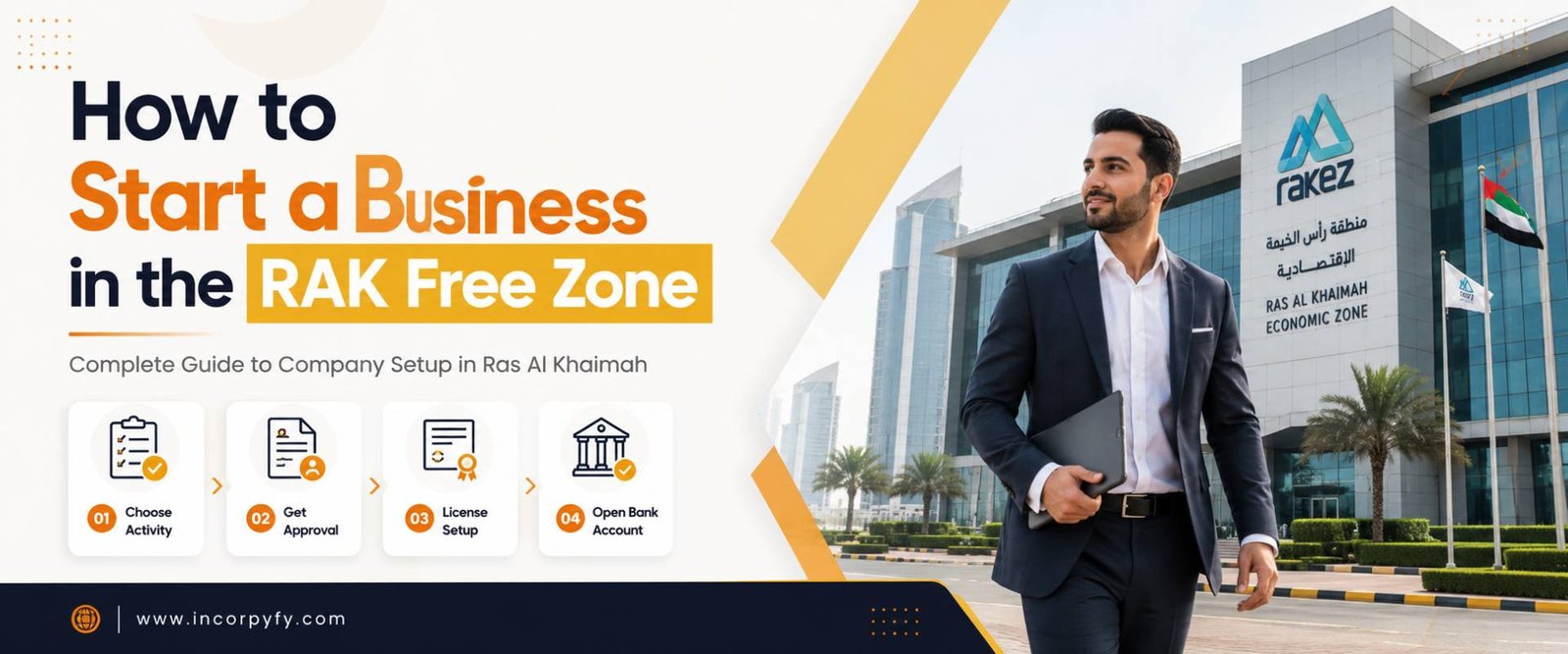
- Choose your business activity and licence type. Match your intended activity to the correct commercial, professional, industrial, or e-commerce licence.
- Select a legal structure. Decide between an FZE, FZC, or branch based on shareholder count and ownership goals.
- Reserve your trade name. Submit your preferred name for approval against UAE naming conventions and RAKEZ guidelines.
- Submit your application and documents. Upload the application form, passport copies, and supporting paperwork through the RAKEZ digital portal.
- Choose your facility. Pick a flexi-desk, shared office, dedicated office, or warehouse depending on your operational needs.
- Pay fees and receive your licence. Once approved, RAKEZ issues your trade licence, usually within a few working days.
- Apply for visas and open a corporate bank account. With your licence in hand, apply for residency visas for yourself and any staff, then proceed to bank account opening, a step where local PRO services can meaningfully speed things up.
RAK Free Zone vs. Other Setup Options
RAKEZ isn’t the only route into the UAE market, and it’s worth knowing where it fits:
- Vs. Dubai free zones: RAKEZ packages are typically cheaper than comparable Dubai free zone options, while still offering banking relationships and market access close to Dubai. If you’re weighing the two, our breakdown of company formation cost in Dubai lays out the comparison in detail.
- Vs. RAK mainland: A mainland trade licence in Ras Al Khaimah suits businesses that need to trade freely across the whole UAE without free zone restrictions, though it typically involves a different regulatory path.
- Vs. RAK offshore: If you don’t need a physical UAE office at all, RAK offshore company formation is a lighter-weight, holding-company-style alternative.
- Vs. other named free zones: For comparison, our guides to Ajman Free Zone and Hamriyah Free Zone cover two other cost-competitive options elsewhere in the UAE.
- Long-term residency: Founders planning to relocate long-term often pair their RAKEZ company with a Golden Visa in Ras Al Khaimah once eligibility criteria are met.
Common Mistakes to Avoid
- Picking the cheapest package without checking visa allocation. Some zero-visa packages look attractive but offer no residency visa at all, which can be a dealbreaker if you plan to actually live in the UAE.
- Assuming the 0% tax rate applies automatically. Qualifying Free Zone Person status has real conditions attached around substance and income type; get this checked before you start invoicing.
- Underestimating facility requirements. Industrial and warehousing activities need the right zone and lease type from the outset, not a shared desk retrofitted later once operations scale up.
- Skipping bank account due diligence prep. UAE banks apply their own compliance checks separate from RAKEZ licensing, and having your documentation ready in advance avoids weeks of delay.
- Confusing RAKEZ with RAK offshore or RAK DAO. These are separate licensing regimes with different rules on physical presence, visas, and permitted activities; picking the wrong one means restarting the process.
Why Work With a RAKEZ Business Setup Consultant
RAKEZ’s process is largely digital and genuinely straightforward, but choosing the right licence, structure, and package still benefits from local expertise, particularly around activity classification, visa allocation, and bank introductions. Incorpyfy is a Dubai-based business setup consultancy that handles RAKEZ company formation end-to-end, from documentation and government approvals through to visa processing and post-incorporation compliance, with transparent, upfront pricing throughout.
Frequently Asked Questions
What is RAKEZ, and how is it different from RAK Free Zone?
RAKEZ (Ras Al Khaimah Economic Zone) is simply the current name and authority for what many people still call the “RAK Free Zone.” It was formed by merging RAK FTZ and RAKIA in 2017.
How long does it take to start a business in RAKEZ?
Licence issuance typically takes 2 to 5 working days once all documents are submitted and approved. Visa processing usually adds another week.
Can foreigners own 100% of a RAKEZ company?
Yes. RAKEZ allows full 100% foreign ownership with no requirement for a local UAE sponsor.
Is there a minimum capital requirement?
Most licence types have no mandatory minimum share capital, which makes RAKEZ accessible for startups and solo founders.
Do RAKEZ companies pay corporate tax?
Companies that qualify as a Qualifying Free Zone Person pay 0% on qualifying income; income outside those conditions is taxed at the standard 9% UAE corporate tax rate.
Can I get a UAE residency visa through my RAKEZ company?
Yes, though visa eligibility and quota depend on your licence type, package, and office or facility size.
How much does it cost to renew a RAKEZ licence?
Renewal typically starts from around AED 7,000 per year, varying by licence category and any additional visas attached.
Conclusion
RAK Free Zone business setup remains one of the most accessible ways into the UAE market: fast registration, full foreign ownership, and a genuinely competitive cost base compared to Dubai’s free zones. The trade-off is that getting the licence type, structure, and tax positioning right from the start matters more than the headline price. If you’d rather have that handled properly the first time, Incorpyfy offers full RAKEZ setup support alongside broader free zone business setup services in Dubai. Use our free cost calculator to get a starting estimate, or reach out for a tailored quote.