

Summary
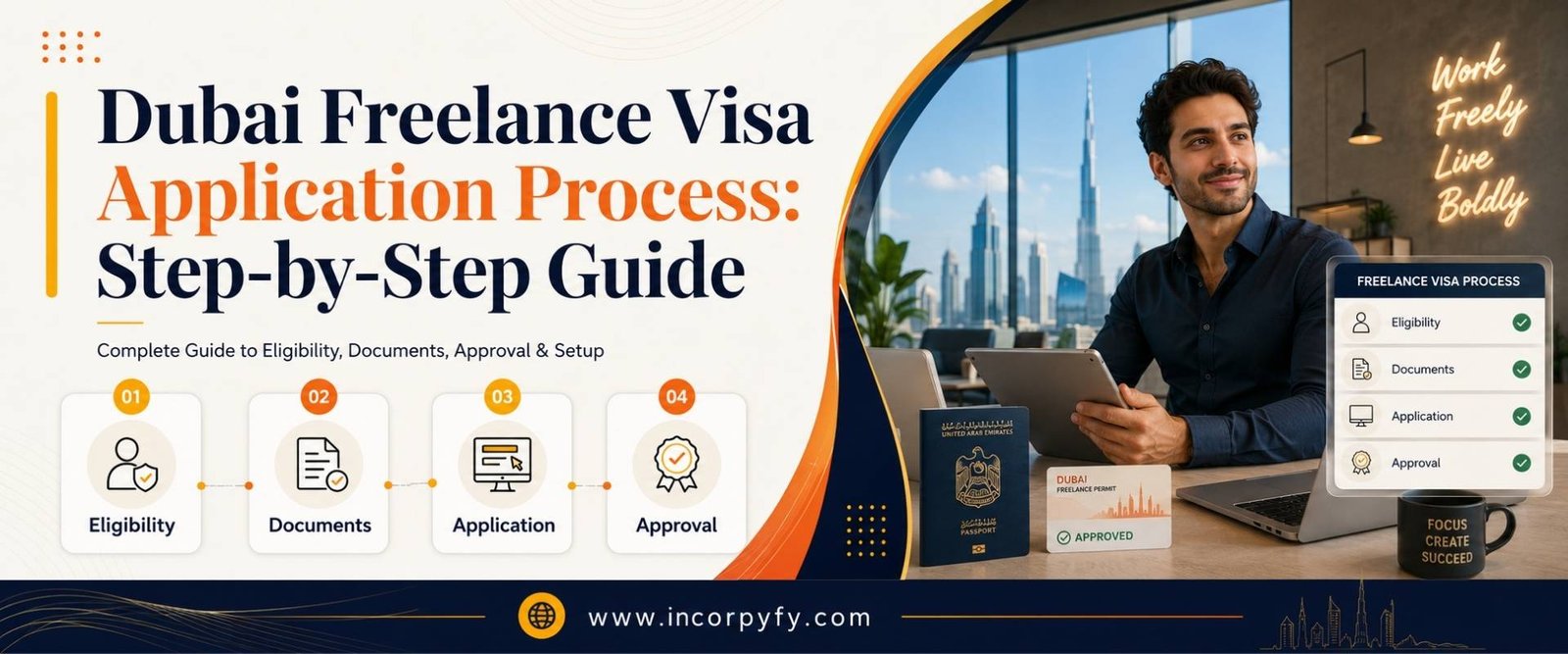
The Dubai freelance visa process runs through two main routes, Dubai’s own GoFreelance permit or a free zone freelancer package, and combines a professional permit with a residence visa. A complete application typically takes 1 to 3 weeks and costs AED 7,500 to 18,000 depending on the route and whether a visa is included. This guide walks through exactly what happens at each stage, from choosing your issuing authority to your first day working legally as a freelancer.
The Fast Answer: What the Process Actually Involves
Becoming a licensed freelancer in Dubai means clearing two separate approvals that get bundled together in most marketing material but function as distinct stages in practice. First, a freelance permit, issued either by Dubai’s Department of Economy and Tourism through its GoFreelance platform or by a free zone authority, authorizes you to legally invoice clients under an approved professional activity. Second, if you need to reside in the UAE under this status rather than through another visa, a residence visa application runs alongside or immediately after the permit, adding medical testing, Emirates ID issuance, and visa stamping to the process.
A permit alone, without a visa, is the cheaper and faster route, useful for UAE residents already sponsored through a spouse, family member, or another company who simply need legal authorization to freelance. A permit combined with a residence visa is the fuller package most new freelancers actually need, and it is this combined process the rest of this guide walks through in detail.
Before You Apply: Confirm Your Activity and Route
The single decision that shapes everything downstream is which issuing authority you apply through, since Dubai does not have one universal freelance license. Dubai’s Department of Economy and Tourism operates its own GoFreelance platform, covering professional categories in technology, media, design, and education. Alongside this, several free zones, Dubai Media City and other TECOM-affiliated zones for media and creative professionals, Meydan Free Zone for a broader range of consulting and professional activities, and RAK or Fujairah-based options for founders prioritizing lower cost, each run their own freelancer permit programs with their own activity lists and pricing.
Confirming that your specific professional activity is actually covered by your chosen authority’s approved list before starting the application avoids the common situation where a founder assembles a full document package only to discover their activity is not recognized under that particular program. Activity lists differ meaningfully between GoFreelance and the various free zone programs, and a consultancy activity accepted under one is not automatically accepted under another.
Stage One: Choosing Your Issuing Authority and Activity Category
Once you have identified which authority covers your professional activity, this stage is about formally selecting your activity category and, where relevant, your legal structure. Most freelance permits fall under a small number of broad categories, commonly technology, media and creative work, design, consulting, and education, each with its own list of specific approved activities beneath it. Selecting the category that most precisely matches your actual work, rather than the closest available option, reduces the risk of a later amendment being required once your invoicing activity does not clearly match your registered category.
Stage Two: Assembling Your Documents
Document requirements vary somewhat by issuing authority, but a consistent core applies across nearly every route. You will need a passport valid for at least six months, passport-style photographs, a CV or résumé demonstrating relevant experience or qualifications, and, for creative and media-related activities specifically, a professional portfolio showing prior work. Educational certificates are sometimes required and, if issued outside the UAE, generally need attestation before submission.
If you are already a UAE resident sponsored under another visa, whether through an employer, a spouse, or another company, you will typically need a No Objection Certificate from your current sponsor before a new freelance permit and visa can be processed under your own name. This single document causes more delays than any other in the entire process, since obtaining it depends on a third party, your current sponsor, cooperating on a timeline you do not fully control. Requesting this early, well before the rest of your documentation is ready, is worth prioritizing over every other preparatory step.
Stage Three: Submitting the Permit Application
With documents assembled, the permit application itself is submitted either through the GoFreelance online platform directly or through your chosen free zone’s own portal, depending on which route you selected in the earlier stage. This stage typically includes an activity and document review by the issuing authority, and for GoFreelance specifically, additional verification against the applicant’s stated qualifications and portfolio for creative and media categories.
Approval at this stage grants the freelance permit itself, the legal authorization to invoice clients under your registered activity. If you already hold residency through another route and do not need a new visa, this is effectively the end of the process. For everyone else, the permit approval is the trigger for the next stage rather than the finish line.
Stage Four: Converting Your Permit Into a Residence Visa
With an approved permit in hand, the residence visa process begins with an establishment card, the document that allows the permit holder to sponsor their own visa, typically costing around AED 2,000. From there, the process follows the standard UAE residence visa path: entry permit issuance, a medical fitness test, Emirates ID application, and finally visa stamping in the passport. This portion of the process generally takes one to two weeks on top of the permit approval itself, and applicants should expect it to run as a distinct phase rather than something that completes automatically once the permit is issued.
What It Costs, Start to Finish
Costs vary by route and by whether a residence visa is included, and the range quoted across comparison sites is wide enough that a genuine breakdown is more useful than a single headline figure.
- Freelance permit alone: starting around AED 7,500 annually, the base cost before any visa-related fees
- Establishment card: approximately AED 2,000, required only if you are sponsoring your own residence visa under the permit
- Residence visa processing: AED 4,000 to 6,000, covering entry permit, status change, and visa stamping
- Medical test and Emirates ID: AED 1,000 to 2,000 combined
- Additional fees: AED 500 to 2,000, covering document attestation, translation, or typing center charges depending on your specific case
Added together, a complete permit-plus-visa package for a two-year term commonly starts around AED 13,000 and can run up to AED 18,000 depending on the issuing authority and individual document requirements. Our detailed guide to freelance visa costs in Dubai breaks these figures down further by authority and activity type. Renewal costs are generally lower than the initial setup, since establishment card and first-time processing fees do not repeat each cycle.
How Long the Full Process Actually Takes
Permit approval alone, once a complete application is submitted, typically takes 3 to 7 business days through most authorities, though some digital-first platforms process certain activity categories considerably faster. The residence visa portion that follows generally adds another 1 to 2 weeks, covering the establishment card, medical test, and Emirates ID stages described above. A realistic total timeline for the full process, permit through visa stamping, is 2 to 3 weeks for an applicant with complete documentation ready from the outset, extending meaningfully if the No Objection Certificate or any attested documents are still being sourced when the application begins.
GoFreelance or a Free Zone Permit: Which Route Fits You
Dubai’s own GoFreelance platform, run through the Department of Economy and Tourism, is generally the most straightforward route for technology, media, design, and education professionals whose activity clearly matches its published categories, and it carries the direct backing of the government authority itself. Free zone freelancer programs, whether through Meydan, a TECOM-affiliated zone, or one of the lower-cost northern emirates options, often offer broader activity lists or different pricing structures, and can be the better fit for consulting or professional service activities that sit outside GoFreelance’s narrower category list.
For founders specifically prioritizing the lowest possible entry cost, our guide to low-cost business setup options in Dubai and the UAE covers how free zone freelancer and small-package options compare against a full company license, since a freelance permit is not always the cheapest legal route into working independently in the UAE, particularly for activities that could instead operate as a zero-visa company license.
Opening a Bank Account as a Freelancer
Banking is frequently the step new freelancers underestimate, since a freelance permit is treated differently by UAE banks than a standard company trade license. Some banks are comfortable opening accounts for freelance permit holders relatively quickly, particularly for well-established categories like technology and design, while others apply more scrutiny to freelance income specifically, since it is inherently less predictable than a salaried position or an established company’s revenue. Having your permit, visa, and a clear description of your typical client base and expected income ready before approaching a bank speeds this process up considerably, and it is worth budgeting a few extra days for this step rather than assuming it completes as quickly as the permit and visa stages themselves.
Freelancers who anticipate working primarily with international clients and receiving payments from outside the UAE should raise this specifically during account opening, since some banks have particular requirements or restrictions around foreign-sourced freelance income that are worth understanding before, not after, the account is already active.
Corporate Tax Obligations for Freelancers
A detail many freelance visa guides skip entirely is that freelance income in the UAE is not automatically exempt from corporate tax. Freelancers whose annual turnover exceeds the threshold set under UAE corporate tax law are required to register, even when operating under a permit rather than a full company license, and the registration and filing obligation applies regardless of how the income is structured. Freelancers below the relevant turnover threshold may still need to register depending on how their specific activity and income are classified, so confirming your obligation early rather than assuming a freelance permit sits outside the corporate tax system entirely avoids a compliance gap discovered only once a filing deadline is close. Our guide on registering and filing corporate tax in the UAE covers the registration thresholds and process in more depth.
Common Mistakes That Delay Approval
A handful of recurring issues account for most delays seen in freelance permit and visa applications.
- Requesting the No Objection Certificate from a current sponsor late in the process, rather than as the very first document sourced
- Selecting an activity category that approximates the actual work rather than matching it precisely, resulting in a request for clarification or amendment mid-review
- Submitting a portfolio that does not clearly demonstrate the specific creative or media activity being registered, particularly for applicants pivoting into a new specialization
- Assuming the residence visa process begins automatically once the permit is approved, rather than treating the establishment card and subsequent visa stages as a separate phase requiring its own submission
- Choosing an issuing authority based on cost alone without first confirming the specific professional activity is actually covered under that authority’s approved list
After You’re Approved: What Changes
Once your permit and visa are active, you are legally authorized to invoice clients, open a bank account under your freelance status, and sponsor your own residence in the UAE. Ongoing obligations include maintaining valid health insurance, renewing your permit and visa on the same schedule described in our broader guide to UAE visa renewal, and, depending on your income level, potentially registering for corporate tax or VAT as your freelance activity grows. Our ICP Smart Services guide and our walkthrough on checking your Emirates ID status are useful references once your status is active, since both become part of routine account management going forward.
Getting Your Application Right the First Time
Because the No Objection Certificate and activity category selection cause the majority of delays, and because permit and visa fees are generally non-refundable once submitted, getting these two decisions right before applying is worth more than rushing to submit. A consultant who works across both GoFreelance and the major free zone freelancer programs can confirm which route actually fits your specific activity, source your NOC early if one is needed, and structure your application to avoid the amendment cycle that slows down a meaningful share of first-time applications. Our complete guide to the freelancer visa in Dubai covers the broader landscape of options for anyone still deciding whether freelancing is the right structure before starting this specific process.
Frequently Asked Questions
How long does the Dubai freelance visa application take?
Permit approval typically takes 3 to 7 business days. The residence visa portion adds another 1 to 2 weeks, making a realistic total 2 to 3 weeks for a complete application with all documentation ready from the start.
How much does a Dubai freelance visa cost overall?
A complete permit-plus-visa package for a two-year term commonly starts around AED 13,000 and can run up to AED 18,000, covering the permit fee, establishment card, visa processing, medical test, and Emirates ID.
Do I need a No Objection Certificate to apply?
Only if you are already a UAE resident sponsored under another visa, such as through an employer or spouse. This document depends on your current sponsor’s cooperation and is the single most common cause of delay, so requesting it as early as possible is worthwhile.
What is the difference between GoFreelance and a free zone freelance permit?
GoFreelance is issued directly by Dubai’s Department of Economy and Tourism and covers technology, media, design, and education categories. Free zone programs, run by authorities like Meydan or TECOM-affiliated zones, often offer broader activity lists or different pricing, and may suit consulting or professional activities outside GoFreelance’s category list.
Can I freelance in Dubai without a residence visa?
Yes, if you already hold UAE residency through another route, such as a spouse or family sponsorship, you can obtain a freelance permit alone without a new visa, which is faster and less expensive than the full permit-plus-visa package.
Is a portfolio required for every freelance activity category?
No, portfolios are generally required specifically for creative and media-related activities. Consulting, technology, and education categories more often rely on a CV and relevant qualifications rather than a work sample portfolio.
Can I switch my freelance permit to a full company license later?
Yes, many freelancers who outgrow the freelance structure, typically once they need to hire employees or expand beyond their individual activity list, transition to a standard free zone or mainland company license, which is a separate registration process rather than an automatic upgrade.
Do freelancers need to register for corporate tax in the UAE?
Potentially, yes. Freelance income above the relevant turnover threshold under UAE corporate tax law requires registration and filing, regardless of whether the income is earned under a permit rather than a full company license, so confirming your specific obligation is worth doing early.
Is it harder to open a bank account as a freelancer than as a company?
Sometimes. Freelance income is viewed differently than a company’s established revenue by some banks, and applicants working primarily with international clients should be prepared for additional questions about the source and pattern of their income during account opening.