


Summary
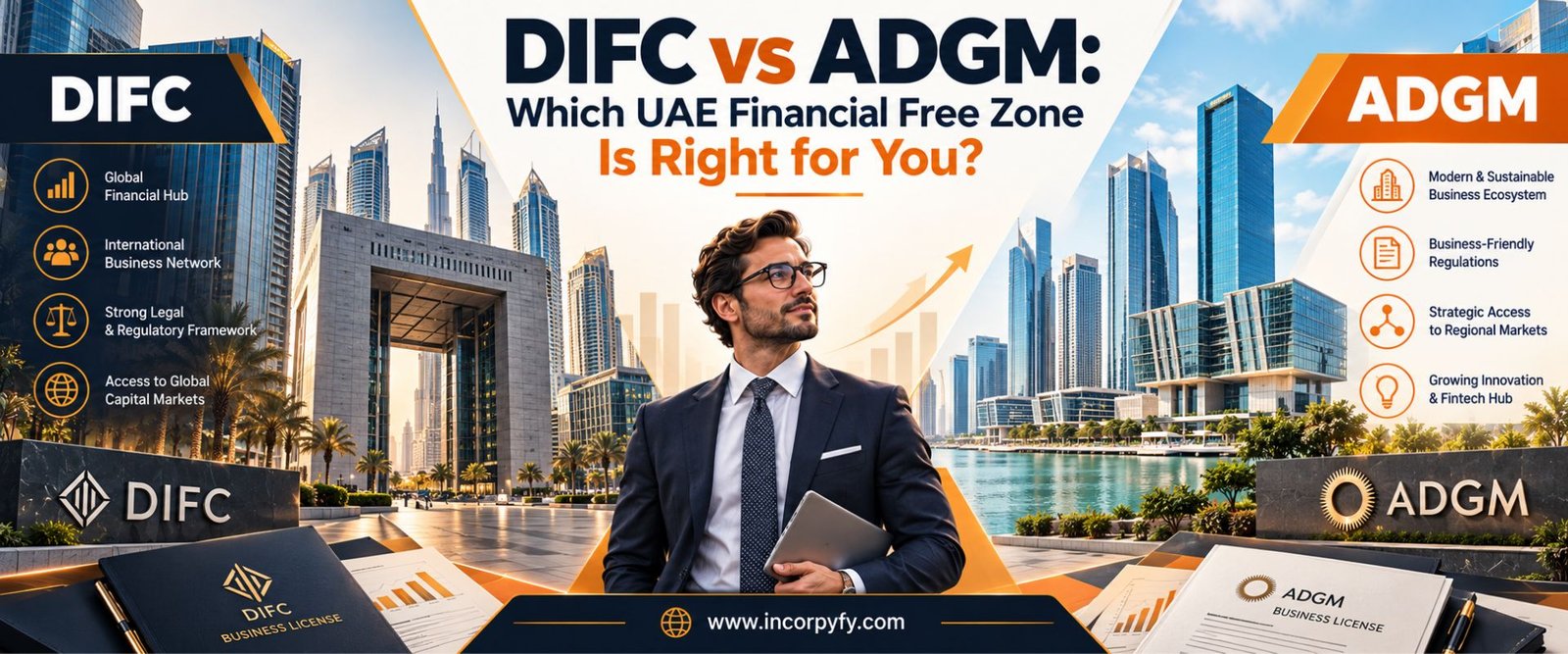
DIFC and ADGM are the UAE’s two leading financial free zones, both operating under English common law with their own courts and regulators. DIFC, based in Dubai, offers a deeper banking and professional services ecosystem, while ADGM, based in Abu Dhabi, offers a more cost-efficient setup and a more mature virtual assets framework. This guide compares both across legal structure, regulation, cost, and business fit.
Introduction
For financial services firms deciding where to set up in the UAE, the choice almost always comes down to two names: DIFC and ADGM. Both are UAE financial free zones built on English common law, both regulate independently of the UAE’s civil law system, and both have become genuine hubs for banking, asset management, and fintech. Yet the two zones are not interchangeable, and the right choice depends heavily on your specific business activity, scale, and growth plans.
This guide compares DIFC and ADGM directly across legal framework, regulation, cost, and business specialization, so you can make an informed decision rather than defaulting to whichever name is more familiar.
DIFC vs ADGM: What They Have in Common (and Where They Differ)
Both DIFC (Dubai International Financial Centre) and ADGM (Abu Dhabi Global Market) share a core structure that sets them apart from other UAE free zones:
- Independent jurisdictions operating under English common law
- Their own dedicated courts, separate from UAE civil courts
- Independent financial regulators distinct from the UAE Central Bank
- 100% foreign ownership and 0% personal income tax, consistent with UAE free zones generally
Where they differ comes down to scale, regulatory maturity in specific areas, and cost structure. DIFC has the larger, more established ecosystem with deeper banking relationships, while ADGM has built a reputation for cost efficiency and a notably more mature regulatory framework for virtual assets, having begun regulating crypto activity years before DIFC’s equivalent regime launched.
Legal Framework: DIFC Courts vs ADGM Courts
Both zones operate independent common law court systems, but the underlying approach differs slightly:
- DIFC Courts apply a body of DIFC-specific statutes and accumulated case law, built up since the centre’s establishment, giving the jurisdiction a well-developed legal precedent system of its own.
- ADGM Courts apply English common law more directly, incorporating English legal principles and precedent with less reliance on a separately built body of local case law.
In practice, both court systems are internationally respected and commonly used in commercial contracts across the region. DIFC also operates the DIFC Wills Service, a distinct regime for non-Muslim residents to register common law wills for UAE assets, which remains one of DIFC’s more unique legal offerings.
Regulatory: DFSA (DIFC) vs FSRA (ADGM): Which Is Better?
- DIFC is regulated by the DFSA (Dubai Financial Services Authority), which launched its virtual assets regulatory regime in 2022.
- ADGM is regulated by the FSRA (Financial Services Regulatory Authority), which began regulating crypto activity back in 2018, years ahead of most global regulators, giving it a more mature, tested framework for digital asset businesses specifically.
Neither regulator is objectively “better” across the board. DFSA’s regime benefits from DIFC’s deeper institutional banking relationships and larger professional services ecosystem, while FSRA’s earlier start in virtual assets gives ADGM a genuine edge for crypto exchanges, custodians, and digital asset businesses specifically. For fintech and asset management more broadly, ADGM’s FinTech Regulatory Laboratory (RegLab) offers a 2 to 4 month sandbox period for testing prototypes, while DIFC’s Innovation License and FinTech Hive accelerator support earlier-stage fintech access to the zone’s investor network, typically reaching market entry within 3 to 6 months for regulated categories.
Business Activities: What Each Zone Specialises In
| Business Type | Typically Stronger Fit |
|---|---|
| Hedge funds and private equity | DIFC, for its deeper HNW investor network and institutional credibility |
| Family offices under roughly USD 10 million | ADGM, with a lower entry threshold than DIFC’s higher family office requirements |
| Crypto exchanges and digital asset custodians | ADGM, given its more mature, established token-approval framework |
| Early-stage fintech and prototyping | ADGM, through RegLab’s flexible sandbox approach |
| Institutional fintech scaling globally | DIFC, for its larger ecosystem and global trust requirements |
| SPVs and holding structures | ADGM, which allows holding structures without a mandatory physical office |
| Non-Muslim succession and wills planning | DIFC, through its dedicated DIFC Wills Service |
DIFC is home to a significantly larger financial ecosystem overall, with 350+ financial institutions registered and a concentration of major global banks, which matters for businesses that depend on deep banking relationships and institutional credibility from day one. ADGM’s ecosystem is smaller but has grown quickly, particularly in fintech, virtual assets, and holding structures where its cost and flexibility advantages are most pronounced.
Cost: DIFC vs ADGM Formation and Annual Fees
Cost is broadly similar between the two zones, with ADGM generally landing slightly lower, particularly for non-financial and holding company structures:
| Cost Factor | DIFC | ADGM |
|---|---|---|
| Non-financial company setup | Higher, variable by license type | Roughly USD 5,500 setup |
| Non-financial annual renewal | Higher, variable by license type | Roughly USD 5,000 annually |
| Regulated financial license (application) | Roughly USD 10,000 to 70,000 depending on category | Roughly USD 5,000 to 30,000 for lower-tier activities |
| Fintech/innovation license (initial) | Roughly USD 8,000 | Roughly USD 10,000 |
| Fintech/innovation license (annual) | Roughly USD 12,000 to 15,000 | Roughly USD 10,000 to 16,200 |
Both jurisdictions apply the UAE’s standard 9% corporate tax rate, with 0% available for Qualifying Free Zone Persons meeting substance and compliance conditions, so tax treatment itself rarely tips the decision between the two. For holding companies and SPVs specifically, ADGM’s exemption from a mandatory physical office requirement creates a meaningful, recurring cost advantage over DIFC’s typically higher office-dependent cost structure.
Location: Dubai Financial Centre vs Al Maryah Island Abu Dhabi
- DIFC is based in the Gate District on Sheikh Zayed Road in Dubai, home to over 5,000 registered firms and the majority of the world’s top 20 global banks, giving it unmatched proximity to Dubai’s broader financial and business community.
- ADGM is based on Al Maryah Island in Abu Dhabi, a purpose-built financial district with a smaller but rapidly growing ecosystem, benefiting from proximity to UAE sovereign wealth funds and Abu Dhabi’s government and institutional investor base.
For businesses whose clients or partners are concentrated in Dubai, DIFC’s location carries obvious practical advantages. For businesses targeting sovereign capital, government-linked entities, or Abu Dhabi-based institutional investors, ADGM’s location is the more natural fit.
Which to Choose: Financial Services Decision Guide
- Choose DIFC if you’re running a hedge fund, private equity firm, or institutional fintech business that depends on deep banking relationships, global brand recognition, and access to DIFC’s dense network of established financial institutions.
- Choose ADGM if you’re an early-stage fintech, crypto or digital asset business, family office under roughly USD 10 million, or a holding/SPV structure where cost efficiency and regulatory flexibility matter more than institutional scale.
- Choose DIFC if your business or your clients require UAE-recognized non-Muslim succession planning through the DIFC Wills Service.
- Choose ADGM if your business is crypto-native, since FSRA’s longer regulatory track record in virtual assets since 2018 gives ADGM a genuine maturity advantage over DIFC’s newer DFSA virtual assets regime.
Neither zone is universally superior. The right answer depends on matching your specific financial activity, target client base, and growth stage to each zone’s actual strengths.
How Incorpyfy Can Help
Choosing between DIFC and ADGM, and structuring your application correctly for either regulator, requires matching your specific financial activity to the zone built for it. Incorpyfy helps financial services firms evaluate both jurisdictions and manages the formation process for whichever zone fits your business.
For a deeper look at DIFC specifically, our guide to starting a business in DIFC covers the full setup process, and our explainer on setting up a holding company in the UAE is useful if a holding structure is part of your plan. If a foundation structure is relevant to your succession or asset-protection planning, our guide to starting a foundation company in DIFC covers that in detail. For ADGM specifically, our guide to SPV company setup in ADGM walks through that structure’s requirements. Our DIFC free zone service page has more on our DIFC formation support. Visit the Incorpyfy homepage to speak with a consultant about which financial free zone fits your business.
Frequently Asked Questions
Is DIFC or ADGM better for fintech?
It depends on your stage. ADGM’s RegLab sandbox and FSRA’s longer track record in virtual assets regulation since 2018 make it a strong fit for early-stage and crypto-native fintech, while DIFC’s larger ecosystem and FinTech Hive accelerator suit fintech businesses scaling toward institutional credibility and global trust.
Which is cheaper, DIFC or ADGM?
ADGM is generally slightly cheaper, particularly for non-financial companies and holding structures, where setup costs run around USD 5,500 compared to DIFC’s typically higher, variable fees by license type.
What’s the difference between DFSA and FSRA?
DFSA regulates DIFC and launched its virtual assets framework in 2022, while FSRA regulates ADGM and has regulated crypto activity since 2018, giving ADGM a more established regulatory track record specifically for digital assets.
Can I set up a holding company in either DIFC or ADGM?
Yes, both support holding company and SPV structures, though ADGM is generally the more cost-efficient choice since it does not require a mandatory physical office for these structures, unlike DIFC.
Which zone is better for a hedge fund or asset manager?
DIFC is generally preferred for hedge funds and asset managers targeting high-net-worth investors, given its deeper institutional banking relationships and more established fund manager ecosystem.
Do DIFC and ADGM have different tax treatment?
No, both apply the UAE’s standard 9% corporate tax rate, with 0% available for Qualifying Free Zone Persons meeting substance requirements, so tax rarely differentiates the choice between the two.
Is ADGM better for crypto businesses than DIFC?
Generally yes. FSRA’s virtual assets framework has been in place since 2018, years longer than DFSA’s 2022 launch, giving ADGM a more mature, tested regulatory process for crypto exchanges and digital asset custodians.
What is the DIFC Wills Service, and does ADGM have an equivalent?
The DIFC Wills Service allows non-Muslim residents to register common law wills covering UAE assets, a distinct offering that remains one of DIFC’s unique legal structures without a direct ADGM equivalent.
Which zone has a larger financial ecosystem?
DIFC, with over 350 financial institutions registered and the majority of the world’s top 20 global banks present, compared to ADGM’s smaller but faster-growing ecosystem.
Can I switch from ADGM to DIFC later as my business scales?
It’s possible but involves a new registration process rather than a simple transfer, so many growing businesses evaluate their long-term scale and target investor base upfront rather than planning to switch zones later.