Summary
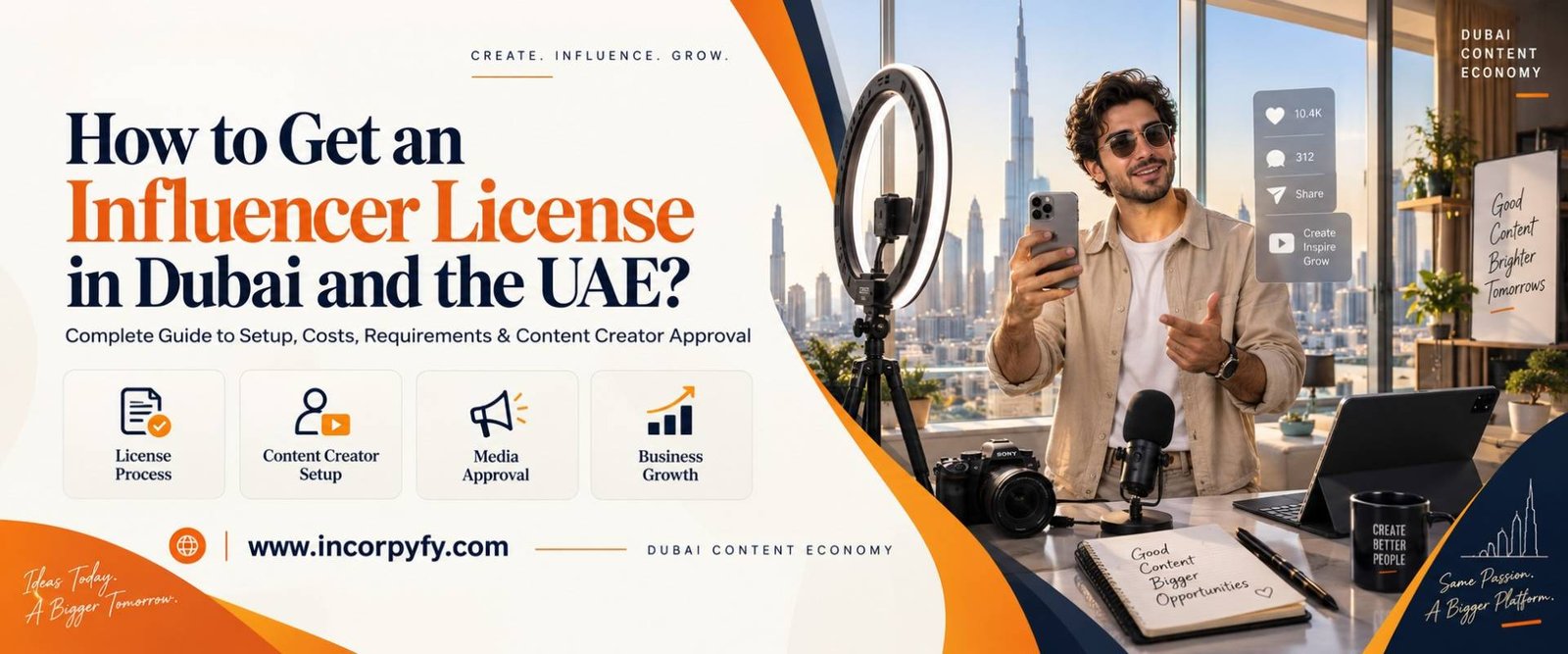
Getting an influencer license in Dubai means securing a trade license, either freelance, free zone, or mainland, plus registration with the National Media Authority and, since 1 February 2026, a paid Advertiser Permit for anyone monetising content, at any follower count. This guide covers real costs, the enforcement rules that changed recently, and a common factual error still circulating: the Advertiser Permit is no longer free.
Dubai has emerged as a global hub for social media influencers, digital marketers, and content creators. With the exponential growth of influencer marketing, the UAE government has introduced specific regulations to legalise and regulate influencer activities. If you’re planning to monetise your content, collaborate with brands, or work as a freelancer in the UAE, obtaining an influencer license is essential, and getting the current rules right matters more than it did even a year ago, since enforcement has genuinely tightened.
What Is an Influencer License in Dubai, UAE?
An influencer license in Dubai is a legal permit that allows content creators, vloggers, bloggers, and social media influencers to promote brands and monetise their online presence legally within the UAE. This license ensures compliance with UAE regulations, protecting influencers and businesses from legal complications.
Regulatory Framework and Authorities
The framework involves multiple bodies. The National Media Authority (NMA), formerly the National Media Council (NMC) and briefly known as the “UAE Media Council” before its most recent rename in late 2025 and early 2026, oversees media-related activities and content regulations federally. For business licensing, content creators need approvals from either the Department of Economy and Tourism (DET) for mainland operations or the relevant free zone authority. These two tracks, media regulation and business licensing, run in parallel and both need to be in order before you can legally monetise content.
Legal Importance of Licensing
Operating without proper licensing exposes content creators to substantial penalties, account restrictions, or legal action. Licensing legitimises your activities, enables business banking, facilitates brand collaborations, and protects your intellectual property and earnings.
Who Needs an Influencer License in Dubai?
If you’re involved in sponsored content, paid promotions, brand collaborations, or even gifted-product posts within the UAE, you need this license. This covers YouTubers and video creators, Instagram, TikTok, and LinkedIn influencers, podcasters running sponsored segments, bloggers publishing sponsored or affiliate content, freelance digital marketers, brand ambassadors, affiliate marketers, and PR firms managing creator campaigns. Critically, the current rules apply regardless of follower count, an earlier informal assumption that only large accounts needed a permit no longer holds, and treating a modest following as an automatic exemption is exactly the kind of outdated assumption that leads to a first-offence fine.
Benefits of Getting an Influencer License in Dubai
- Legal protection: avoid fines and licence suspension for unlicensed commercial activity, and protect your intellectual property and earnings.
- Credibility with brands: licensed creators access premium deals and long-term ambassadorships that unlicensed accounts often can’t secure, since brands increasingly check for it.
- Business independence: operate as a genuine business, hire staff, and scale beyond solo content creation.
- UAE residency and banking access: a licence supports visa sponsorship and opens the door to business banking and credit.
- Tax efficiency: 0% personal income tax on influencer earnings, with no capital gains or wealth tax.
Types of Influencer Licenses in Dubai, UAE
Individual Influencer License (Freelancer Permit)
Suits solo creators wanting lower capital investment and simpler procedures, typically issued through free zones offering dedicated freelancer packages.
Influencer License via Free Zone Company
Free zone company setup offers 100% ownership, the ability to sponsor employees and family, and room to expand into related activities, suited to professional influencers or agencies managing multiple creators.
Mainland Company Setup
Mainland company setup through DET gives unrestricted market access across Dubai and the UAE, suited to established influencers targeting primarily UAE-based audiences and brands.
Step-by-Step Guide to Getting an Influencer License
Step 1: Determine Your Business Model
Decide between a freelance permit, free zone company, or mainland setup based on your ownership preferences, capital, and scalability plans.
Step 2: Select Your Licensing Jurisdiction
Compare mainland Dubai against free zones like Dubai Media City, Fujairah Creative City, twofour54 Abu Dhabi, or Sharjah Media City (SHAMS), covered in more depth below.
Step 3: Register with the National Media Authority (NMA)
All influencers must register with the NMA, the federal body regulating media activities, regardless of business structure.
Step 4: Reserve Your Business Name
Choose a compliant trade name and submit it to DET or your free zone authority for approval.
Step 5: Prepare Required Documentation
Compile your documents in advance, covered in full below, since thorough preparation is what actually speeds up approval.
Step 6: Submit Your License Application
File your application with the chosen authority. Processing typically takes one to three weeks depending on jurisdiction and document completeness.
Step 7: Obtain Additional Regulatory Approvals
Health content may need Dubai Health Authority clearance, financial content needs appropriate disclaimers, and educational content may need specific certification.
Step 8: Receive Your Trade License
Your trade license specifies your permitted activities and validity period.
Step 9: Apply for Your UAE Residency Visa
With your license secured, apply for a UAE residency visa, including medical testing, Emirates ID, and biometrics.
Step 10: Register for the Advertiser Permit
Covered in full detail below, since the rules here have genuinely changed and this is where most existing guides are now out of date.
The Advertiser Permit: What Actually Changed
This is the single most important update on this page, and it directly corrects a claim that circulates widely, including in older versions of guides like this one, and could genuinely cost a creator real money if relied on. The Advertiser Permit is not currently free. It was free during the initial voluntary rollout in 2025, but since mandatory enforcement began on 1 February 2026, the permit carries a fee of approximately AED 370 per licensing cycle.
Key facts as they actually stand today:
- Legal basis: Federal Decree-Law No. 55 of 2023 on Media Regulation, operationalised through Cabinet Resolution No. 20 of 2025 and Decision No. 3 of 2025 issued by the Chairman of the regulatory authority.
- Regulator: the National Media Authority (NMA), the current name after the body formerly known as the National Media Council and, briefly, the “UAE Media Council” was renamed in late 2025 and early 2026.
- Who needs it: any individual, agency, or business producing promotional content for UAE audiences, paid or unpaid, at any follower count. Non-residents targeting UAE audiences or collaborating with UAE-based brands need it too, even if only visiting.
- Enforcement deadline: originally targeted for October 2025, then extended to 31 January 2026, with full enforcement beginning 1 February 2026, not later in the year as some guides still claim.
- Penalties: fines commonly cited up to AED 500,000 for serious or repeat violations, with some sources citing penalties reaching AED 1 million for the most severe cases.
- Adoption: the NMA had issued over 1,800 Advertiser Permits to creators from more than 75 nationalities by late 2025, and reported more than 13,000 registered influencers by mid-2026, genuine evidence this is an actively enforced system rather than a rule on paper.
Apply for the permit through the NMA’s online portal once your trade license covering influencer or advertising activity is active, since the permit application requires a valid license as a prerequisite, not the other way around.
Cost of an Influencer License in Dubai, UAE
- Freelance permit: AED 7,500 to 12,000 annually, depending on the free zone
- Free zone company setup: AED 15,000 to 25,000 for initial setup, including trade license and MOA preparation
- Mainland company license: AED 15,000 to 30,000 depending on activity classification
- NMA registration: approximately AED 3,000 to 5,000 for initial registration
- Advertiser Permit: approximately AED 370 per licensing cycle, since 1 February 2026
- Visa processing: AED 4,000 to 8,000 per person
- Office space: AED 5,000 to 15,000 annually for a flexi-desk, where required
Total realistic investment: a freelance setup typically runs AED 15,000 to 25,000, a free zone company AED 30,000 to 50,000 including first-year operating costs, and a premium mainland setup AED 50,000 to 80,000 or more.
Documents Required
- Valid passport with at least six months’ remaining validity
- UAE visa and Emirates ID, if already resident
- Passport-style photographs
- Business plan outlining content strategy, audience, and monetisation methods
- Social media account documentation and engagement metrics
- NMA registration certificate
- NOC from a current sponsor, if applicable
- Bank reference letter
- Advertiser Permit application or confirmation of exemption status
Legal Compliance and Content Regulations
- Transparency: disclose paid partnerships clearly using recognised tags like #ad or #sponsored, including for gifted products, not just paid campaigns.
- Truth in advertising: no misleading claims, exaggerated results, or false testimonials.
- Cultural sensitivity: respect UAE values, Islamic traditions, and local customs.
- Prohibited content: religious or political commentary that could be seen as inflammatory, explicit content, defamatory statements, and unqualified financial advice.
- Penalties: fines up to AED 500,000 for serious violations, plus license suspension, account restrictions, or deportation for repeated non-compliance.
Choosing the Right Free Zone
- Dubai Media City: the premier destination for established media professionals, with production facilities and industry connections.
- Fujairah Creative City: cost-effective for freelancers and startups, with competitive pricing.
- twofour54 Abu Dhabi: specialises in broadcast, film, and video content, with professional production infrastructure.
- Sharjah Media City (SHAMS): affordable, media-focused, with proximity to Dubai markets.
Common Challenges and Solutions
- High initial cost: start with a freelance permit and transition to a company as revenue grows.
- Complex regulatory requirements: work with experienced business setup consultants who track NMA and DET requirements closely.
- Understanding content compliance: review NMA guidelines directly and take a conservative approach until you fully understand the boundaries.
- Choosing the right jurisdiction: compare costs, visa allocation, and operational flexibility against your actual audience location and budget.
- Maintaining annual compliance: track your trade license renewal and Advertiser Permit cycle separately, since they run on different timelines.
Conclusion
Getting an influencer license in Dubai and the UAE now means clearing two distinct requirements: a trade license authorising the business activity, and an Advertiser Permit from the National Media Authority that, since 1 February 2026, is no longer free and applies regardless of follower count. Understanding these current rules, rather than an outdated version still circulating online, keeps your content creation business genuinely compliant rather than exposed to fines that can reach AED 500,000. This is a field where the rules have shifted meaningfully in the space of a year, so treat any guide, including older versions of this one, with some caution unless it names the specific decree and effective date. For end-to-end support navigating both, business setup in Dubai guidance from Incorpyfy covers licensing, NMA registration, and Advertiser Permit applications together.
Frequently Asked Questions (FAQs)
Is the UAE Advertiser Permit free?
No, not anymore. It was free during the 2025 voluntary rollout, but since mandatory enforcement began on 1 February 2026, it carries a fee of approximately AED 370 per licensing cycle.
Do I need a permit if I have a small following?
Yes. The current rules apply at any follower count, an earlier informal exemption for smaller accounts no longer applies.
What is the difference between the NMC and the NMA?
The National Media Council (NMC), briefly also called the “UAE Media Council,” was renamed the National Media Authority (NMA) in late 2025 and early 2026. It’s the same federal body under its current name.
How much does a full influencer license setup cost?
A freelance setup typically totals AED 15,000 to 25,000, a free zone company AED 30,000 to 50,000, and a premium mainland setup AED 50,000 to 80,000 or more, including NMA registration and the Advertiser Permit.
What happens if I post sponsored content without a permit?
You risk fines commonly cited up to AED 500,000, with more severe violations reported at higher penalties, alongside license suspension or account restrictions.
Do non-residents need the Advertiser Permit?
Yes, if they’re targeting UAE audiences, running paid campaigns in the UAE, or collaborating with UAE-based brands, even if only visiting.
Which free zone is best for content creators?
Dubai Media City suits established professionals wanting premium infrastructure, while Fujairah Creative City and SHAMS suit budget-conscious freelancers, and twofour54 suits video and broadcast-focused creators.
Do I need the permit for unpaid brand collaborations?
Yes, if you receive any commercial benefit, including gifted products, the requirement applies regardless of whether cash payment is involved.