

Summary
IFZA and RAKEZ are two of the UAE’s most cost-competitive free zones, but they serve different priorities. IFZA offers a Dubai address with a broad, consolidated activity list, while RAKEZ offers a lower headline price and stronger manufacturing support from Ras Al Khaimah. This guide compares real costs, visa packages, banking, and location to help you choose the right fit for your SME.
Introduction
IFZA and RAKEZ consistently come up together in free zone comparisons, and for good reason: both are genuinely budget-friendly, both support a wide range of SME activities, and both offer UAE residency through company formation. The headline price difference between them gets a lot of attention, but it rarely tells the full story once visas, activity scope, and your actual business needs enter the picture.
This guide compares IFZA and RAKEZ directly so you can decide based on your real setup cost and business activity, not just the lowest number on a pricing page.
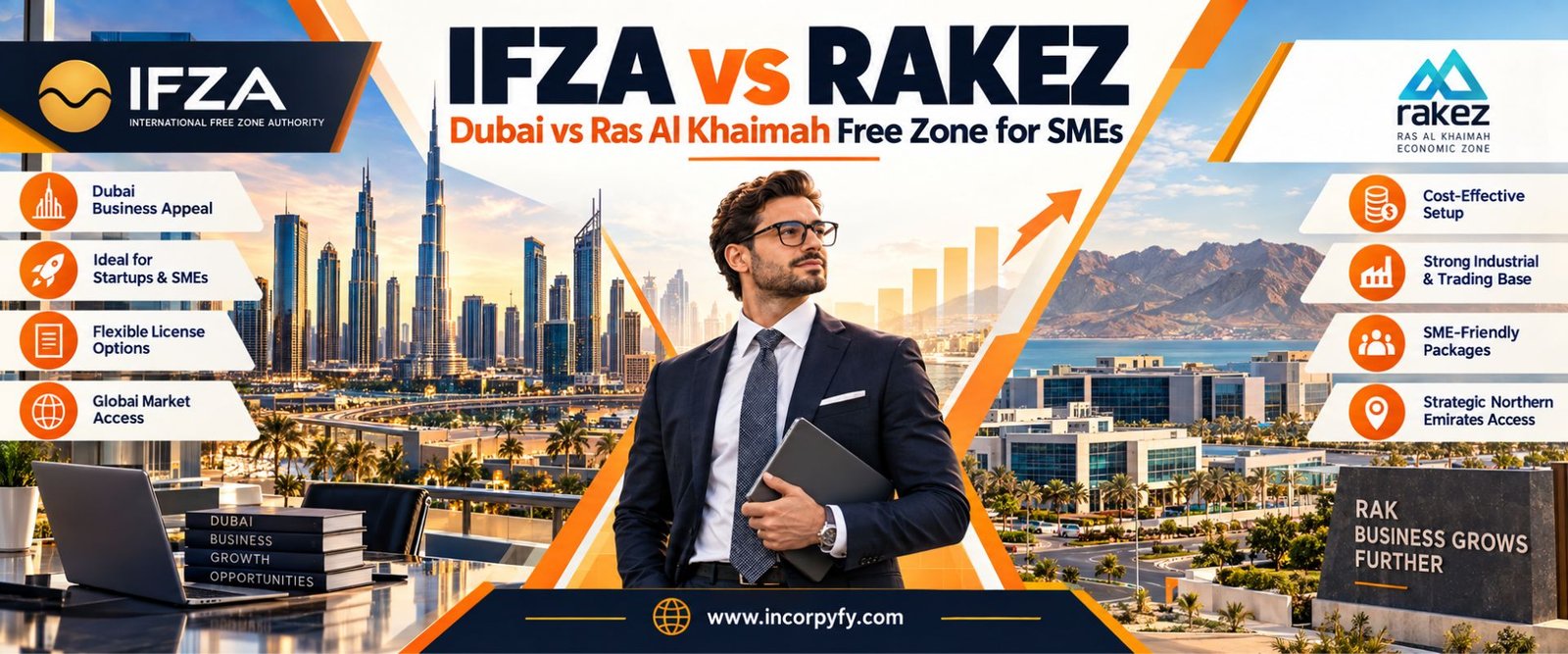
IFZA vs RAKEZ: Quick Comparison Table
| Factor | IFZA | RAKEZ |
|---|---|---|
| Location | Dubai (Dubai Silicon Oasis) | Ras Al Khaimah |
| Starting license cost (0 visa) | From roughly AED 12,500 to 16,500+ | From roughly AED 7,500 to 9,150+ |
| Distance from Dubai | Around 20 km | Around 100 km |
| Activities per license | Broad, consolidated activity list, commonly 3 bundled | Broad range, less consolidated than IFZA |
| Best known for | Services, consultancies, Dubai-based businesses | Manufacturing, industrial, trading |
| Bank account opening | Comparable to RAKEZ | Comparable to IFZA |
License Cost: IFZA from AED 12,500 vs RAKEZ from AED 7,500
On paper, RAKEZ looks significantly cheaper, with zero-visa packages starting from roughly AED 7,500 to 9,150, compared to IFZA’s zero-visa starting point of around AED 12,500 to 16,500 depending on activity and inclusions. This is the number most comparison articles lead with, and it’s accurate as far as it goes.
What it leaves out is what happens once you add a visa, which almost every SME needs from day one. Once a single residence visa is factored in, the cost gap between the two zones narrows considerably, since visa-related government fees (medical testing, Emirates ID, establishment card, and the visa itself) are broadly similar across both zones. In practice, a one-visa RAKEZ package and a one-visa IFZA package often land closer together than the advertised zero-visa prices suggest, so comparing fully loaded costs for your actual visa requirement matters more than comparing the cheapest possible headline figure.
Location: Dubai Silicon Oasis vs Ras Al Khaimah
IFZA is based in Dubai Silicon Oasis, giving licensed companies a genuine Dubai address, roughly 20 km from central Dubai. This matters for businesses where client perception or proximity to Dubai’s commercial districts plays a role in day-to-day operations.
RAKEZ is based in Ras Al Khaimah, around 100 km from Dubai. Importantly, a RAKEZ license does not restrict where you can actually live or work day to day: UAE residence visas function across the country regardless of which emirate issued them, so a RAKEZ visa holder can live and work in Dubai without issue. The practical difference is mainly about the address printed on your license and trade documents, which matters more for certain client-facing or government-facing activities than for daily operations.
Visa Packages: IFZA Defined Packages vs RAKEZ Custom Quota
IFZA typically structures its offering around defined visa package tiers, bundled with the license at set price points, which gives founders clear, predictable upfront pricing for a known visa count.
RAKEZ generally offers more flexibility to scale visa quotas at custom pricing as a business grows, which can work out more cost-effective for businesses planning to add multiple visas over time rather than needing a fixed count from day one.
Beyond the headline license fee, both zones charge broadly comparable government pass-through costs per visa, including medical testing, Emirates ID issuance, and a one-time establishment card fee for first-time applicants. Neither zone holds a dramatic cost advantage once these per-visa costs are factored in at similar visa counts.
Business Activities: What Each Zone Permits
IFZA’s main strength is its consolidated activity list, frequently cited as one of the broadest in the UAE, allowing businesses to combine professional and commercial activities under a single license. This makes IFZA a strong fit for consultancies, agencies, and multi-service businesses that would otherwise need separate licenses elsewhere.
RAKEZ offers a genuinely broad activity range as well, with particular strength in manufacturing, industrial, and trading activities, supported by RAKEZ’s dedicated industrial zones and warehouse infrastructure that IFZA doesn’t offer in the same way. For businesses in manufacturing or heavier industrial activities, RAKEZ’s infrastructure is generally the more practical fit.
Both zones share the standard free zone limitation on direct retail sales to UAE mainland customers, which applies equally regardless of which zone you choose, and generally requires either a mainland license or a local distributor arrangement for direct mainland retail.
Bank Account Opening: Which Is Easier?
Neither IFZA nor RAKEZ holds a decisive advantage here. UAE banks generally evaluate account applications based on the strength and coherence of your business activity and documentation rather than which specific free zone issued your license. That said, UAE banks are broadly familiar with both zones given their popularity, and some banks may give a slight perception edge to a Dubai-addressed IFZA license at certain institutions, though this is not a consistent or guaranteed advantage across all banks.
The more decisive factor for banking success at either zone is a well-documented business plan, clear source of funds, and a coherent activity story, rather than the free zone name on your trade license.
Which Is Right for Your Business?
- Choose IFZA if you want a Dubai-based address, run a services or consultancy business, and want to bundle multiple activities under a single consolidated license.
- Choose RAKEZ if your business is manufacturing, industrial, or trading-focused, and you want access to dedicated industrial infrastructure alongside competitive entry pricing.
- Choose RAKEZ if you’re planning to scale visa count significantly over time and want custom quota flexibility rather than fixed package tiers.
- Choose IFZA if a Dubai address specifically matters for your client base or government-facing documentation.
For most straightforward SMEs without a strong preference either way, the real decision often comes down to your specific business activity and whether you need industrial infrastructure, rather than the headline price difference alone.
How Incorpyfy Can Help
Choosing between IFZA and RAKEZ comes down to matching your business activity, visa plans, and budget to the zone that actually fits, not just picking the lowest advertised starting price. Incorpyfy helps SMEs compare real, fully loaded costs across both zones and manages the registration process end to end.
For a closer look at IFZA specifically, our guide to registering a company in IFZA covers the full setup process, and our IFZA free zone service page has more on our formation support there. For RAK Economic Zone, our guide to starting a business in RAK Free Zone walks through RAKEZ’s setup process in detail, and our RAKEZ free zone service page covers our support there. If you’re comparing more than just these two, our guide to Ajman Free Zone company formation and our broader roundup of the cheapest free zones in the UAE cover additional budget-friendly options. Visit the Incorpyfy homepage to speak with a consultant about which free zone fits your SME.
Frequently Asked Questions
Is IFZA or RAKEZ better for a small business?
It depends on your activity. IFZA suits services and consultancies wanting a Dubai address and consolidated activity licensing, while RAKEZ suits manufacturing, industrial, and trading businesses wanting dedicated infrastructure at a competitive entry price.
Is RAKEZ really cheaper than IFZA?
At the zero-visa level, yes, RAKEZ is noticeably cheaper. Once a visa is added, the cost gap narrows considerably since visa-related government fees are broadly similar at both zones, so comparing fully loaded costs for your actual visa needs matters more than the headline zero-visa price.
Can I live in Dubai with a RAKEZ visa?
Yes. UAE residence visas work nationwide regardless of which emirate issued the license, so a RAKEZ visa holder can live and work in Dubai without restriction.
Which zone is better for manufacturing businesses?
RAKEZ, given its dedicated industrial zones and warehouse infrastructure, which IFZA does not offer in the same way.
Does IFZA or RAKEZ make bank account opening easier?
Neither has a decisive advantage. Banks generally evaluate applications based on your business documentation and activity coherence rather than which specific free zone issued your license.
How many activities can I combine under one license at IFZA or RAKEZ?
IFZA is known for a particularly broad, consolidated activity list that commonly bundles multiple professional and commercial activities under one license, while RAKEZ also supports multiple activities though its structure is generally less consolidated than IFZA’s.
Is IFZA actually based in Dubai?
Yes, IFZA is based in Dubai Silicon Oasis, giving licensed companies a genuine Dubai address, roughly 20 km from central Dubai.
Can a free zone company from either zone sell directly to UAE mainland customers?
Generally no. Both IFZA and RAKEZ free zone licenses are subject to the standard restriction on direct mainland retail sales, typically requiring a mainland license or local distributor arrangement for that specific activity.
Which zone offers more flexible visa scaling?
RAKEZ generally offers more flexibility to scale visa quotas at custom pricing as your team grows, while IFZA typically structures its visas around defined package tiers.
Do I need to visit the UAE to set up with IFZA or RAKEZ?
Both zones support remote incorporation for most standard license categories, though visa processing and bank account opening may require additional steps or, in some cases, a visit.