

Summary
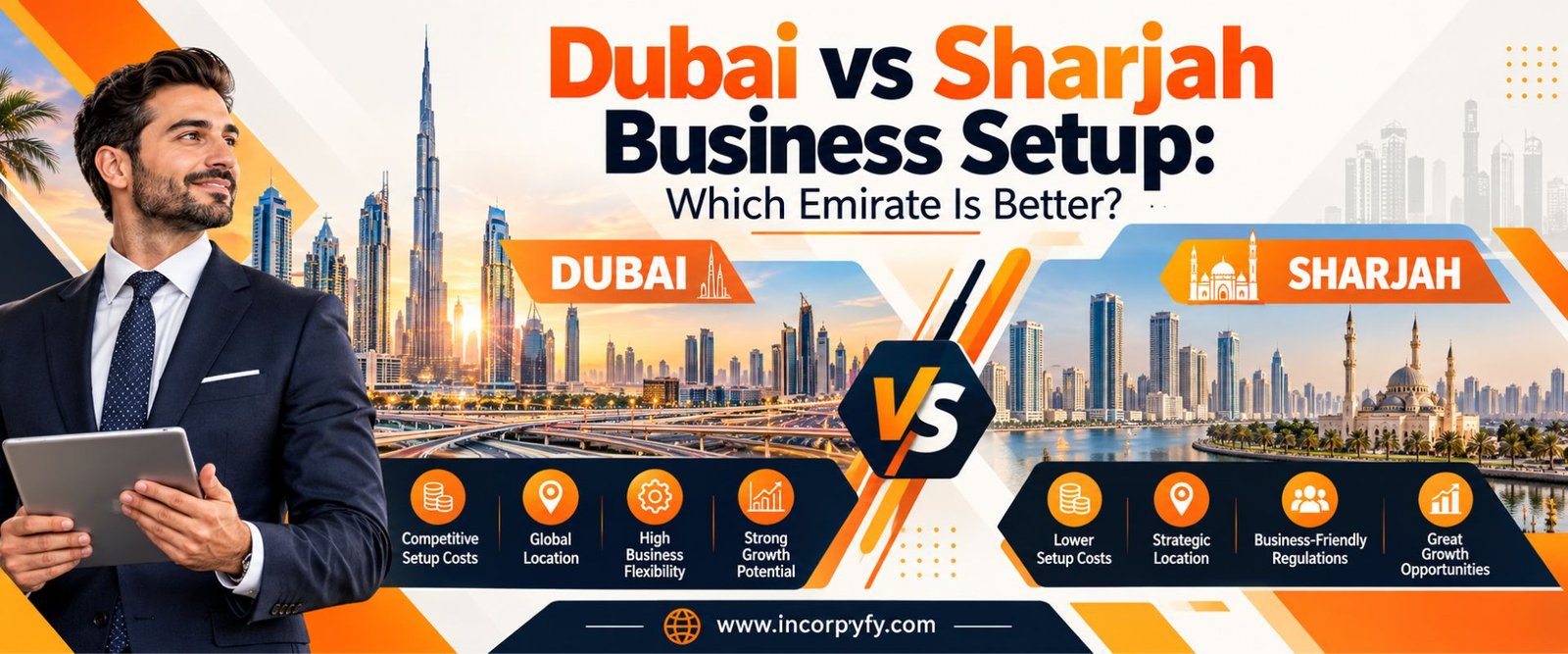
Dubai suits finance, luxury, e-commerce and international-facing companies that need global visibility, while Sharjah suits manufacturing, logistics, printing and cost-sensitive SMEs. Sharjah is usually cheaper on licences and office space, and the two emirates sit minutes apart. This guide compares cost, location, free zones, industries and lifestyle so you can choose the emirate that genuinely fits your business model and budget.
Dubai vs Sharjah: The Business Case for Each
Most founders ask this question for one reason: money. Sharjah borders Dubai, shares the same federal laws, and still tends to cost less. So why doesn’t everyone simply set up in Sharjah? Because cost is only one of several things that decide whether a company grows.
The case for Dubai
- Global brand recognition, which helps with banks, investors and international clients
- The deepest talent pool, financial ecosystem and professional services market in the region
- Jebel Ali Port, Dubai’s airports and a strong re-export network
- Wide choice of free zones, from DMCC and DIFC to IFZA and DAFZA
The case for Sharjah
- Lower licence fees and noticeably cheaper office and industrial space
- Strong manufacturing, warehousing and printing base, with three seaports in the emirate
- Quieter operating environment and lower overheads for small teams
- Free zones such as SAIF Zone, SHAMS and Hamriyah built for specific sectors
Both emirates follow the same federal rules. Corporate tax is 9% on taxable profit above AED 375,000 everywhere in the UAE, 100% foreign ownership is available in free zones and in most mainland activities, and a UAE residence visa works nationwide regardless of which emirate issued it. So the decision comes down to cost structure, market access and fit, not legal ownership.
Cost: Dubai vs Sharjah Setup (Mainland and Free Zone)
Published figures vary between providers and change often, so treat the numbers below as indicative ranges and confirm a written quote before paying anything.
| Cost factor | Dubai | Sharjah |
|---|---|---|
| Regulator (mainland) | Department of Economy and Tourism (DET, formerly DED) | Sharjah Economic Development Department (SEDD) |
| Mainland commercial licence | Often quoted from about AED 25,000 to 50,000 all in | Often quoted from about AED 12,000 to 35,000; licence fees alone around AED 9,500 to 13,000 |
| Office rent | Higher, especially in prime districts | Commonly 10% to 20% cheaper, and industrial space is far cheaper |
| Free zone entry packages | Roughly AED 12,000 and above at popular zones; premium zones cost more | Roughly AED 8,500 to 20,000 headline depending on the zone |
| Real cost vs headline | Add visas, deposits and office | Add roughly 30% to 50% on top of headline in practice |
Three points matter more than the table:
- Rent drives most of the gap. The licence itself is a smaller part of the difference. Office and warehouse rent is what makes Sharjah cheaper year after year.
- Compare total first-year cost, not the headline. Visas, medical, Emirates ID, establishment card, deposits and renewals change the picture quickly.
- Renewals matter. A cheap year one followed by a steep renewal is a common surprise. Ask for the year-two figure upfront.
If you want a Dubai baseline, our breakdown of company formation cost in Dubai for mainland and free zones shows how the numbers build up. For Sharjah, our guide to how to obtain a Sharjah mainland licence explains the SEDD process step by step.
Location and Market Access: Dubai vs Sharjah
Sharjah sits right next to Dubai. Depending on the time of day, getting from Sharjah to Deira can take anywhere from roughly 15 minutes to well over an hour in peak traffic, so the real question is how often you actually need to cross.
- Customers in Dubai: A Sharjah company can serve Dubai clients, but its trade address, and its distance from Dubai’s business districts, may matter to clients who judge by location.
- Logistics: Sharjah offers port access through Khalid Port, Khor Fakkan and Hamriyah, plus Sharjah International Airport with strong cargo links. Dubai offers Jebel Ali and Dubai’s airports.
- Residence: Many Sharjah-licensed founders live in Dubai or Sharjah. Your visa works nationwide, so this is a lifestyle choice rather than a legal one.
- Mainland trading: Free zone companies in either emirate are generally restricted from direct retail sales to mainland customers. They need a mainland licence or a distributor arrangement for that.
Sharjah Free Zones vs Dubai Free Zones
Dubai has dozens of free zones. Sharjah has fewer, but each has a clear identity.
Sharjah’s main free zones
- SAIF Zone: Established, airport-adjacent, strong for trading and light industry. See our guide to registering a company in SAIF Zone.
- SHAMS: Media, creative and freelance-friendly, usually at a lower cost. See our guide to registering a company in SHAMS.
- Hamriyah Free Zone: Port-based and industrial, suited to manufacturing and heavy trade. Read our guide to Hamriyah Free Zone company formation.
- Sharjah Publishing City: Built for publishing, printing and content businesses. See Sharjah Publishing City.
Dubai’s strengths: specialist ecosystems such as DMCC for commodities and crypto, DIFC for financial services, DAFZA for aviation-linked trade and JAFZA for port-based logistics. For a budget Dubai option, our guide to registering a company in IFZA explains one of the most flexible entry points.
How to decide: if your sector has a dedicated Dubai ecosystem, such as finance or commodities, Dubai’s premium is often justified. If you need space, a lower fixed cost and a practical industrial base, Sharjah’s zones are hard to beat. For a wider view, see our roundup of the best free zones in the UAE.
Industry Clusters: Where Each Emirate Excels
Sharjah is strongest for:
- Manufacturing and light to medium industry
- Warehousing, storage and logistics
- Printing, publishing and packaging
- Building materials, trading and distribution
- Education, culture and creative services
Dubai is strongest for:
- Financial services, fintech and professional services
- Luxury retail, hospitality and tourism
- E-commerce, technology and creative agencies
- Commodities, gold and international trading
- Aviation and global logistics
If you are unsure, ask where your customers and suppliers actually are. A factory serving the Northern Emirates gains from Sharjah’s space and cost. A consultancy selling to multinational clients usually gains from a Dubai address.
Quality of Life and Business Environment
Sharjah is more conservative than Dubai. Alcohol sales and consumption are not permitted in the emirate, dress and public conduct norms are stricter, and the weekend and working-week pattern has followed its own approach in the past, so confirm current working days before planning operations. Many families and employees value the quieter pace and lower living costs. Others, especially in hospitality, nightlife or international events, find Dubai a better match.
Dubai offers a larger international community, more entertainment and a denser network of banks, advisers and events. The trade-off is higher rent, higher living costs and more competition for talent.
For staffing, residence visas, Emirates ID and labour rules are federal, so hiring works the same way. Many businesses use a hybrid model: a Sharjah licence and operations base with staff living in whichever emirate suits them best.
A quick decision guide
- Choose Sharjah if you are cost-sensitive, space-heavy, industrial or running a small team with a local or regional customer base.
- Choose Dubai if brand image, international clients, banking depth or a specialised free zone ecosystem drive your revenue.
- Consider a mainland licence in either emirate if you want to trade freely across the UAE. Our guide to opening a mainland company in Dubai covers that route.
How Incorpyfy Can Help
Choosing an emirate is easier when someone compares real quotes against your actual plans. Incorpyfy reviews your activity, headcount and customers, then manages setup in either emirate. Explore our business setup in Sharjah service, our Dubai business setup service and our Dubai mainland company formation page. Visit the Incorpyfy homepage to speak with a consultant.
For official references, see the UAE Government portal, the UAE Ministry of Finance corporate tax pages and the Federal Tax Authority.
FAQs
Is it cheaper to set up a business in Sharjah than Dubai?
Usually yes. Licence fees and especially office and industrial rent tend to be lower in Sharjah, though the true saving depends on your activity, visas and zone.
Can I live in Dubai with a Sharjah licence?
Yes. UAE residence visas work nationwide regardless of the issuing emirate.
Which is better for manufacturing, Dubai or Sharjah?
Sharjah, thanks to its industrial areas, lower rents and port access, with Hamriyah and SAIF Zone as popular options.
Which is better for a consultancy or finance business?
Usually Dubai, given its financial ecosystem, brand recognition and client base.
Do Sharjah and Dubai pay different corporate tax?
No. Corporate tax is federal: 9% above AED 375,000, with 0% only for Qualifying Free Zone Persons on qualifying income.
Can a Sharjah free zone company sell in Dubai?
It can serve Dubai clients in many B2B cases, but direct mainland retail generally needs a mainland licence or a distributor.
Is 100% foreign ownership allowed in both emirates?
Yes, in free zones and in most mainland activities.
Is Sharjah stricter than Dubai?
Socially, yes. Alcohol is not permitted and cultural norms are more conservative, which can matter for hospitality and events businesses.
What is the best Sharjah free zone for a small business?
It depends on your activity. SHAMS suits media and freelancers, SAIF Zone suits trading, and Hamriyah suits industrial work.
Can I move from a free zone to the mainland later?
Yes, through a separate licensing process. See our guide to converting a free zone company to mainland Dubai.