


Summary
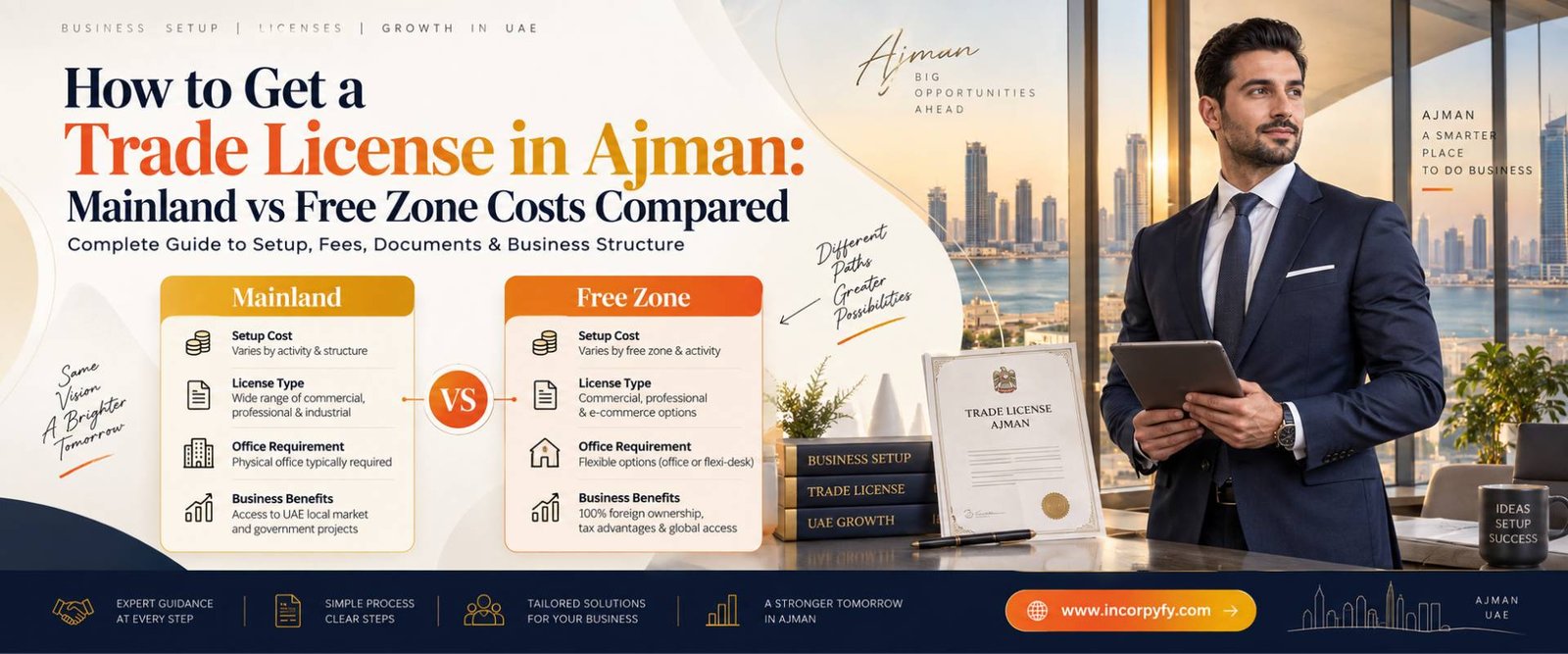
Getting a trade license in Ajman means choosing between the Ajman DED (mainland), Ajman Free Zone (AFZA), or Ajman Media City, each with genuinely different costs, visa quotas, and ownership rules. This guide compares Ajman directly against Dubai’s pricing, breaks down real 2026 fee ranges for each path, and covers the Taziz fee exemption programme most guides never mention.
Ajman is consistently cited as one of the most affordable places to license a business in the UAE, but “affordable” only means something once you see it next to the alternative. Most guides to this topic repeat the same generic process regardless of which emirate is in the title, which is exactly why it is hard to tell Ajman’s actual advantages from marketing language borrowed off a Dubai or Sharjah template. This guide compares Ajman’s real costs against Dubai and other emirates, breaks down the difference between an Ajman DED mainland license, Ajman Free Zone (AFZA), and Ajman Media City, and covers a fee exemption programme genuinely unique to this emirate that most competing articles never mention.
How Ajman Compares to Dubai and Other Emirates
Before the process, the number that actually drives most people’s decision: how much cheaper is Ajman, really?
| Jurisdiction | Entry-Level Cost | Notes |
|---|---|---|
| Ajman Free Zone (AFZA), zero-visa | From around AED 5,555 | License only, no residency visa attached |
| Ajman Media City, Business Club package | From around AED 4,888 | Zero-visa, no establishment card, cannot add a visa without upgrading |
| Ajman DED mainland, license only | From around AED 12,000 | Add AED 18,000 to 22,000 with one visa |
| Dubai mainland (DET) | From around AED 15,000 | Excludes office costs, which typically add AED 20,000 to 50,000 per year |
| Dubai free zone (e.g. IFZA) | From around AED 10,900 | Usually includes one residency visa |
| Umm Al Quwain Free Trade Zone | Around AED 12,500 all-in | Comparable budget alternative outside Ajman |
Ajman’s mainland licence runs roughly 30 percent cheaper than Dubai’s for a comparable setup, mainly because office rent and government fees are both lower across the emirate. If your business genuinely needs to trade with UAE government entities or sit physically close to Dubai clients, this gap is worth knowing before you default to Dubai’s mainland trade license simply because it is the more heavily marketed option. The reverse is also true: if your activity depends on a Dubai-based address for client perception or logistics, Ajman’s savings may not offset the trade-off, so treat this table as a starting comparison rather than an automatic answer.
Ajman DED, Ajman Free Zone, or Ajman Media City: Choosing Your Authority
Ajman actually runs three separate licensing paths, and picking the wrong one is the most common source of buyer’s remorse in this market, since each carries a different cost structure, visa quota, and long-term flexibility profile.
- Ajman DED (mainland): issues licenses for businesses trading directly within Ajman and across the wider UAE, including government contracts. Offers unlimited visa quotas, unlike free zone packages, and since 2021 has opened more than 1,000 economic activities to 100 percent foreign ownership in commercial and industrial sectors.
- Ajman Free Zone (AFZA): the emirate’s flagship free zone, established in 1988 and now home to more than 9,000 companies from over 165 countries across roughly 1,500 licensed activities. Offers FZE (single shareholder), FZC (multiple shareholders), and branch structures, plus a dedicated freelancer’s license and a young entrepreneurs’ innovative business license for early-stage founders.
- Ajman Media City: a separate, smaller free zone focused on media, creative, and consulting activities, known for its low entry-level packages, though its cheapest tier excludes an establishment card, meaning no visa can be issued without upgrading.
Free zone packages cap visas, typically at three to six per license, while mainland licenses through Ajman DED do not, an important distinction if you plan to grow your team beyond a handful of staff.
Types of Trade Licenses Issued in Ajman
- Commercial License: for businesses buying and selling goods, including general and specialised trading activities.
- Professional License: for service providers such as consultants, marketing agencies, and IT firms serving clients locally and internationally.
- Industrial License: for manufacturing and industrial activities, with dedicated warehouse and production facilities available through AFZA.
- E-Commerce License: for businesses selling goods and services online, a category that has grown quickly across both DED and AFZA.
Step-by-Step Process to Get a Trade License in Ajman
Step 1: Choose Your Business Activity
Select from Ajman DED’s or AFZA’s published activity list. This determines your license category and whether any external approval applies.
Step 2: Decide Your Authority and Company Structure
Choose between Ajman DED, AFZA, or Ajman Media City using the comparison above, then select your legal structure, LLC, sole establishment, FZE, or FZC.
Step 3: Register Your Trade Name
Reserve a unique trade name that complies with Ajman’s naming guidelines through your chosen authority’s portal.
Step 4: Submit Initial Approval Request
File your application and supporting documents for preliminary approval from Ajman DED or your chosen free zone authority.
Step 5: Secure Your Office Space
Lease commercial premises for a mainland license, or use the flexi-desk or facility options bundled into most AFZA and Ajman Media City packages.
Step 6: Submit Final Documents and Pay Fees
Submit your finalised documents, tenancy contract, passport copies, and business plan, then pay the applicable license and registration fees.
Step 7: Collect Your License
Once approved, collect your official trade license and, where applicable, begin your visa applications.
Documents Required for an Ajman Trade License
- Trade name approval certificate
- Passport and visa copies for all shareholders and directors
- Tenancy contract or facility agreement
- Business activity approval, plus any external authority approval your activity requires
- Initial approval certificate from your chosen authority
Real Cost Breakdown by Path
Ajman Free Zone (AFZA):
- Zero-visa package: from AED 5,555 for the license, or around AED 8,200 all-in with an establishment card and desk
- Higher visa-tier packages scale up from there, since AFZA prices most bundles by visa allocation
Ajman Media City:
- Business Club (zero-visa) package: from around AED 4,888, but with no establishment card, so no visa can be added without an upgrade
Ajman DED (mainland):
- License only: from around AED 12,000
- License plus one visa: AED 18,000 to 22,000
- License plus two to three visas: AED 25,000 to 35,000
Across all three paths, renewal costs generally track close to the original package for free zones, since visa-inclusive bundles renew as a unit, while mainland renewals often drop once one-time registration charges fall away. VAT at 5 percent applies to license and service fees themselves, so confirm whether any quote you receive is inclusive or exclusive before comparing two offers directly, since this alone can make one provider’s quote look artificially cheaper than another’s.
How Long Does It Take to Get a Trade License in Ajman?
Most straightforward applications clear in 3 to 5 working days once documents are complete, with free zone pre-approved packages sometimes issuing even faster. Mainland setups needing external activity approvals, or any application with incomplete documentation, can extend to 1 to 3 weeks. Confirm your specific activity’s approval requirements before assuming the fastest timeline applies to you.
A Fee Exemption Programme Most Guides Don’t Mention
Ajman DED runs two dedicated entrepreneur support programmes, Taziz and Reyada, that genuinely differentiate the emirate from a simple “cheaper than Dubai” pitch. Entrepreneurs registered under these programmes receive exemption from local government fees for five years on external licenses and three years on household-based licenses. This sits on top of the already lower baseline costs above and is specifically aimed at first-time founders and small home-based businesses. Ajman DED has also run dedicated Entrepreneurship Week events to enrol founders directly into these programmes, a level of hands-on small business support that rarely appears in generic UAE trade license comparisons, worth checking eligibility for before assuming the standard fee schedule applies to you.
Foreign Ownership and Local Sponsor Rules
Since 2021, Ajman DED has approved more than 1,000 economic activities in commercial and industrial sectors for 100 percent foreign ownership, mirroring the federal Commercial Companies Law reform. A narrow list of strategic-impact activities still requires Emirati participation. In Ajman Free Zone and Ajman Media City, 100 percent foreign ownership has always applied as standard, with no local partner required at any point. For mainland activities that do still require local involvement, a Local Service Agent, a UAE national paid a fixed fee for government liaison, is the typical arrangement rather than an equity partner.
Renewal of Your Ajman Trade License
- Prepare your updated tenancy contract or facility agreement and any changed shareholder documents.
- Submit your renewal application to Ajman DED or your free zone authority.
- Pay the renewal fee.
- Collect your renewed license before the previous one expires.
Missing your renewal date risks fines and, eventually, suspension of your ability to trade, renew visas, or open banking facilities, so track your expiry date well ahead of time rather than at the deadline.
Common Mistakes to Avoid
- Comparing a zero-visa headline price against a visa-inclusive package: these are not the same product, and the cheapest advertised figure often excludes the establishment card you actually need.
- Choosing Ajman Media City’s entry tier assuming a visa is included: the Business Club package specifically excludes the establishment card required to sponsor one.
- Defaulting to Dubai mainland without checking Ajman DED: for businesses that don’t specifically need a Dubai address, the roughly 30 percent cost gap is real and recurring, not a one-time saving.
- Overlooking Taziz and Reyada eligibility: first-time founders who qualify are leaving a genuine, multi-year fee exemption on the table by not checking.
- Assuming free zone and mainland visa quotas work the same way: free zones cap visas per package; Ajman DED mainland licenses do not.
- Skipping the VAT question when comparing quotes: a quote that looks cheaper may simply be excluding the 5 percent VAT another provider already included, so always ask which basis you are comparing.
Which Businesses Actually Suit Ajman
The cost comparison above only tells half the story. Ajman genuinely suits some business models better than others:
- Import-export and light manufacturing: AFZA’s warehouse and industrial facilities, combined with Ajman Port access, make it a strong fit for businesses moving physical goods rather than purely digital services.
- Small teams planning to grow headcount: Ajman DED’s unlimited visa quota is a real advantage over free zone caps once you plan to hire beyond three to six staff.
- First-time founders and home-based businesses: the Taziz and Reyada fee exemptions specifically target this group, making Ajman meaningfully cheaper than the headline comparison table already suggests.
- Media, creative, and consulting freelancers: Ajman Media City’s low entry packages work well here, provided you budget for the establishment card upgrade if you need a visa.
Businesses that specifically need a Dubai postcode for client perception, or that depend on being physically inside a Dubai free zone cluster for networking and partnerships, are the clearest case where Ajman’s savings may not offset the trade-off, and business setup in Dubai remains the better starting point.
Conclusion
A trade license in Ajman remains one of the most cost-effective entry points into the UAE market, but only if you choose the right authority for your actual business rather than the cheapest headline number. Ajman DED suits businesses wanting unlimited visa capacity and UAE-wide trading rights, while AFZA and Ajman Media City suit leaner, internationally focused setups that don’t need a physical mainland presence. Compare this directly against business setup in Dubai if your client base is genuinely split between the two emirates, and factor in the Taziz and Reyada programmes if you qualify as a first-time founder, since that alone can change your effective cost for years, not just your first invoice. For a setup plan matched to your specific activity and budget, explore business setup in Ajman before you commit to a package.
Frequently Asked Questions
How much does it cost to get a trade license in Ajman?
Free zone packages start from around AED 5,000 for a zero-visa license, while a mainland license with one visa typically runs AED 18,000 to 22,000. The right figure depends heavily on your authority and visa needs.
How long does it take to get a trade license in Ajman?
Most straightforward applications clear in 3 to 5 working days, extending to 1 to 3 weeks if external approvals or incomplete documents are involved.
Can foreigners fully own a company in Ajman?
Yes. Ajman Free Zone and Ajman Media City have always allowed 100 percent foreign ownership. Ajman DED now permits it across more than 1,000 mainland activities following the 2021 reform, excluding a narrow list of strategic-impact sectors.
Is Ajman cheaper than Dubai for a trade license?
Yes, generally. Ajman’s mainland license runs roughly 30 percent cheaper than Dubai’s for a comparable setup, and its free zone entry packages start well below most Dubai-based alternatives.
What is the Taziz programme?
An Ajman DED initiative exempting registered entrepreneurs from local government fees for five years on external licenses and three years on household-based licenses, aimed at first-time founders and small home businesses.
Do I need a local sponsor for a trade license in Ajman?
Not for free zone setups, which have always allowed full foreign ownership. For the narrow list of mainland activities still requiring local involvement, a Local Service Agent is the typical arrangement rather than an equity partner.
How many visas can I get with an Ajman trade license?
Free zone packages typically cap visas at three to six depending on the tier purchased. Ajman DED mainland licenses do not cap visa quotas.
Can I run an online business with a trade license in Ajman?
Yes. Both Ajman DED and AFZA issue dedicated e-commerce licenses for businesses selling goods and services online, locally and internationally.
What is the difference between AFZA and Ajman Media City?
AFZA is the larger, multi-sector free zone covering roughly 1,500 activities including trading and industrial work. Ajman Media City is smaller and focused on media, creative, and consulting activities, with lower entry-level pricing but a zero-visa tier that excludes an establishment card.
Do I need a physical office for an Ajman trade license?
Mainland licenses through Ajman DED require a genuine leased premises. Free zone packages through AFZA and Ajman Media City generally bundle a flexi-desk or shared facility into the license cost instead.