

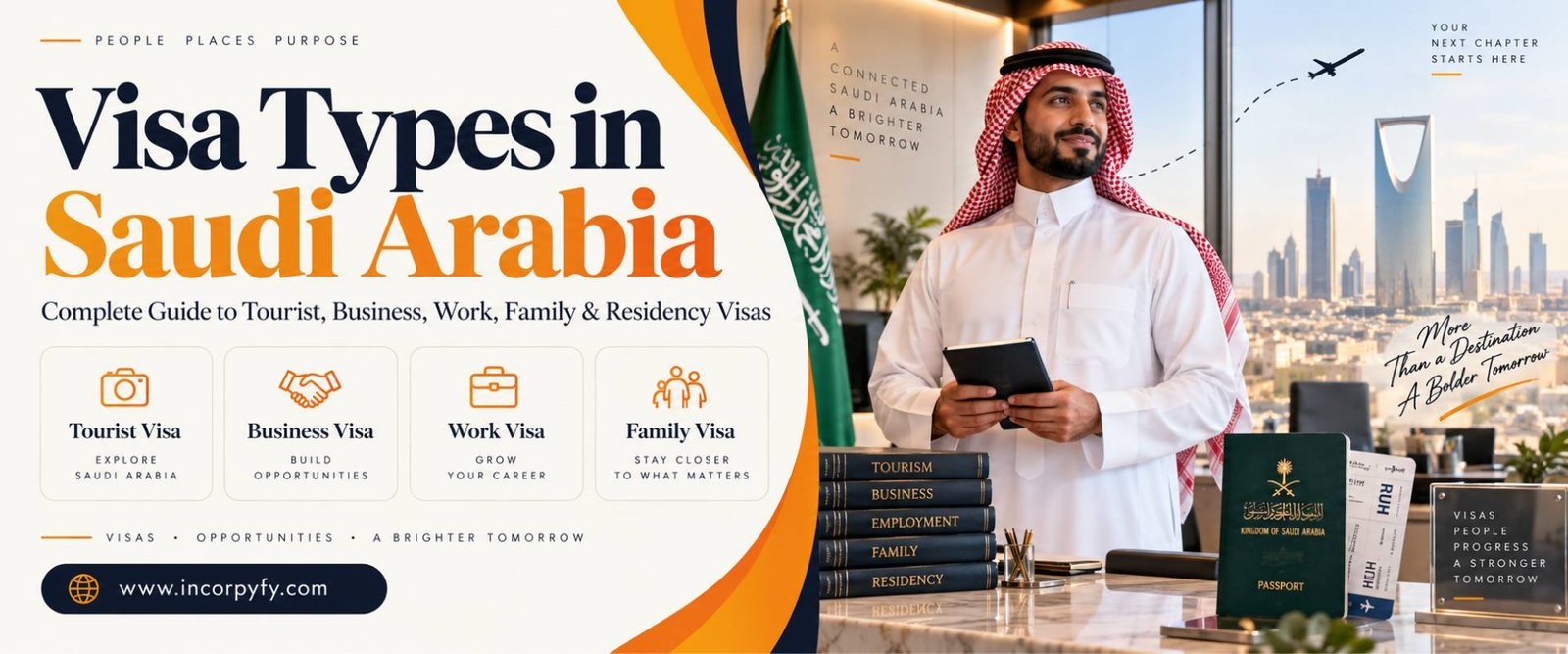

Summary
Saudi Arabia offers distinct visa categories for tourism, business, work, family, pilgrimage, study, and long-term residency, each with its own real cost and validity period, from a SAR 480 tourist e-visa to a SAR 800,000 permanent Premium Residency. This guide covers every major visa type with actual fees, the newly confirmed GCC unified tourist visa, and how a Government Relations Officer can smooth the process for businesses sponsoring staff.
Getting the right Saudi Arabia visa is your first step whether you’re visiting for business, work, tourism, or planning to live in the Kingdom long-term. Saudi Arabia’s visa system has changed substantially over the past few years under Vision 2030, expanding tourist eligibility, introducing skill-tiered work permits, and building toward a region-wide unified visa. This guide, from a business setup company working across Saudi Arabia and the wider Gulf, walks through every major visa type with real costs and validity periods, not just categories and generic descriptions.
Saudi Arabia’s Visa System at a Glance
Saudi Arabia issues visas based on purpose of travel, and each category carries distinct requirements, fees, and processing timelines. Since launching its tourist e-visa in 2019, a historic first for the Kingdom, Saudi Arabia has steadily expanded eligibility and streamlined applications as part of a push toward 150 million annual visitors by 2030, a target it is already on track to meet or exceed. The system spans short-term visit visas, employer-sponsored work permits, religious pilgrimage visas, and a genuinely flexible long-term residency track for investors and high-net-worth individuals, each governed by its own set of documentation and eligibility rules rather than a single unified process.
Major Visa Types in Saudi Arabia
Tourist Visa
- Cost: SAR 480 to 535 for most nationalities, including mandatory medical insurance; SAR 300 for GCC residents
- Validity: 1 year, multiple entry
- Stay per visit: Up to 90 days
- Eligible nationalities: Over 49 countries, including the US, UK, EU member states, Canada, Australia, and Japan
- Purpose: Tourism, leisure, events, and family visits, though religious travel to Makkah specifically for Hajj is not covered
Business Visa
A Saudi Arabia business visa is for individuals travelling for meetings, partnerships, or commercial activities without taking up local employment.
- Cost: SAR 800 to 2,000
- Requires: An invitation letter from a Saudi-registered company
- Types: Single-entry and multiple-entry
- Stay duration: Up to 90 days per visit
You cannot work under this visa, but it’s the standard route for exploring business setup opportunities in Saudi Arabia before committing to a structure.
Work Visa
- Cost: Roughly SAR 3,000 in core fees (medical, Kingdom ID, stamping, entry permit, basic insurance), plus a visa authorisation or quota fee through Qiwa ranging SAR 2,000 to 7,000 depending on the employer’s Saudization classification and sector, bringing the realistic total to SAR 5,000 to 10,000 per employee, typically employer-borne
- Requires: A confirmed job offer, valid employment contract, medical fitness test, and attested educational documents
- Classification: Since 2025, work permits are grouped into High-Skilled, Skilled, and Basic tiers with different salary thresholds, replacing a flatter classification system
- Validity: Initially short-term, then converted into an Iqama (residency permit) once employment begins
Family Visit Visa
- Issued to: Parents, children, spouses, and siblings of legal residents or citizens
- Stay duration: 90 days, extendable up to 180 days
- Not valid for: Employment or education
- Process: Online application through the Ministry of Foreign Affairs portal
Hajj Visa
- Available once a year during Hajj season, issued through approved travel agents
- Requires proof of vaccination and round-trip tickets
- Valid for the duration of the pilgrimage only
Umrah Visa
- Now available year-round, a change from the older Hajj-season-only restriction
- Valid for 30 days
- Does not permit non-religious tourism in other cities
- Applied through the official Nusuk platform or approved travel agents
Student Visa
- Requires a university admission letter, valid passport, academic records, and proof of financial support
- Extendable based on the length of the study programme
Resident Visa (Iqama)
After arriving on a work visa, individuals apply for an Iqama, the residency permit that also functions as an official ID within the Kingdom.
- Allows legal stay and employment
- Required for opening bank accounts, renting property, and sponsoring family
- Renewable annually
Dependent Visa
- Cost: Roughly SAR 2,150 per dependent
- Sponsored by the main Iqama holder, covering spouse, children, and in some cases parents
- Does not permit employment, though it allows children to attend school
- A minimum sponsor income is generally required, commonly cited around SAR 4,000 for a spouse or child and higher for sponsoring parents
Freelance Permit
A category often missed in generic visa guides: freelancers can register a freelance work document with the Ministry of Human Resources and Social Development through the Musaned platform, covering select professions, without needing a free zone licence, since Saudi Arabia does not operate the UAE-style free zone freelance model.
Investor Visa (Saudi Premium Residency)
Saudi Arabia’s Premium Residency programme, informally called the Saudi Green Card, allows qualifying foreigners to reside without a local sponsor.
- Limited duration: SAR 100,000 per year, renewable for 1 to 5 years at a time, no employer sponsor needed
- Permanent residency: SAR 800,000 as a one-time payment
- Category-specific permits for talented professionals, investors, and entrepreneurs: from SAR 4,000, often via ministry nomination rather than a flat fee
- Golden investor route: qualifying with either SAR 2 million in property or SAR 500,000 invested in a Saudi business
This is the most flexible residency option in the Kingdom, and the right choice depends heavily on whether you value the lower recurring cost of the annual option or the one-time certainty of permanent residency, alongside how confident you are that your circumstances in Saudi Arabia will remain stable enough to justify the larger upfront commitment.
Visa Validity, Extensions, and Overstay Penalties
- Tourist and business visas: 1-year validity, multiple entries, 90 days per visit
- Visit visas: usually 90 days, extendable up to 180 days
- Work visas: valid for the duration of the employment contract
- Iqama: annual renewal required
- A 30-day grace period for expired visit visas was introduced in June 2025, softening what used to be a harder cutoff
Overstaying carries real financial risk: a daily fine of roughly SAR 100 applies, with first-time overstays risking fines up to SAR 15,000 plus deportation. Employers who fail to report overstaying workers face their own exposure, with penalties reported as high as SAR 50,000 alongside imprisonment and deportation risk, so businesses sponsoring staff have a direct compliance interest in tracking visa status, not just the individual.
The Upcoming GCC Unified Tourist Visa
This is a genuinely significant development most existing guides haven’t caught up with. Saudi Arabia’s Tourism Minister confirmed at the Manama Forum in November 2025 that a Schengen-style unified tourist visa across all six GCC states, Saudi Arabia, the UAE, Oman, Kuwait, Bahrain, and Qatar, is on track for a 2026 launch, with officials describing the timeline as “2026, maximum 2027.” Once implemented, a single visa would grant multi-entry access across all six countries for up to 90 days, though the technical roadmap still requires deeper security alignment and a shared digital immigration platform before a firm launch date is confirmed. The six member states have reportedly completed the technical roadmap for a single-window application platform, but real-time data-sharing protocols and harmonised security vetting across six sovereign states remain the harder work still ahead. Anyone planning multi-country Gulf travel or business trips over the next year or two should watch this development closely rather than assuming it’s already active.
Saudi Arabia Visa Application Process
- Choose the correct visa type for your purpose of travel
- Prepare your documents
- Apply online through the relevant government portal, or through a Saudi embassy where required
- Pay the applicable fee
- Attend a biometric or medical check, where required
- Track your application status
- Collect your visa or eVisa confirmation
Documents Required for a Saudi Arabia Visa
- Valid passport with at least 6 months’ validity remaining
- Passport-size photographs
- Completed visa application form
- Flight and hotel bookings, for tourist applications
- Invitation letter, for business visas
- Medical certificate, for work and study visas
- Proof of relationship, for family and dependent visas
- Financial statements, where required
Common Reasons for Saudi Visa Rejection
- Incomplete or inconsistent documentation
- A passport nearing expiry
- A prior overstay history
- An unclear or poorly evidenced purpose of visit
- Any indication of intended unauthorised employment
How a Government Relations Officer Helps With Visa and Iqama Processing
Businesses sponsoring staff, managing multiple Iqama renewals, or navigating the newer skill-tiered work visa classification often rely on a Government Relations Officer (GRO) to handle this ongoing administrative load rather than assigning it to internal staff without local regulatory experience. A GRO manages visa applications, Iqama renewals, Qiwa quota compliance, and government liaison on an ongoing basis, which matters more as your Saudi workforce grows and the volume of overlapping renewal dates becomes genuinely difficult to track manually, particularly once dependents, multiple nationalities, and varying visa validity periods enter the picture.
Conclusion
Whether you’re visiting for business, family, tourism, or planning a long-term move, choosing the right Saudi Arabia visa category, and budgeting for its real cost, is what keeps the process smooth rather than a source of delays and fines. From a SAR 480 tourist e-visa to an SAR 800,000 permanent Premium Residency, each category serves a genuinely different purpose, and the upcoming GCC unified visa may reshape short-term travel planning within the next year. For businesses managing visa sponsorship, staff Iqamas, or company setup alongside it, business setup consultants in Saudi Arabia can guide the process end to end, and if your plans also extend into the UAE, business setup in Dubai support can help align both markets.
Frequently Asked Questions (FAQs)
What is the easiest visa to get for Saudi Arabia?
The tourist e-visa is the simplest for short visits, available online for over 49 nationalities with minimal documentation and processing that can take as little as 30 minutes.
Can I convert a tourist visa to a work visa in Saudi Arabia?
No. You must exit and re-enter the Kingdom with an approved work visa sponsored by a Saudi employer.
How long does it take to get a Saudi business visa?
Typically 3 to 7 business days, depending on the invitation letter and processing channel.
Is medical insurance required for Saudi visas?
Yes, it’s included in the tourist e-visa fee and mandatory for most visa categories, including business and work visas.
What is the Saudi Premium Residency visa?
A long-term investor residency programme allowing foreign nationals to live, work, and own property in Saudi Arabia without a local sponsor, available as a renewable annual permit (SAR 100,000/year), a one-time permanent option (SAR 800,000), or category-specific permits from SAR 4,000.
How much does a Saudi work visa actually cost?
Core fees run around SAR 3,000, but including the Qiwa visa authorisation fee, the realistic total is SAR 5,000 to 10,000 per employee, generally paid by the employer.
Is there a unified visa for the whole GCC region?
Not yet, but a Schengen-style unified tourist visa across all six GCC states has been confirmed for a 2026, possibly 2027, launch, allowing multi-entry travel across the region on a single visa once implemented.
Can I work as a freelancer in Saudi Arabia without a company sponsor?
Yes, for select professions, through a freelance work document registered with the Ministry of Human Resources and Social Development via the Musaned platform, without needing a free zone licence.