

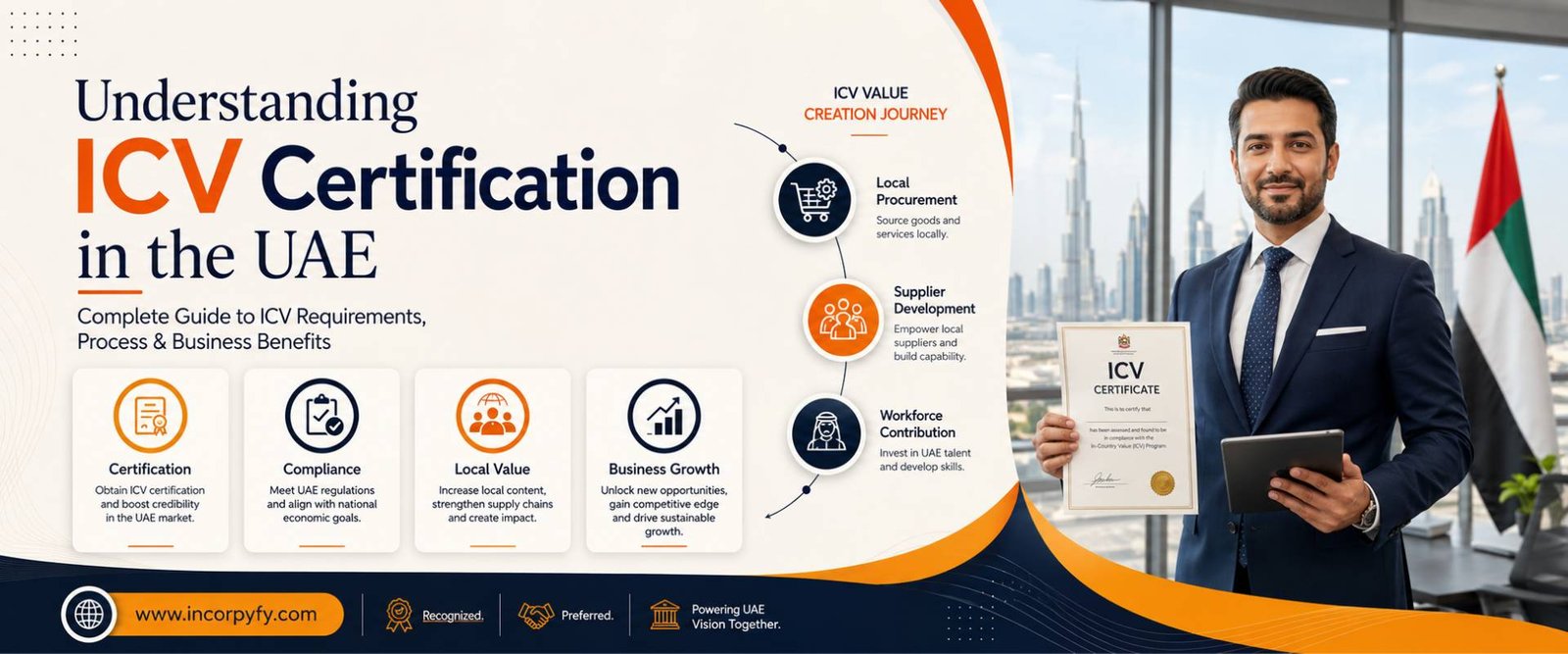

Summary
ICV (In-Country Value) certification measures how much of a company’s spending, hiring, and investment stays within the UAE economy, and it’s often mandatory for winning tenders with ADNOC, MoIAT, and other government or semi-government entities. Certification typically costs AED 5,000 to AED 15,000 and is valid for 14 months. Since January 2025, MoIAT requires stand-alone audited financials for every certificate, a change many businesses still haven’t adjusted for.
The UAE’s push for economic diversification and industrial growth has made ICV certification a critical factor for businesses working with government entities and large semi-government groups. If you’re a supplier, manufacturer, or service provider looking to compete in tender processes or build stronger public sector relationships, understanding how ICV actually works, and what’s changed recently, is essential. This guide covers its purpose, scoring, cost, the application process, and practical ways to improve your score.
What Is ICV Certification in the UAE?
ICV certification is a government initiative under the National In-Country Value Program, launched by ADNOC in 2018 and expanded nationwide in 2021 under the Ministry of Industry and Advanced Technology (MoIAT). It now measures a company’s economic contribution to the UAE, based on factors including:
- Emiratisation (hiring UAE nationals)
- UAE-based investments
- Procurement of local goods and services
- Manufacturing activities within the UAE
The programme has grown considerably since launch: MoIAT reports that investments by ICV-certified companies exceeded AED 200 billion, and Emirati employment within certified companies has continued climbing year over year, a scale that reflects just how central ICV has become to doing business with UAE public and semi-government entities.
Why Is ICV Certification Important in the UAE?
ICV certification matters because it helps your business win tenders, especially with government and semi-government clients. It shows you’re contributing to the UAE economy by hiring locals, investing in assets, and buying from local suppliers, and it gives you a measurable edge under a weighted evaluation model most competitors either aren’t certified for or haven’t optimised.
- Access to government contracts: most government tenders now prioritise companies with a strong ICV score. If you want to supply to ADNOC, Etihad Rail, Aldar, or MoIAT-linked entities, a valid ICV certificate is often mandatory, not optional.
- Competitive advantage: businesses with higher ICV scores have a better chance of winning bids under weighted evaluation models that favour local economic contribution, even against lower-priced competitors.
- National economic development: the programme supports the UAE’s economic diversification agenda by directing procurement spend toward local goods, services, and jobs.
- Corporate reputation: ICV compliance signals genuine commitment to the local market, which matters to investors, partners, and enterprise clients evaluating you beyond price.
Who Needs ICV Certification in the UAE?
ICV certification is essential for suppliers, manufacturers, and service providers working with UAE government or semi-government entities:
- Suppliers and contractors providing products or services to government-owned or semi-government organisations must submit an ICV certificate during procurement.
- Manufacturers are expected to show the percentage of manufacturing activity and procurement that happens locally.
- Service providers, including consultancies, engineering firms, IT companies, and logistics providers, also undergo ICV evaluation.
Even foreign-owned entities operating in the UAE must comply if they participate in relevant tenders, regardless of whether they’re structured on the mainland or in a free zone.
Which Entities Recognise the ICV Programme?
Initially launched by ADNOC, the programme is now unified under the MoIAT National ICV Programme and followed by:
- ADNOC Group
- Aldar Properties
- Etihad Rail
- Etisalat
- Emirates Steel Arkan
- Department of Economic Development (DED) Abu Dhabi
- MoIAT and participating federal and local entities
These entities now require ICV certification from vendors and suppliers as standard procurement practice.
How Is the ICV Score Calculated?
The ICV score is a weighted calculation based on a company’s audited financial statements, assessed across:
- Emiratisation: number of Emirati nationals employed, salaries paid to UAE nationals, and national training programmes.
- Investment in the UAE: assets owned in the UAE, including factories, offices, and machinery.
- Procurement from UAE vendors: total value of goods and services sourced from ICV-certified local suppliers.
- Manufacturing contribution: for manufacturers, local production value compared to total production.
- Exports outside the UAE: export performance can also add economic value to the score.
Each factor carries a specific weight depending on your business model and activity, and the final figure is expressed as a percentage, higher is better.
Types of ICV Certificates in the UAE
- Company-Specific ICV Certificate: issued based on a company’s audited financials for the previous fiscal year, valid for 14 months from issuance.
- Group ICV Certificate: available only where multiple legal entities operate in the same emirate under identical ownership; branches spread across different emirates or with differing ownership structures generally each require their own certificate.
- Start-Up Certificate: for companies with less than 10 months of operation or without audited financials, a temporary certificate may be granted with MoIAT approval, though it must be regularised once full financials are available.
How to Apply for ICV Certification in the UAE
Step 1: Prepare Stand-Alone Audited Financial Statements
This is where the process has genuinely changed. From 1 January 2025, MoIAT requires every ICV certificate to be backed by stand-alone audited financial statements specific to the legal entity being certified, prepared under IFRS (or IFRS for SMEs), and clearly separating UAE operations from any international activity, since only UAE-based economic activity counts toward the score. Companies that previously relied on management accounts or group-level financials now need to budget time for a proper entity-level audit before applying.
Your financials must also:
- Be audited by a licensed UAE audit firm
- Cover the latest financial year, not older than 2 years
Step 2: Choose a Certified ICV Certifying Body
MoIAT has approved a number of certifying bodies authorised to issue ICV scores, including the Big Four (Deloitte, EY, KPMG, and PwC) as well as several approved local audit and advisory firms. You must engage one of them for evaluation; certificates from unauthorised evaluators are not valid for tenders.
Step 3: Submit ICV Template and Supporting Documents
You’ll complete the ICV Submission Template, which includes:
- Employee breakdown
- Salary reports
- Procurement summaries
- Investment details
- Lease agreements or asset ownership documents
Step 4: Review and Audit by Certifier
Your ICV certifier verifies the template data against your audited financials, bank statements, payroll, and vendor invoices. If your bank statements or account structure aren’t in order yet, it’s worth sorting that out early; our guide to opening a corporate bank account in Dubai covers what banks typically expect.
Step 5: Receive Your ICV Certificate
Once verified, you’ll receive an official ICV Certificate valid for 14 months, ready to use in tenders and procurement processes.
Cost of Getting an ICV Certificate
Cost varies depending on company size, business complexity, number of legal entities involved, and certification type. Average fee range: AED 5,000 to AED 15,000, with additional charges possible for revisions or multi-entity evaluations. Since the 2025 audit requirement, some companies are also budgeting for the cost of a proper stand-alone audit where one wasn’t previously required, worth factoring in if your current financials are prepared at a group level.
How to Improve Your ICV Score
- Hire more Emirati nationals. MoIAT has been progressively raising Emiratisation expectations, with a target of 10% skilled Emirati roles by the end of 2026 factored into scoring for many categories. Our overview of UAE employment and labour laws covers the broader compliance picture around hiring.
- Invest in local assets. Buy or lease office space, infrastructure, equipment, or warehousing in the UAE.
- Source from ICV-certified suppliers. Track local spend against international procurement and prioritise certified vendors.
- Shift production to the UAE. If you manufacture overseas, relocating or assembling locally adds real value-added weight to your score.
- Maintain clean documentation. Keep payroll, procurement, and leasing records transparent and audit-ready year-round, not just at renewal time.
When to Renew Your ICV Certificate
Certificates are valid for 14 months from issuance. Renew after your next financial audit, and submit your renewal request before expiry to avoid tender disqualification. With verification now increasingly digital through MoIAT-linked procurement systems, discrepancies between your submitted data and your actual records are more likely to surface, so track renewal dates closely and treat ICV compliance as an ongoing process rather than an annual scramble.
Common Mistakes to Avoid in the ICV Process
- Submitting unaudited financials. ICV relies on audited data only; draft or management reports are rejected outright, and under the 2025 rule, group-level audits no longer suffice either.
- Inaccurate Emirati headcounts. All claims must be backed by salary slips, Emirates ID, and GOSI registrations.
- Misreporting local procurement. You must provide supplier ICV certificates to validate local spending claims.
- Using expired certificates. Tenders require valid, current certificates; expired ones lead to disqualification regardless of your actual score.
- Not hiring an authorised certifier. Only MoIAT-approved certifying bodies can issue valid ICV certificates.
Industries That Require ICV Certification Most
- Oil and Gas
- Construction
- Engineering and Procurement (EPC)
- IT and Technology
- Logistics and Transport
- Facilities Management
- Healthcare Supply and Medical Equipment
- Manufacturing
Even small subcontractors in these sectors are expected to maintain valid ICV certification to remain eligible for larger contracts.
What’s New: ICV+ and Rising Stakes for Suppliers
Beyond the 2025 audit rule change, a newer ICV+ initiative tied to ADNOC’s broader industrial resilience programme is giving contractors and suppliers with strong local sourcing additional ICV credit, worth understanding if you’re competing for ADNOC-linked project awards, since local sourcing is shifting from a scoring bonus toward something closer to a baseline expectation. Combined with increasingly digital, MoIAT-linked verification of supplier scores, the practical takeaway is the same either way: a properly prepared, currently valid ICV certificate is becoming less of a differentiator and more of a baseline requirement for serious government-facing suppliers.
Benefits of ICV Certification for Your Business
- Access to high-value projects. ICV-certified companies can work with major UAE entities and access multi-million-dirham projects.
- Enhanced tender ranking. Even without being the lowest bidder, a high ICV score can help you win tenders based on value contribution.
- Brand image boost. Demonstrates genuine commitment to UAE economic development, a message worth reinforcing consistently across your marketing and, for companies scaling their reputation long-term, worth protecting alongside formal trademark registration for your company name and brand assets.
- Strategic local partnerships. Encourages UAE-based alliances that create long-term opportunities beyond a single tender cycle.
Frequently Asked Questions
Is ICV certification mandatory in the UAE?
Yes, for companies bidding on tenders from ADNOC, MoIAT, and other participating entities. Without it, you may be ineligible to participate at all.
How long is the ICV certificate valid?
14 months from the date of issuance, based on your latest audited financial year.
Can startups get an ICV certificate in the UAE?
Yes. Startups without audited financials can apply for a provisional certificate but must regularise within 10 months of operation.
What changed with the 2025 audit requirement?
From 1 January 2025, all ICV certificates must be backed by stand-alone audited financial statements for the specific legal entity being certified, replacing the earlier acceptance of management accounts or group-level financials in many cases.
What if my ICV score is low?
You can still bid, but higher-scoring competitors may receive preference in evaluations. Scores can be improved over time by adjusting Emiratisation, local procurement, and investment levels.
Do I need separate ICV certificates for each legal entity?
Generally yes, unless entities operate in the same emirate under identical ownership, in which case a Group ICV Certificate may apply with auditor approval.
Getting Support with ICV Certification
Understanding and complying with ICV certification is now essential for companies that want to compete in government-driven sectors in the UAE. From improving local hiring to investing in UAE assets, sourcing from certified vendors, and getting your entity-level audit sorted under the 2025 rules, every part of your operating structure feeds into your score. Incorpyfy helps businesses preparing for ICV certification alongside broader business setup in Dubai, from company structuring and VAT compliance to PRO support for the documentation ICV certifiers expect to see. It’s not just about the certificate itself, it’s about building a business genuinely positioned to compete in one of the world’s fastest-growing procurement markets.