

Summary
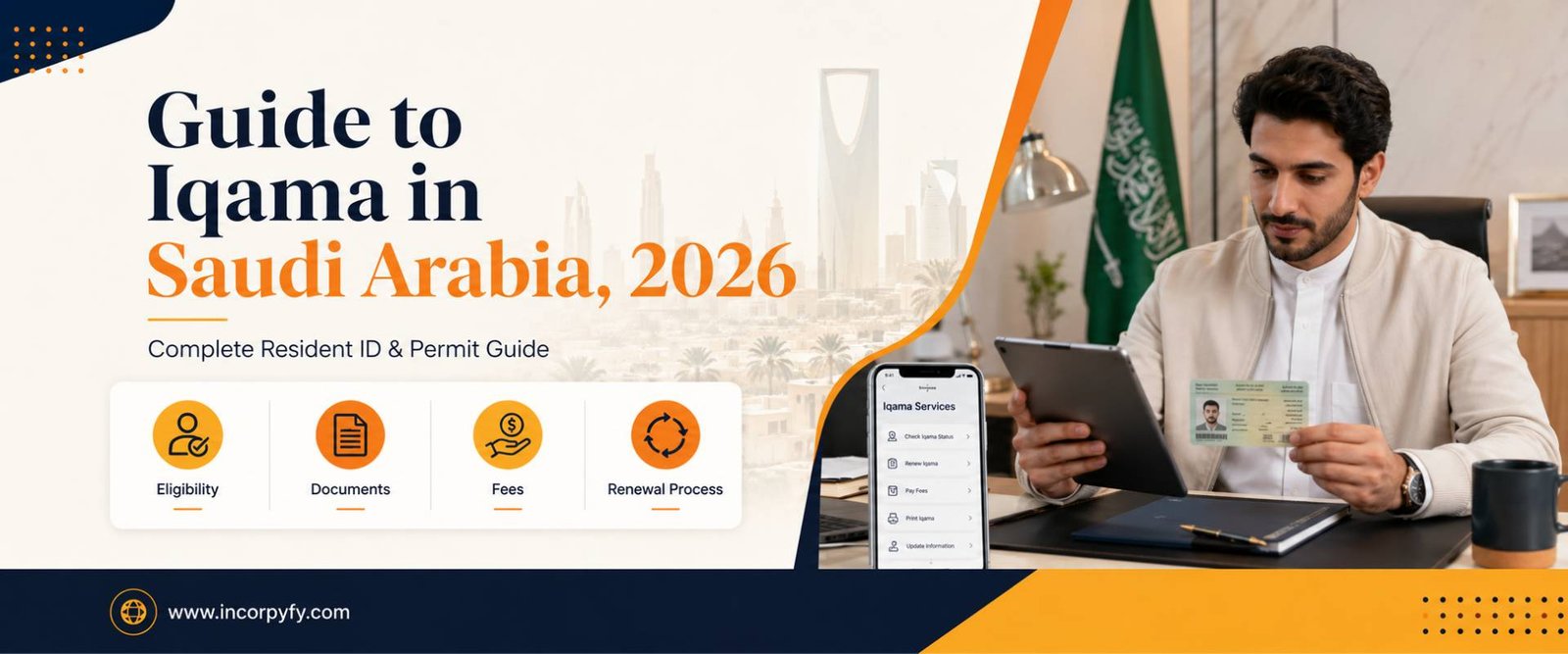
An Iqama is Saudi Arabia’s residency permit, issued by the General Directorate of Passports (Jawazat) to every expatriate resident, and it doubles as your primary identity document in the Kingdom. This guide covers what it contains, how to print or access a digital copy, the quarterly renewal system, current fees, and what happens if it lapses.
If you’re living or working in Saudi Arabia as a foreign national, the Iqama is the single document everything else runs through: banking, renting an apartment, sponsoring family, opening a mobile line, even leaving and re-entering the country. It’s also one of the most misunderstood documents among new arrivals, partly because the rules around renewal, dependents, and fees have changed more than once in recent years. This guide covers what an Iqama actually is, how to get, print, or renew one, and what it costs today.
What Is an Iqama?
An Iqama, sometimes referred to as a Muqeem ID, is Saudi Arabia’s official residency permit for expatriates, issued by the Ministry of Interior’s General Directorate of Passports, commonly known as Jawazat. It serves as both proof of legal residency and your primary identification document while you’re in the Kingdom, required for nearly every government and private-sector transaction.
The card itself carries a set of standard details: your name in English and Arabic, your Iqama number, an ID version number that increases each time the card is reissued or renewed, the place and date of issue, your date of birth, nationality, occupation, sponsor information, and an expiry date. Most of this information is printed in Arabic, though your name and Iqama number also appear in English for convenience.
Who Needs an Iqama, and How to Get One
Every foreign national residing in Saudi Arabia under a work or residency sponsorship needs a valid Iqama. It’s issued after your sponsor, typically an employer, completes your visa and residency processing, and it’s tied directly to that sponsorship. Getting one for the first time generally follows this sequence:
- Your sponsor completes your entry visa and work permit processing.
- You undergo a medical fitness test at an approved facility, a standard requirement before Iqama issuance.
- Your sponsor submits your Iqama application through Absher Business or a registered government services office.
- Biometric details are captured where required, and the Iqama is issued, either as a physical card or as a digital record accessible through Absher.
New residents must obtain their Iqama within 90 days of entering the Kingdom. Missing this window carries a fine of SR 500, so it’s not a deadline worth treating loosely.
How to Print or Access Your Digital Iqama
This is one of the most searched Iqama-related questions, and for good reason: since 2021, residents have been able to carry a digital copy of their Iqama on their smartphone rather than relying solely on the physical card.
To access your digital Iqama:
- Log in to the Absher Individuals app or website with your Iqama number and password.
- Navigate to your personal profile section, where your digital Iqama is displayed with all current details.
- Screenshot or save this view for situations where you need to show proof of residency without carrying the physical card.
To print or reissue a physical Iqama:
- Log in to Absher Business (for sponsors managing employee Iqamas) or Absher Individuals.
- Select the Iqama printing or reissuance service, confirm that all fees and violations linked to the Iqama holder are cleared.
- Pay the applicable printing fee and submit the request.
- Collect the printed card from the designated centre, or arrange delivery where available.
A digital Iqama carries the same legal validity as the physical card for most purposes, but certain transactions, particularly with institutions less familiar with digital verification, still ask for the physical version, so it’s worth keeping both accessible.
Iqama Renewal in Saudi Arabia
Iqama renewal used to mean a single annual payment, but that changed in 2021 when Jawazat introduced quarterly renewals for Iqamas linked to a work permit. Under this system, employers can renew an employee’s Iqama and work permit for a minimum of three months at a time, splitting the fee into three-month, six-month, or twelve-month cycles rather than paying the full annual amount upfront.
Conditions for renewal include:
- No unpaid traffic violations linked to the Iqama holder
- A valid passport
- No record of being registered as a work absentee (huroob)
One notable update: Iqama renewal is now possible even if a dependent or family member under the same sponsorship is temporarily outside the Kingdom, as long as the head of household remains in Saudi Arabia. This resolved a long-standing issue where families faced renewal delays simply because one member was abroad for education, medical treatment, or a family emergency.
Important exception: the quarterly renewal option does not apply to domestic workers, housekeepers, drivers, nannies, and similar roles, whose Iqama and related fees must still be renewed and paid on a full annual basis.
Iqama Fees and Costs
Fee amounts have been revised more than once in recent years, so treat the figures below as current planning guidance and confirm exact amounts on Absher before paying.
| Service | Fee (SAR) |
|---|---|
| Iqama issuance (Absher Business value-added service) | 51.75 |
| Iqama renewal (Absher Business value-added service) | 51.75 |
| Final exit fee | 70 |
| Exit/re-entry visa extension | 103.5 |
| Employee report request | 28.75 |
| Passport information update | 69 |
| Late Iqama application fine (after 90 days) | 500 |
Separate from these per-transaction service fees, companies also pay an annual residency and work permit renewal package, and a monthly dependent levy, currently SR 400 per dependent, for each family member sponsored on an employee’s Iqama who isn’t independently employed. This levy has been under government review given its impact on expatriates choosing to keep families outside the Kingdom, so it’s worth confirming the current rate before budgeting for a renewal cycle, particularly for larger families.
Iqama for Dependents
Spouses, children, and other sponsored family members each hold their own Iqama linked to the primary sponsor’s file. The process mirrors the main applicant’s: medical test, application through Absher, and issuance or renewal on the same cycle as the sponsor’s Iqama where applicable. As covered above, dependent Iqamas can now be renewed even while the dependent is temporarily outside Saudi Arabia, provided the sponsor remains in the Kingdom, a meaningful improvement over the previous requirement that everyone be physically present.
Checking Iqama Validity and Status
Beyond printing or renewing, residents and sponsors often need to simply confirm an Iqama’s current status, whether it’s still valid, when it expires, or whether a renewal has gone through. This can be checked through the Muqeem portal without needing to log in to a full Absher account, useful for a quick check from outside Saudi Arabia or for sponsors verifying multiple employees at once. Enter the Iqama number and a matching detail, such as date of birth, to view validity dates and current status instantly.
What Happens If Your Iqama Expires
An expired Iqama triggers a fine, but contrary to a persistent rumour, it is not on its own grounds for arrest. A Saudi lawyer publicly clarified this point after it circulated widely on social media: a police officer cannot arrest a resident solely because their Iqama has expired, though the automatic fine still applies and accumulates the longer renewal is delayed.
What an expired Iqama does block is more practical: you cannot obtain a final exit visa to leave Saudi Arabia permanently without a valid, renewed Iqama, and many routine transactions, banking, contract renewals, government services, become difficult or impossible until it’s current again. Renewing promptly rather than waiting is always the cheaper and simpler option.
One related myth worth addressing directly: a visit visa cannot be converted into a regular Iqama. Saudi authorities have repeatedly and publicly denied claims circulating online that this conversion is possible for a fee. The one narrow exception is for expatriates’ children under 18 whose visit visa can, in specific circumstances, be converted to a resident ID if their parents already hold valid Iqamas, but this doesn’t extend to adults or to visit visas generally.
Common Mistakes to Avoid
- Missing the 90-day window for first-time Iqama applications after entering the Kingdom, triggering an automatic SR 500 fine.
- Assuming domestic worker Iqamas follow the same quarterly renewal rules as standard employee Iqamas, they don’t, and must be renewed annually.
- Believing a visit visa can be converted into an Iqama. It cannot, for adults, regardless of what’s claimed online.
- Letting the Iqama lapse while assuming nothing will happen. It won’t trigger arrest on its own, but it blocks a final exit visa and many routine services, and the fine grows the longer it’s ignored.
- Overlooking unpaid traffic fines before attempting a renewal. These are one of the most common reasons a renewal request gets held up.
How Incorpyfy Can Help
Managing Iqama issuance and renewal for a single employee is straightforward once you know the process. Managing it across a growing team, alongside exit re-entry permits, Saudization requirements, and government relations, is a different scale of task. Our team at Incorpyfy supports businesses across Saudi Arabia with exactly this kind of ongoing compliance through our government relations officer (GRO) services, keeping Iqama renewals, sponsor changes, and Absher Business administration on schedule so nothing lapses unnoticed. If your business is also managing employee travel, our guide to the Saudi Arabia exit re-entry permit system covers the closely related process that runs alongside Iqama validity.
Conclusion
An Iqama is more than a formality, it’s the document that determines whether daily life and business in Saudi Arabia run smoothly or hit friction at every turn. Understand the 90-day deadline for first-time applicants, take advantage of the quarterly renewal option where it applies, keep both a digital and physical copy accessible, and renew ahead of expiry rather than after. Businesses managing this across multiple employees benefit most from treating it as an ongoing compliance calendar rather than a once-a-year task.
FAQs
What is an Iqama in Saudi Arabia?
It’s the official residency permit and primary identity document issued to expatriates living in the Kingdom, issued by the General Directorate of Passports (Jawazat) and tied to a sponsor.
How do I print my Iqama?
Log in to Absher Business or Absher Individuals, select the printing or reissuance service, confirm any outstanding fees or violations are cleared, pay the applicable fee, and collect the card from the designated centre.
Can I access my Iqama digitally without the physical card?
Yes. A digital Iqama has been available through the Absher app since 2021 and carries the same legal validity as the physical card for most transactions.
How much does Iqama renewal cost?
The Absher Business value-added renewal service fee is SR 51.75, separate from the annual residency package and the SR 400 monthly dependent levy that applies to sponsored family members.
Can I renew my Iqama every three months instead of annually?
Yes, for standard work-permit-linked Iqamas, renewal can be split into three, six, or twelve-month cycles since 2021. This option does not apply to domestic worker Iqamas, which remain annual.
What happens if my Iqama expires?
fine applies, and you cannot obtain a final exit visa until it’s renewed. Expiry alone is not grounds for arrest, though other violations linked to your status could be.
Can a visit visa be converted into an Iqama?
No, not for adults. Saudi authorities have repeatedly denied this is possible. The narrow exception is for expatriate children under 18 whose parents already hold valid Iqamas.
Can my Iqama be renewed if a family member is currently outside Saudi Arabia?
Yes, as long as the head of household remains in the Kingdom, renewal can proceed even if a dependent is temporarily abroad.