

Summary
Starting an educational institute in Saudi Arabia involves MISA and Ministry of Education registration, facility and Civil Defense approvals, and curriculum licensing, with total setup taking 3 to 6 months for most institute types. Foreign investors can generally own 100% of the business through MISA rather than a mandatory Saudi sponsor, a detail worth getting right before you structure your investment.
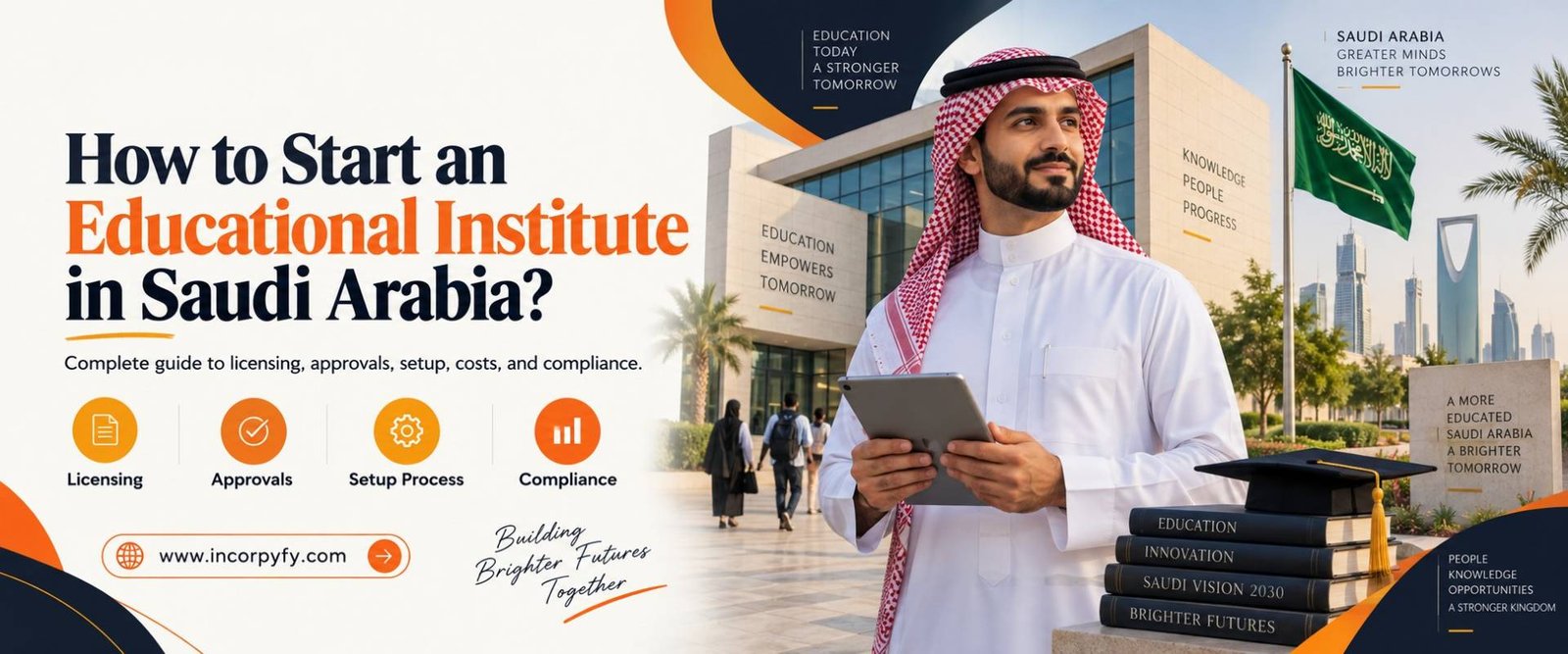
Starting an educational institute in Saudi Arabia is more than just a business idea, it’s a contribution to shaping the nation’s future. With a young population, a growing demand for quality education, and the government’s support for private sector involvement, this is the right time to take that step. Whether you’re thinking of a preschool, training center, or a higher education institution, this guide covers everything you need to know to get started, including the correct current ownership rules.
A meaningful share of existing content on this topic still lists a mandatory Saudi national sponsor as a standard requirement for foreign investors entering this sector, a picture that hasn’t reflected current investment rules for some time now. Getting this detail right from the outset shapes how you structure your investment and ownership from day one.
Why Education Is Booming in Saudi Arabia
Saudi Arabia has one of the youngest populations in the region. With Vision 2030 in motion, education is a major pillar for transformation, and the government actively supports new learning models, skill development, and private investment in education. This push has created genuine space for innovation and new types of learning institutes across the Kingdom.
Key Benefits of Launching an Educational Institute in Saudi Arabia
Setting up an educational institute here comes with real advantages.
Favorable Regulations
The Ministry of Education encourages local and international investors to enter the education sector, making approvals meaningfully easier than they were even a few years ago.
Growing Demand
Parents are constantly seeking better academic environments for their children, meaning there’s genuinely always room for new, well-run players entering the market.
Open to Innovation
Whether it’s digital learning, bilingual education, or skill-based training, there’s real appetite for modern learning formats across Saudi Arabia’s expanding education sector.
Types of Educational Institutes You Can Start
Depending on your background, budget, and goals, several paths are genuinely viable.
Preschool or Nursery
Ideal for early childhood educators focused on foundational learning, generally the most accessible entry point given lower capital requirements.
Private K-12 School
A full academic setup catering from kindergarten to high school students, requiring significant investment but offering genuine long-term growth potential.
Training and Skills Centers
Focuses on adults or professionals looking to upgrade their skills in fields like IT, languages, design, or business, often a faster path to revenue given shorter program cycles.
Tutoring Centers
Well suited to after-school learning support, exam preparation, or subject-focused coaching, typically requiring lower upfront investment than a full school.
Higher Education Institute
Universities or colleges, often in partnership with international institutions, requiring robust infrastructure and genuine academic credibility before licensing proceeds.
Foreign Ownership: What Actually Applies Today
This is worth clarifying directly, since some existing guidance on this topic still lists a mandatory Saudi national sponsor as a standard legal requirement for foreign investors. Under Saudi Arabia’s current investment framework, administered through the Ministry of Investment of Saudi Arabia (MISA), 100% foreign ownership is generally permitted for education sector activities, provided the specific institute type isn’t on the limited negative list of restricted activities. MISA replaced the former SAGIA, so any guide still framing a Saudi partner as a default requirement is describing an outdated process rather than current practice.
This doesn’t mean a local partner is never useful. Some foreign-owned educational institutes still bring on Saudi partners for community relationships, government liaison, or specific licensing categories where local involvement genuinely helps, but that’s a strategic choice made on its own merits rather than a blanket legal precondition for entering this sector.
Step-by-Step Timeline to Start an Educational Institute in Saudi Arabia
| Step | What Happens | Typical Timeframe |
|---|---|---|
| 1. Identify the type of institute | Confirm your specific category and licensing path | 1 to 2 weeks |
| 2. Prepare your business plan | Draft mission, curriculum structure, financials, and staffing plan | 2 to 4 weeks |
| 3. Register your business | Apply through MISA, obtain Commercial Registration | 2 to 4 weeks |
| 4. Choose and secure a location | Confirm zoning, safety, and Civil Defense compliance | 3 to 6 weeks |
| 5. Apply for the education license | Submit documentation and curriculum approval to the Ministry of Education | 4 to 8 weeks |
| 6. Build your facility | Fit out classrooms, labs, and administrative space | 4 to 12 weeks, depending on scale |
| 7. Recruit qualified staff | Hire educators meeting Ministry qualification standards | 3 to 6 weeks, often run in parallel |
| 8. Market your institute | Build visibility ahead of enrollment | Ongoing, starting before launch |
Total realistic timeline: 3 to 6 months for most institute types with complete documentation, extending further for larger K-12 schools or higher education institutes requiring more extensive facility build-out and curriculum accreditation. Preschools and training centers generally move through this timeline faster than full K-12 schools, given their narrower facility and curriculum approval requirements, so matching your expectations to your specific institute type from the start avoids planning around an overly optimistic universal timeline.
Step-by-Step Process to Start an Educational Institute in Saudi Arabia
Step 1: Identify the Type of Institute
Know exactly what kind of institute you want to start, since your licensing and legal process depends directly on this choice.
Step 2: Prepare Your Business Plan
This should include your mission, target students, curriculum structure, financial plan, staffing requirements, and location preferences, prepared with enough specificity to support your MISA and Ministry of Education applications.
Step 3: Register Your Business
Apply through MISA and obtain a Commercial Registration. You’ll also need a license and approval from the Ministry of Education, since business registration alone doesn’t authorize you to actually operate an educational institute.
Step 4: Choose and Secure a Location
Your facility must meet safety, accessibility, and zoning standards, with approvals required from Civil Defense and the local municipality before proceeding further.
Step 5: Apply for the Education License
Submit your full documentation and business proposal to the Ministry of Education, including curriculum approvals, especially important for K-12 schools or institutes offering international curricula.
Step 6: Build Your Facility
Equip classrooms, labs, administrative offices, and supporting facilities according to your level of education and expected student size.
Step 7: Recruit Qualified Staff
Hire educators who meet the Ministry’s qualification standards, with both local and international hiring permitted, and register your staff for GOSI social insurance as part of standard employment compliance.
Step 8: Market Your Institute
Build genuine visibility, starting early with marketing campaigns, events, and partnerships to establish your student base well ahead of your actual launch date.
Legal Requirements You Should Know
- Minimum investment capital appropriate to your institute type and scale
- Health and safety certifications for your facility
- Qualified faculty and administrative staff meeting Ministry standards
- Curriculum approval from the Ministry of Education
- Commercial registration and municipality license
Documents Required
- Valid passport and residence permit, for foreign founders
- Business plan
- Commercial Registration (CR)
- Lease agreement or property ownership proof
- Architectural and facility layout plan
- Staff credentials and resumes
- Curriculum documents
- NOC from the local municipality
- Civil Defense approval
Challenges You Might Face
Starting strong is genuinely possible, but expect a few real bumps along the way.
Regulatory Delays
Approval sometimes takes longer than expected, and having all documents complete and correctly formatted upfront meaningfully reduces the wait compared to submitting partial applications and responding to requests for missing information as they arise.
Finding Qualified Staff
Recruiting experienced educators who also understand the local culture and curriculum requirements can genuinely take time, so starting your recruitment process well ahead of your target opening date matters, particularly for specialized subjects or bilingual instruction roles where the qualified talent pool is naturally smaller.
Competing for Students
Building a solid brand, offering modern learning methods, and engaging with parents regularly helps you stand out in an increasingly competitive local market, since word of mouth among parent networks genuinely drives enrollment more than advertising alone in this sector.
Tips for a Successful Launch
- Localize your content and teaching style rather than importing a curriculum wholesale without adaptation
- Be transparent with parents and staff about expectations, progress, and challenges
- Focus on quality outcomes, not just enrollment numbers or short-term profit
- Get feedback from students and parents regularly rather than only at term’s end
- Offer flexible fee structures and scholarships to widen genuine access
Real Cost of Starting an Educational Institute
| Institute Type | Estimated Investment (SAR) |
|---|---|
| Preschool or Daycare | 300,000 to 800,000 |
| K-12 School | 2 million to 10 million |
| Training Center | 200,000 to 600,000 |
| Higher Education Institute | 20 million and above |
Ongoing operational expenses include salaries, materials, licensing renewals, marketing, and utilities, and these recurring costs should be budgeted separately from your initial setup investment rather than treated as a one-time expense.
Conclusion
Starting an educational institute in Saudi Arabia is not just about filling classrooms, it’s about making a genuine, lasting impact, and Saudi Arabia offers a real platform to make that happen. From government support to a growing population in need of quality education, the opportunity is real, provided you structure your investment around current MISA ownership rules rather than an outdated sponsor requirement. If you want to streamline the process, our business setup in Saudi Arabia team can help you handle the paperwork and avoid delays. Explore our full Saudi Arabia company formation services or visit Incorpyfy to get started.
FAQs
Can foreigners own 100% of an educational institute in Saudi Arabia?
Yes, in most cases. MISA registration generally permits 100% foreign ownership for education sector activities, rather than requiring a mandatory Saudi sponsor, provided your specific institute type isn’t on the restricted negative list.
How much does it cost to start an educational institute in Saudi Arabia?
Costs vary significantly by type: SAR 300,000 to 800,000 for a preschool, SAR 2 million to 10 million for a K-12 school, SAR 200,000 to 600,000 for a training center, and SAR 20 million or more for a higher education institute.
How long does it take to set up an educational institute in Saudi Arabia?
Most institute types take 3 to 6 months with complete documentation, extending further for larger K-12 schools or higher education institutes requiring more extensive facility and curriculum approval.
What licenses do I need to open an educational institute?
Commercial Registration through MISA and the Ministry of Commerce, plus a specific education license and curriculum approval from the Ministry of Education, alongside Civil Defense and municipality approval for your facility.
Do I need a Saudi partner to open an educational institute?
Not necessarily. Most education sector activities now permit full foreign ownership through MISA registration, a meaningful shift from the mandatory local partnership model that applied more broadly in the past.
Can I hire international teachers for my Saudi educational institute?
Yes, both local and international hiring are permitted, provided staff meet the Ministry of Education’s qualification standards for their specific role and subject area.
Do I need to register my staff for GOSI?
Yes. Standard employment compliance for any Saudi business, including educational institutes, requires registering employees for GOSI social insurance as part of your broader HR and payroll obligations.
Which type of educational institute is fastest to launch?
Training and skills centers or tutoring centers generally launch faster than full K-12 schools or higher education institutes, given lower capital requirements, simpler facility needs, and a narrower curriculum approval scope.
Do I need a separate curriculum approval if I’m using an international curriculum?
Yes, particularly for K-12 schools and higher education institutes. Foreign curricula typically require specific Ministry of Education review and approval before you can enroll students under that program, so confirming this pathway early avoids a delay discovered late in your setup process.
Can an educational institute in Saudi Arabia operate across multiple campuses under one license?
Generally each physical location requires its own facility approval and municipality license, even under a single overarching business entity, so expanding to a second campus later involves a genuinely fresh round of location-specific approvals rather than an automatic extension of your original license.
What happens if my institute’s enrollment falls below projections after launch?
While there’s no specific regulatory penalty for lower enrollment itself, sustained low enrollment affects your financial viability and ongoing licensing renewal considerations, so building a realistic enrollment projection during your business planning stage, rather than an overly optimistic one, genuinely protects your long-term operational stability.