

Summary
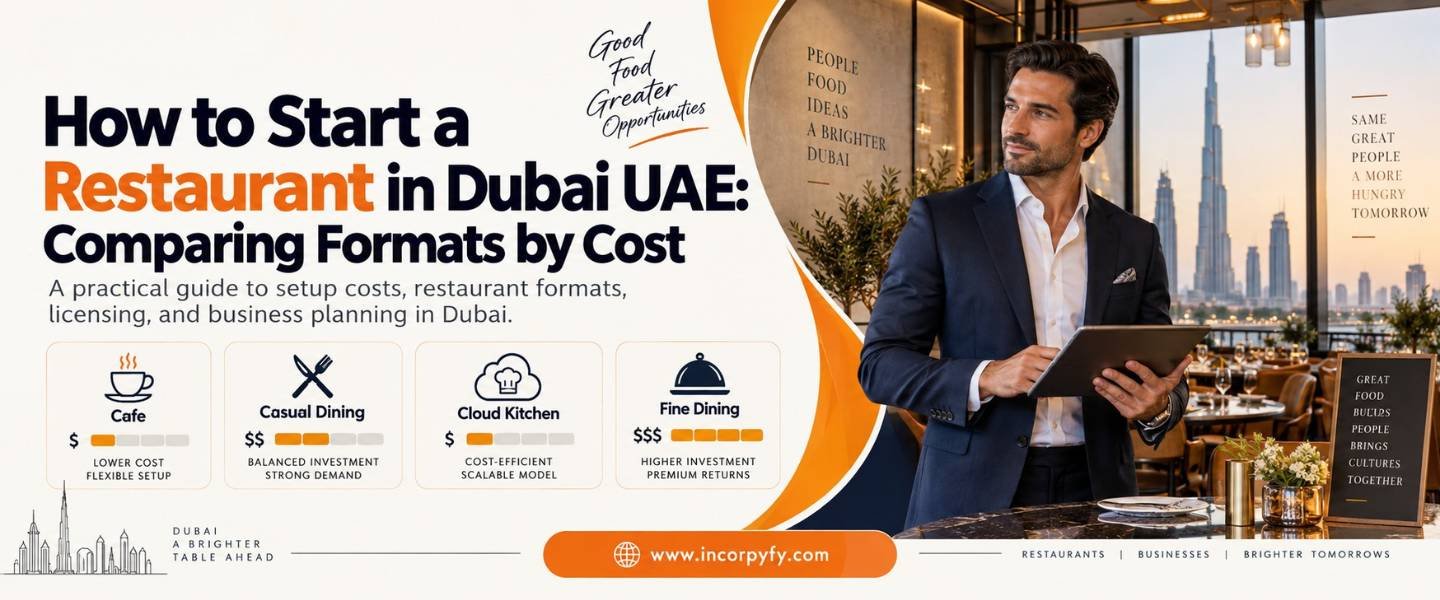
Not every F&B concept in Dubai needs the same investment. A cloud kitchen can launch for AED 80,000 to 150,000, a food truck for AED 100,000 to 200,000, a cafe for AED 200,000 to 400,000, and a full-service restaurant for AED 500,000 to 1,000,000 or more, each with genuinely different licensing, staffing, and location requirements.
Dubai is one of the fastest-growing food and beverage destinations in the world, and “starting a restaurant” here doesn’t have to mean a full dine-in concept from day one. With a mix of expatriates, tourists, and residents driving demand, entrepreneurs increasingly choose from a genuinely wide range of F&B formats, each with its own cost structure, licensing path, and target customer.
A lot of general content on this topic walks through the licensing process in detail but treats every F&B concept as though it needs the same investment and timeline, when in practice a delivery-only kitchen and a full dine-in restaurant sit at genuinely different points on the cost spectrum. This guide focuses specifically on comparing those formats side by side, rather than repeating the general step-by-step licensing process covered elsewhere, so you can match your actual budget and business goals to the right concept before committing.
Why Format Choice Matters More Than It Seems
A lot of general guidance on starting a restaurant in Dubai treats “restaurant” as a single business model with one cost structure. In practice, a cloud kitchen serving delivery-only orders and a full-service fine dining restaurant sit at genuinely opposite ends of the investment and complexity spectrum, despite both technically falling under F&B licensing. Choosing your format first, before working through licensing specifics, is the decision that actually shapes your total cost, timeline, and staffing needs, and it’s a decision worth making deliberately rather than defaulting to “restaurant” as the only option because that’s the term most guides use.
Comparing Dubai F&B Formats by Real Cost
| Format | Typical Setup Cost (AED) | Key Requirement | Best Fit |
|---|---|---|---|
| Cloud kitchen | 80,000 to 150,000 | Commercial kitchen space, delivery platform integration | Delivery-focused founders testing a concept with lower overhead |
| Food truck | 100,000 to 200,000 | RTA and Dubai Municipality mobile vending approval | Founders wanting flexibility and lower fixed rent |
| Cafe or small eatery | 200,000 to 400,000 | Smaller commercial space, simpler menu and kitchen setup | Budget-conscious dine-in concepts, residential or budget areas |
| Full-service restaurant | 500,000 to 1,000,000+ | Full kitchen fit-out, larger commercial lease, complete staffing | Established concepts targeting premium or high-footfall locations |
These figures cover licensing, fit-out, and initial operational costs specifically for each format. Actual costs shift considerably based on location, since a cloud kitchen in an industrial area costs meaningfully less than one in a central Dubai food hub, and the same location sensitivity applies across every format listed here, with premium neighborhoods pushing costs toward the higher end of each range regardless of which format you ultimately choose.
Cloud Kitchens: The Lowest-Cost Entry Point
Cloud kitchens, sometimes called ghost kitchens, operate without a dine-in space, focusing entirely on delivery through platforms like Talabat, Deliveroo, and Zomato. This format genuinely minimizes your two biggest restaurant costs, prime retail rent and full front-of-house staffing, letting you validate a concept before committing to a larger footprint. For a founder with a strong recipe or concept but limited capital, this is often the most realistic route into Dubai’s F&B market without taking on debt or outside investment upfront.
A cloud kitchen still requires the same Food Safety License from Dubai Municipality as any other food business, alongside your standard trade license from DET (Dubai Department of Economy and Tourism), formerly the DED. Many operators run multiple virtual brands from a single shared kitchen space, spreading fixed costs across several delivery-only concepts rather than one physical restaurant, a strategy that genuinely maximizes utilization of an expensive commercial kitchen asset across different customer segments and cuisine types.
Food Trucks: Flexibility Over Fixed Location
A food truck lets you test different locations and events without committing to a single long-term lease. Beyond your standard F&B licensing, you’ll need specific approval from Dubai’s Roads and Transport Authority (RTA) for mobile vending and confirmation from Dubai Municipality on your truck’s kitchen setup and hygiene standards. This format suits founders wanting to build a following at markets, events, and rotating locations before deciding whether a fixed cafe or restaurant location genuinely makes sense for their concept, and the built-in mobility means you can chase footfall to wherever it’s genuinely strongest on a given day or season rather than committing to one fixed catchment area.
Cafes and Small Eateries: The Middle Ground
A cafe or small eatery sits between the lower-cost delivery and mobile formats and a full-service restaurant, offering a genuine dine-in experience without the scale of a larger establishment. This format works well in Deira, Bur Dubai, and other budget-conscious residential areas where a smaller footprint and simpler menu keep both setup and ongoing costs manageable while still building steady local repeat business. A well-run cafe in the right neighborhood can genuinely outperform a struggling restaurant in a premium location, since consistent local demand often matters more than prestige address for this specific format.
Full-Service Restaurants: The Complete Investment
A full-service restaurant carries the highest cost across every category: prime location rent, complete kitchen fit-out, a larger staff roster covering front and back of house, and often additional permits if you plan to serve alcohol, which requires a separate Liquor License through Dubai Police and relevant authorities. This format suits founders with an established concept, sufficient capital, and a specific target location like Downtown Dubai, Dubai Marina, or a spot near major malls and tourist attractions where footfall justifies the higher fixed costs. Attempting a full-service concept without the capital to properly execute the space, staffing, and marketing that premium locations demand is a genuinely common way founders overextend early, so honestly assessing whether your available capital matches this format’s real requirements matters more than the appeal of a flagship-style launch.
Foreign Ownership Across All Formats
Regardless of which format you choose, current Commercial Companies Law reforms mean most mainland F&B activities generally permit 100% foreign ownership without a mandatory local partner, alongside the long-standing full ownership option through free zones. This applies consistently across cloud kitchens, food trucks, cafes, and full-service restaurants, so structuring your specific format around an unnecessary local partnership assumption is worth avoiding regardless of your chosen concept.
The Tax Position Worth Understanding Correctly
Personal income tax genuinely doesn’t apply in the UAE regardless of your F&B format, a real and unconditional advantage. Corporate tax is a separate matter worth stating precisely: every UAE F&B business must register for corporate tax, generally facing the standard 9% rate above AED 375,000 in annual taxable income. Free zone F&B businesses can access 0% specifically on qualifying income if they meet Qualifying Free Zone Person conditions, not as an automatic exemption tied simply to holding a license, a nuance that applies whether you’re running a single cloud kitchen or a full restaurant group. Most F&B activities involving physical food preparation and mainland retail sales don’t neatly fit the qualifying activity categories that free zone tax benefits are built around, so mainland F&B founders specifically should plan their tax position assuming the standard rate applies rather than a blanket exemption.
Licensing Components Common to Every Format
Regardless of format, every F&B business in Dubai needs a trade license covering the commercial activity itself, and a Food Safety License from Dubai Municipality confirming hygiene, kitchen layout, and food handling compliance. Formats serving alcohol or pork specifically need additional permits, and any business importing food ingredients directly needs a Food Consignment License confirming imported goods meet UAE food safety standards. Our detailed guide to restaurant licensing in Dubai covers the full step-by-step licensing process for founders who’ve already settled on their specific format.
Choosing the Right Format for Your Actual Budget
If your capital is genuinely limited and you want to validate a concept quickly, a cloud kitchen or food truck lets you enter the market at a fraction of a full restaurant’s cost, with the flexibility to pivot or relocate if your first location or concept doesn’t perform. If you have moderate capital and want a genuine dine-in presence without the scale of a flagship restaurant, a cafe in a budget-friendly area balances cost and customer experience reasonably well. If you have an established concept, sufficient capital, and a specific premium location in mind, a full-service restaurant is worth the higher investment specifically because that format is what those locations and customer expectations actually demand.
There’s also a genuinely sensible middle path worth considering: starting with a cloud kitchen or food truck specifically to build a customer base and brand recognition, then reinvesting that early revenue into a cafe or full-service location once you have real data on what your customers actually want, rather than guessing at menu and format before you’ve served a single paying customer.
Conclusion
Starting an F&B business in Dubai doesn’t require choosing between “restaurant or nothing.” Cloud kitchens, food trucks, cafes, and full-service restaurants each offer a genuinely different entry point depending on your budget, concept, and growth plans, and matching your format to your actual capital avoids either overextending early or under-investing in a concept that needed a bigger footprint from the start. Our business setup consultants in Dubai can help you choose the right format and navigate licensing from day one. Explore our full company formation services or visit Incorpyfy to get started.
FAQs
Which F&B format is cheapest to start in Dubai?
A cloud kitchen is generally the lowest-cost entry point, commonly AED 80,000 to 150,000, since it avoids prime retail rent and full front-of-house staffing entirely.
Can I switch from a cloud kitchen to a full restaurant later?
Yes, this is a genuinely common growth path. Many operators start with a cloud kitchen or food truck to validate demand, then transition into a cafe or full-service restaurant once they’ve built a customer base and confirmed their concept works.
Do all F&B formats need the same licenses?
The core trade license and Food Safety License apply across every format, though food trucks additionally need RTA mobile vending approval, and full-service restaurants serving alcohol need a separate Liquor License.
Is 100% foreign ownership available for restaurants in Dubai?
Yes, generally, across all F&B formats. Current mainland ownership rules permit 100% foreign ownership for most F&B activities without a mandatory local partner, alongside the long-standing free zone option.
Do restaurants in Dubai pay corporate tax?
Yes. Every UAE F&B business must register for corporate tax, generally facing 9% above AED 375,000, with 0% available only on qualifying income for free zone businesses meeting Qualifying Free Zone Person conditions.
Is a food truck a good starting point for a first-time F&B founder?
It can be, particularly for founders wanting to test a concept across multiple locations and events before committing to a fixed lease, though it requires specific RTA approval beyond standard F&B licensing.
How much more does a full-service restaurant cost compared to a cafe?
A full-service restaurant commonly runs AED 500,000 to 1,000,000 or more, roughly double to several times a cafe’s AED 200,000 to 400,000 range, reflecting the larger space, full kitchen fit-out, and larger staff roster involved.
Can I run multiple virtual brands from one cloud kitchen license?
Yes, many operators do exactly this, running several delivery-only concepts from a single shared kitchen space to spread fixed costs across multiple revenue streams rather than committing to one physical restaurant.
Does a cafe require the same food safety approval as a full-service restaurant?
Yes. Every format serving food to the public, regardless of size, needs Dubai Municipality’s Food Safety License covering hygiene, kitchen layout, and food handling standards, so a smaller footprint doesn’t reduce this specific compliance requirement.
How do I decide between a cloud kitchen and a food truck if my budget fits either?
A cloud kitchen suits a concept that works well purely through delivery photography and packaging, while a food truck suits a concept that benefits from visible preparation, direct customer interaction, and event-based visibility, so matching the format to how your specific food and brand actually connect with customers matters more than cost alone at this budget level.
What ongoing costs should I budget for beyond the initial setup figures?
Regardless of format, ongoing costs include license renewal, rent, staff salaries, ingredient and supply costs, delivery platform commissions where applicable, and marketing, so building a realistic monthly operating budget alongside your initial setup cost gives a genuinely complete financial picture before you launch.