


Summary
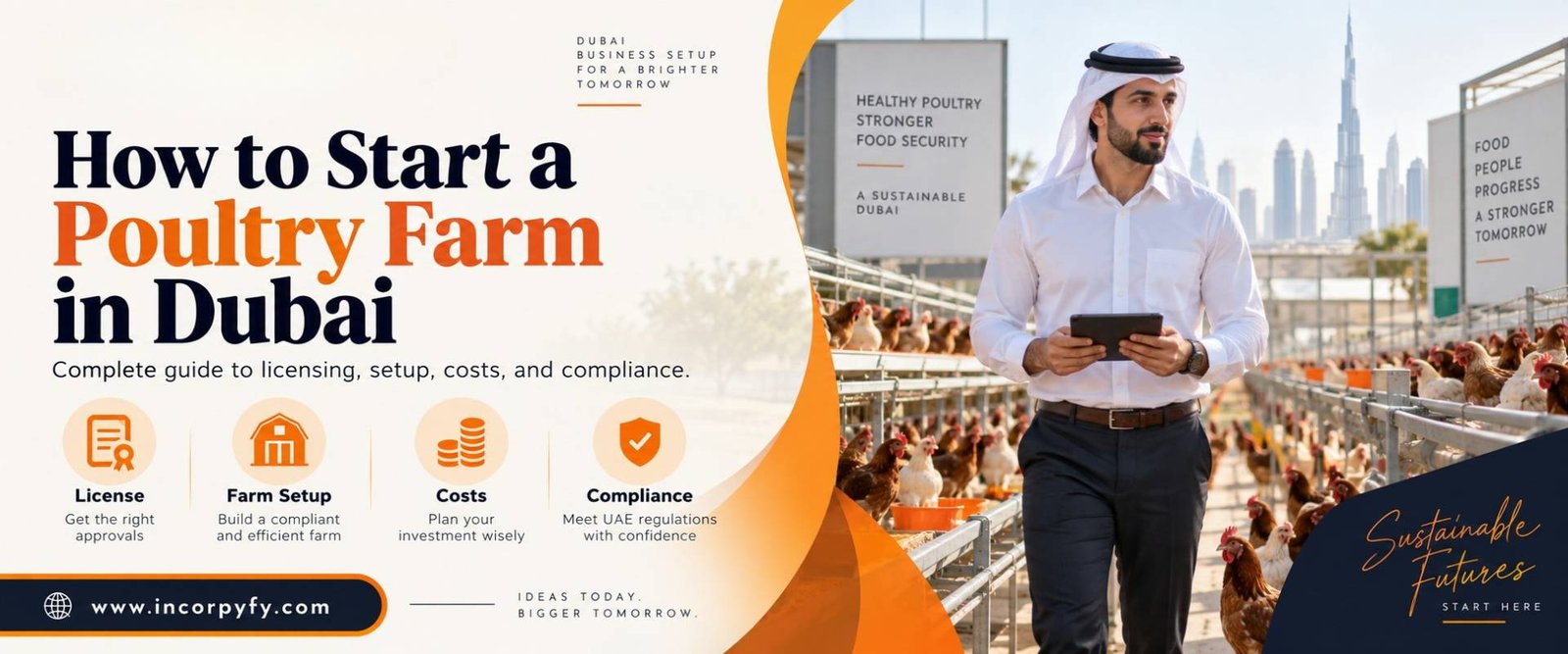
A Dubai poultry farm operates under activity code 0146.00, Raising of Poultry, requiring both a trade license and two specific post-license approvals from the Agriculture and Irrigation Department and Dubai Municipality’s Public Health Department. A detail many guides miss: this license covers breeding and rearing only, not slaughterhouse operations or meat processing, which need separate authorization entirely.
Dubai’s rapidly growing population and thriving hospitality sector have created substantial demand for poultry products. Starting a poultry farm business in the UAE presents genuine opportunities for entrepreneurs entering the agricultural sector. With the right planning, licensing, and execution, your Dubai poultry farm can become a profitable venture that contributes directly to the emirate’s food security goals.
The UAE poultry industry has shown consistent growth, driven by increasing consumer demand for fresh, locally produced chicken and eggs, backed by the government’s National Food Security Strategy 2051 and its target of 100% domestic procurement for key animal products, including poultry, by 2030. This guide covers the licensing specifics, real costs, and operational requirements that a lot of general coverage of this topic leaves out.
Understanding Dubai’s Poultry Market Landscape
The Dubai poultry market is experiencing genuine growth, with local consumption reaching impressive levels annually. The emirate’s commitment to food security has created favorable conditions for domestic poultry production, and major hotels, restaurants, and retail chains actively seek reliable local suppliers, creating real opportunities for commercial poultry farming.
Current market trends show strong demand for both broiler chickens and layer chickens. The hospitality sector, spanning thousands of restaurants and hotels, requires a consistent supply of high-quality poultry products, and the growing health-conscious population increasingly prefers locally sourced, fresh poultry over imported alternatives.
Government initiatives supporting sustainable agriculture have resulted in incentives and support programs for poultry farmers. Dubai Municipality and the Ministry of Climate Change and Environment actively promote local food production through grants, technical assistance, and increasingly streamlined licensing processes.
The Activity Code and Licensing Reality Most Guides Simplify
This is worth getting right from the start, since a lot of general guides describe poultry licensing vaguely without naming the actual activity classification. Poultry farming in Dubai falls under Animal Production, with the specific activity code 0146.00, Raising of Poultry, covering the breeding, rearing, and producing of domesticated birds, chickens, turkeys, ducks, geese, and quails, for meat, eggs, or both.
Here’s the detail most general guides genuinely miss: this activity code specifically excludes feather production, slaughterhouse operations, and the production of fresh, chilled, frozen, dried, salted, or smoked meat or meat products. A poultry farm license authorizes you to raise the birds, not to process or slaughter them commercially. If your business model includes processing, you’ll need entirely separate licensing and approvals covering that specific activity, a distinction that genuinely changes your regulatory scope and investment planning if you assumed your farming license covered the full supply chain from live bird through to packaged product.
Some free zones don’t offer this activity code for selection at all, so confirming availability with your specific chosen free zone or mainland authority before finalizing your business plan matters, rather than discovering the limitation after you’ve already committed to a jurisdiction that doesn’t actually support your intended activity.
Legal Requirements and the Two Post-License Approvals
Establishing a legal poultry farm in Dubai requires securing your trade license first, then obtaining two specific post-license approvals before you can actually begin operating, a sequence worth understanding clearly rather than assuming licensing alone permits you to start:
- Agriculture and Irrigation Department approval: covers land suitability, farm infrastructure, and farming practices specifically, confirming your chosen site and setup actually meets agricultural standards
- Ministry of Climate Change and Environment Public Health Department (Dubai Municipality) approval: assesses health and safety, waste management, disease control, and biosecurity standards, protecting both your flock and broader public health
Both approvals come after your license is issued and before you start operating, not in parallel with the licensing process itself, so sequencing your setup timeline around this order avoids assuming you can begin farming the moment your trade license arrives. Trade license acquisition runs through DET (Dubai Department of Economy and Tourism) for mainland setups or the relevant free zone authority, depending on your intended scale of operation and target market.
Foreign Ownership: What Actually Applies
Some older guidance on this topic still frames poultry farming as requiring a UAE national partner or Local Service Agent by default, a picture rooted in pre-2020 Commercial Companies Law requirements. Under current UAE Commercial Companies Law reforms, most mainland business activities, including many agricultural categories, now permit 100% foreign ownership without a mandatory local partner, and free zone routes for animal production activities specifically confirm full foreign ownership as standard, alongside a structured tax position for qualifying income. Confirming your specific activity’s current ownership status with DET or your chosen free zone directly, rather than assuming the older partnership model still applies universally, avoids structuring your business around a requirement that may no longer exist for your specific activity and jurisdiction combination.
Choosing the Right Location for Your Dubai Poultry Farm
Location selection significantly impacts the success of your poultry farming venture. The ideal location balances market accessibility, zoning compliance, and operational efficiency, with agricultural zones specifically designated for farming activities offering favorable conditions.
Dubai Investments Park and surrounding areas provide strong opportunities for commercial poultry farms, offering adequate space for expansion, proximity to major transportation routes, and access to essential utilities.
When evaluating sites, consider proximity to feed suppliers and veterinary services. Reduced transportation costs for feed, which typically represents 60 to 70% of operational expenses, can significantly improve profitability. Biosecurity considerations are paramount: your site should be isolated from other poultry operations, residential areas, and high-traffic zones to minimize disease transmission risk, with proper drainage, prevailing wind direction, and soil composition all influencing suitability.
Setting Up Poultry Farm Infrastructure and Equipment
Modern poultry farm setup requires real investment in climate-controlled poultry houses, essential for maintaining optimal conditions in Dubai’s challenging heat. These facilities need proper ventilation, temperature control, and humidity management to support bird welfare and productivity.
Automated feeding systems improve efficiency and reduce labor costs, while water systems must provide clean, continuous supply with backup capability. Egg collection systems for layer operations should preserve quality and reduce damage, and waste management systems are essential both for environmental compliance and operational sustainability.
Biosecurity infrastructure, entrance disinfection stations, isolation areas for sick birds, and proper waste disposal, prevents disease outbreaks that could devastate your flock and jeopardize your license standing. Power backup systems ensure continuous operation during outages, since ventilation and water supply failures during Dubai’s heat can be genuinely catastrophic for a flock within hours.
Sourcing Quality Poultry Breeds and Feed Suppliers
Selecting heat-tolerant breeds is crucial for operational success in the UAE’s climate. Commercial broiler strains like Ross and Cobb are popular for meat production, while layer breeds such as ISA Brown and Lohmann provide strong egg production, both showing better productivity and lower mortality under high-temperature conditions than less climate-adapted breeds.
Establishing relationships with reputable chick suppliers ensures consistent access to quality, vaccinated day-old chicks with better disease resistance. Feed quality directly impacts performance and profitability, with starter, grower, and finisher formulations requiring different nutritional profiles at each growth stage, and layer feed specifically needing appropriate calcium and protein levels for consistent egg production.
Health Management and Veterinary Care
Comprehensive health management is essential given Dubai’s climate. Vaccination schedules developed with qualified veterinarians prevent common diseases, with Newcastle disease, infectious bronchitis, and Gumboro disease representing primary concerns requiring systematic programs. UAE law also requires appointing a veterinary doctor who has passed the relevant Health Authority examination before practicing.
Biosecurity protocols include visitor restrictions, vehicle disinfection, and personnel hygiene measures, with all farm workers trained on disease prevention and early symptom recognition. Medication management requires strict adherence to UAE pharmaceutical regulations for livestock, with proper record-keeping ensuring compliance with food safety standards and withdrawal periods.
Marketing and Distribution Strategies
Direct sales to restaurants, hotels, and retail outlets often provide better margins than wholesale distribution, and building relationships with hospitality procurement managers creates stable, long-term revenue streams. Farmers markets and organic food stores represent a growing segment, with free-range chicken and organic eggs commanding premium prices from health-conscious consumers.
Branding and packaging matter genuinely here: professional packaging highlighting local production, freshness, and quality differentiates your products from imported alternatives, and Halal certification is essential for accessing the broader Muslim consumer market in the UAE.
Real Cost of Starting a Poultry Farm in Dubai
Investment varies significantly by scale and automation level:
| Scale | Bird Count | Estimated Investment (AED) |
|---|---|---|
| Small-scale | 1,000 to 5,000 birds | 100,000 to 300,000 |
| Commercial | 20,000+ birds | 1,000,000+ |
Operating costs include feed, generally 60 to 70% of total costs, labor, utilities, veterinary care, and licensing fees, with feed costs fluctuating based on international grain prices and local distribution expenses. Broiler production typically shows faster returns given 6 to 8 week production cycles, while layer operations require a longer initial investment period but provide steadier ongoing income.
UAE banking services offer agricultural loans and financing options for qualifying poultry ventures, and government grants may be available through agricultural development programs specifically supporting the food security push.
Technology and Modern Farming Techniques
Smart poultry farming incorporates IoT sensors monitoring environmental conditions, feed consumption, and bird behavior in real time, with automated climate control maintaining optimal conditions while managing energy consumption. Solar energy is increasingly popular given Dubai’s abundant sunshine, genuinely reducing electricity costs for energy-intensive operations. Precision feeding systems adjust distribution based on bird age, weight, and performance targets, reducing waste and improving feed conversion efficiency.
Sustainability and Environmental Considerations
Sustainable practices align with both UAE environmental goals and consumer preference. Waste management systems can convert poultry manure into organic fertilizer, creating an additional revenue stream while addressing environmental concerns, and water conservation techniques reduce both cost and environmental impact in Dubai’s arid climate.
Conclusion
Starting a poultry farm in Dubai presents genuine opportunities for entrepreneurs willing to invest in proper planning, infrastructure, and management systems, provided you understand the real activity code, its scope limitations, and the two post-license approvals required before operating. The combination of growing market demand, government food security support, and modern farming technologies creates favorable conditions for successful operations. Our business setup services in Dubai team provides comprehensive support for entrepreneurs establishing poultry farming ventures, from licensing and location selection through infrastructure planning and regulatory compliance. Explore our full company formation services or visit Incorpyfy to get started.
Frequently Asked Questions (FAQs)
What licenses are required to start a poultry farm in Dubai?
A trade license under activity code 0146.00 (Raising of Poultry), followed by approval from the Agriculture and Irrigation Department and the Ministry of Climate Change and Environment’s Public Health Department at Dubai Municipality.
Does a poultry farm license cover slaughtering and meat processing?
No. The Raising of Poultry activity code specifically excludes feather production, slaughterhouse operations, and production of fresh, chilled, frozen, dried, salted, or smoked meat products, all requiring separate licensing and approval.
How much investment is required to start a poultry farm in Dubai?
Investment ranges from AED 100,000 for small-scale operations (1,000 to 5,000 birds) to over AED 1,000,000 for large commercial farms (20,000+ birds), depending on automation level and infrastructure.
What are the best poultry breeds for Dubai’s climate?
Heat-tolerant breeds perform best, including Ross and Cobb for broilers, and ISA Brown and Lohmann for layers, showing better productivity and lower mortality in high-temperature conditions.
Can foreign investors start poultry farms in Dubai with 100% ownership?
Yes, in most cases. Current Commercial Companies Law reforms permit 100% foreign ownership for most agricultural activities on the mainland, and free zone routes for animal production confirm full foreign ownership as standard, rather than the older mandatory local partnership model.
How long does it take to get all necessary licenses and approvals?
The overall process, trade license plus both post-license approvals, typically takes 4 to 8 weeks depending on location, farm size, and documentation completeness, with site inspections potentially extending this timeline.
What veterinary requirements apply to a Dubai poultry farm?
UAE law requires appointing a veterinary doctor who has passed the relevant Health Authority examination, alongside systematic vaccination programs addressing diseases like Newcastle disease, infectious bronchitis, and Gumboro disease.
Are there government incentives for poultry farming in Dubai?
Yes, including agricultural development support tied to the National Food Security Strategy 2051, technical assistance programs, and financing support through UAE banks offering agricultural and livestock-specific loan products.
Is every free zone able to issue a poultry farming license?
No. Some free zones don’t offer the Raising of Poultry activity code for selection at all, so confirming availability with your specific chosen jurisdiction before finalizing your business plan is a genuinely necessary early step.
What are the main markets for poultry products in Dubai?
Hotels, restaurants, supermarkets, farmers markets, and direct consumers, with the hospitality sector representing the largest market segment for consistent, high-volume sales.
Can I sell my poultry products directly to consumers, or only through wholesale channels?
Both routes are genuinely viable. Many successful Dubai poultry farms combine direct sales to restaurants and hotels for stable volume with farmers market and premium retail channels for higher per-unit margins, rather than relying on a single distribution model exclusively.
Does poultry farming in Dubai require anti-money laundering compliance like some other regulated activities?
No, poultry farming is generally exempt from AML regulations, unlike several other regulated commercial activities in the UAE, though standard business registration, tax, and agricultural compliance obligations still fully apply.
What happens if I want to add meat processing to my poultry business later?
You’ll need to apply for entirely separate licensing and approvals covering slaughterhouse or meat processing activity specifically, since your original Raising of Poultry license doesn’t extend to cover this scope automatically, regardless of how long you’ve held it or how compliant your farming operation has been.