


Summary
You can check a UAE trade license for free through official government portals: the Invest in Dubai platform for Dubai mainland companies, the ADDED portal for Abu Dhabi, each emirate’s own economic department for the rest, and free zone-specific directories for JAFZA, DMCC, DIFC, and others. For a UAE-wide search, the federal National Economic Registry covers over 1.5 million licenses across all emirates and jurisdictions. This guide gives the exact portals, steps, and what each result actually tells you.
In today’s digital age, verifying trade licenses in the UAE has become more accessible than ever, provided you know which of the country’s several separate systems to actually use. Whether you’re a business owner, investor, supplier, or potential customer, checking a UAE trade license online is one of the simplest due diligence steps available, and one of the most commonly done wrong, mostly by searching the wrong portal for a company’s actual jurisdiction rather than any fault of the verification systems themselves. This guide walks through exactly where to look, what each platform shows, and how to avoid the most common verification mistakes, whether you’re checking your own company’s status or someone else’s.
Understanding the UAE Trade License System
The UAE doesn’t run a single national licensing database in the way many countries do. Each emirate’s economic department issues and manages its own mainland licenses, and every free zone, JAFZA, DMCC, DIFC, and dozens of others, maintains its own separate registry outside that emirate’s mainland system. A trade license itself confirms a company’s registered name, licence number, permitted activities, validity dates, and registered address, and understanding this fragmented structure before you search saves real time, rather than assuming one portal will surface every company regardless of where it’s actually registered.
There is, however, a genuinely useful federal-level option most guides on this topic don’t mention: the National Economic Registry (NER), run by the UAE Ministry of Economy and Tourism, which indexes over 1.5 million licenses across mainland, free zone, and offshore companies nationwide. It’s a strong first stop if you’re not certain which emirate or free zone issued a company’s license, and it exists specifically to reduce the fragmentation described above.
How to Check a Dubai Mainland Trade License
Dubai’s former DED is now the Department of Economy and Tourism (DET), and mainland license verification runs through the Invest in Dubai platform rather than a generic “Dubai Economy website,” a distinction worth knowing since older guides and bookmarked links may point you to a retired page.
- Go to the DET e-services portal at app.invest.dubai.ae, or open the Dubai REST app for the same service on mobile.
- Select “Trade License Verification” or “Search Business Activities” from the services menu.
- Search using the trade license number, the Dubai Unified Licence (DUL) number, or the registered business name in English or Arabic. The license number gives the most reliable match, since company names can have minor spelling variations across records.
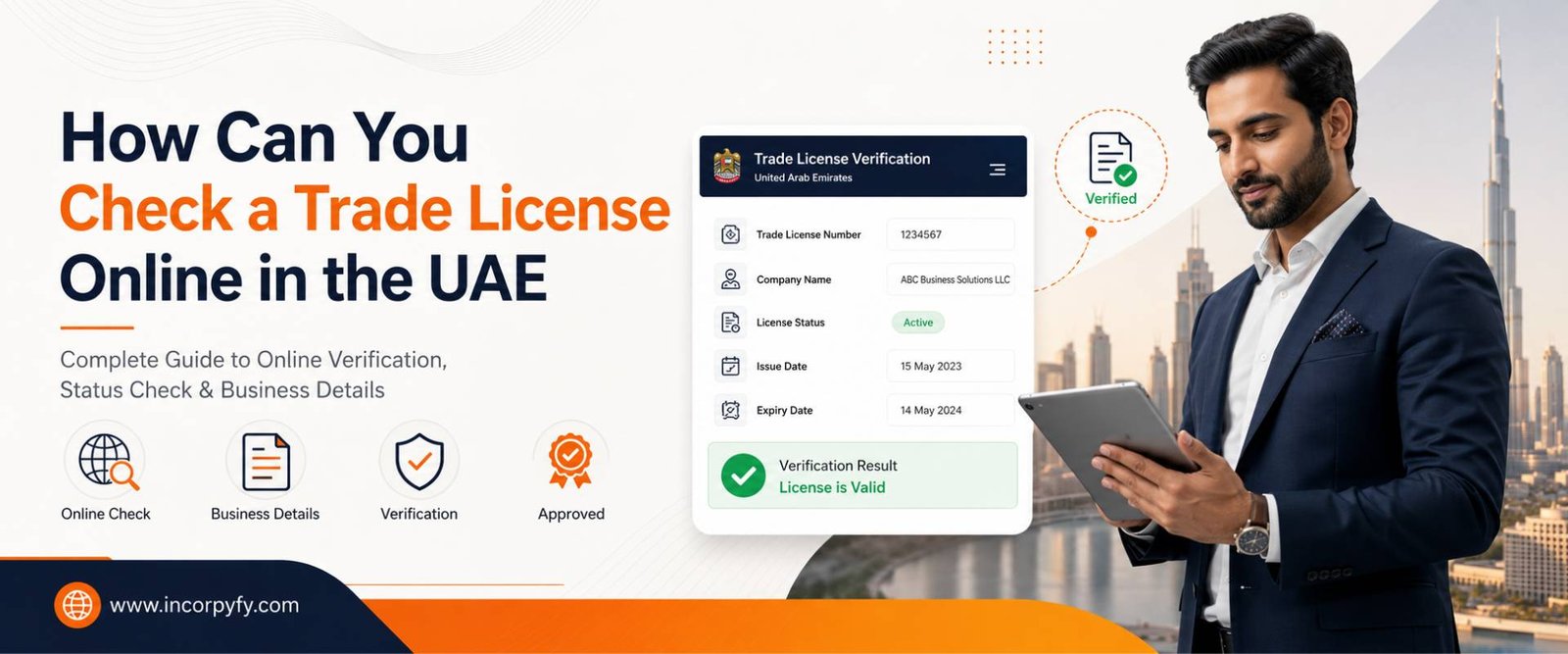
- Review the result: license status (active, expired, or cancelled), expiry date, registered trade name, licensed business activities, legal form, and registered address.
- For formal due diligence documentation, DET also offers a paid trade license certificate download carrying an official stamp and QR code, worth the small fee if you need something more official than a screenshot for a bank, contract, or tender submission.
If the business also handles food service, healthcare, or another municipally regulated activity, Dubai Municipality maintains a separate permit verification system alongside the trade license itself, both should be checked for customer-facing regulated businesses.
How to Check the National Economic Registry (UAE-Wide)
If you’re not sure which emirate issued a license, or you want one search that spans mainland, free zone, and offshore companies together, the National Economic Registry at ner.economy.ae is the right starting point.
- Visit the National Economic Registry.
- Search by business name, trade name, or license/registration number.
- Review the returned entity details, including licensing authority, activity classification, and status.
This platform won’t replace a jurisdiction-specific search when you need the deepest detail (a free zone’s own directory will often show more granular activity codes, for instance), but it’s genuinely useful for a first pass, particularly when you’re verifying a company you know little about beyond its name.
How to Check an Abu Dhabi Trade License
Abu Dhabi mainland companies are verified through the Abu Dhabi Department of Economic Development (ADDED) at added.gov.ae. Search by trade license number, company name, or registration number to retrieve licensed activities, economic sector classification, and current status.
Abu Dhabi Global Market (ADGM), the emirate’s financial free zone, runs entirely separately from mainland ADDED. Financial services firms, investment companies, and professional service providers licensed in ADGM must be verified through the ADGM’s own portal, not the mainland Abu Dhabi system, a distinction worth getting right before you assume a company’s ADGM status one way or the other.
Sharjah and the Northern Emirates
Sharjah maintains its own verification system through the Sharjah Department of Economic Development (SDED), with Arabic-language support built in given the strength of the local business community there, and its own online portal separate from both Dubai’s DET and Abu Dhabi’s ADDED. Ajman, Fujairah, Ras Al Khaimah, and Umm Al Quwain each run their own individual systems too, generally smaller databases than Dubai or Abu Dhabi’s, but often with more direct access to government contacts if a search doesn’t return the result you expect.
If a business could plausibly be registered in more than one emirate, or you’re verifying a multi-branch company, budget time to check each relevant jurisdiction separately rather than assuming one search covers the whole picture, and remember the National Economic Registry can serve as a useful first pass across all of them at once.
Free Zone License Verification
Dubai’s free zones each run independent registries, separate from DET:
- JAFZA: search by license number or company name through the JAFZA portal for authorised activities and office location.
- DMCC: use the DMCC member directory, searchable by company name or registration number, with particular relevance for commodities and precious metals trading companies.
- DIFC: the DIFC portal covers financial services companies specifically, with verification details suited to regulatory and compliance checks in that sector.
Abu Dhabi free zones (KEZAD, Masdar City, and others) and Sharjah free zones (SAIF Zone, Hamriyah Free Zone) each run their own separate systems too. The pattern across almost every free zone is the same: search by license number for the most reliable match, and don’t assume a mainland search will surface a free zone company, or vice versa.
Step-by-Step Verification Best Practices
- Identify the jurisdiction first. Mainland or free zone, and which emirate, determines which portal you actually need; guessing wastes time and often leads to a false “not found” result that has nothing to do with whether the company is real.
- Use the license number over the company name where possible. Names in Arabic and English can differ meaningfully, and minor spelling variations are a common cause of “no results found,” even for perfectly legitimate, active companies.
- Cross-reference for high-value transactions. For significant contracts or partnerships, check both the jurisdiction-specific portal and the National Economic Registry to confirm consistency between the two.
- Document your results. Save a screenshot or download the official certificate where available, along with the date of verification, for your own records and any future compliance review.
- Re-verify periodically for ongoing relationships. Annual verification is a reasonable baseline; higher-value or longer-term partnerships warrant more frequent checks, particularly around contract renewal periods.
Troubleshooting Common Verification Issues
- Inconsistent results across platforms usually mean a recent renewal or amendment hasn’t yet synced across every system. Contact the relevant authority directly if a discrepancy affects a decision you’re about to make, rather than assuming either result is automatically the correct one.
- Arabic-English name mismatches are a frequent cause of failed searches. Where possible, search with the license number instead, or try both language versions of the name before concluding a company isn’t registered.
- Recently issued or renewed licenses can take time to appear online. If a company insists their license was just issued or renewed, ask for the physical certificate as interim confirmation while the online record catches up.
- Technical access issues (browser compatibility, temporary portal downtime) are usually resolved by trying the relevant mobile app instead, DET and several free zones offer app-based alternatives to their web portals. This same principle applies broadly across UAE government digital services, similar to how checking RTA fines in Dubai offers both a web and app-based route when one channel is temporarily unavailable.
Legal and Regulatory Considerations
UAE data protection rules govern how information obtained through these verification systems can be used and shared. Online results are generally sufficient for commercial due diligence and everyday verification, but formal legal proceedings typically require an official certificate rather than a screenshot or search result, worth requesting directly from the relevant authority if you anticipate needing one. If you’re verifying a company as part of a broader compliance check, our guide on what a company registration number in the UAE actually tells you covers the related identifiers you’ll often need alongside the trade license itself.
Frequently Asked Questions
Is it free to check a trade license online in the UAE?
Yes, government portals including DET, ADDED, the National Economic Registry, and free zone directories all offer free basic verification. Paid options exist for official, stamped certificates.
Can I check trade licenses from all UAE emirates through one platform?
For the most detailed results, no, each emirate and free zone maintains its own system. But the federal National Economic Registry does offer a genuine UAE-wide search covering mainland, free zone, and offshore licenses, a useful starting point when you’re unsure of the jurisdiction.
What information do I need to verify a trade license?
A license number gives the most reliable result. The exact registered company name, in English or Arabic, also works but is more prone to spelling-related mismatches.
How often should I verify a company’s trade license?
Annually is a reasonable baseline for ongoing relationships. High-value transactions or new partnerships warrant verification before you commit, not after.
Is the DED the same as DET?
Yes. Dubai’s Department of Economic Development (DED) was rebranded the Department of Economy and Tourism (DET); older references to “DED” typically mean the same authority.
Do free zone companies need a different verification process?
Yes. Free zone companies are verified through that specific free zone’s own portal or directory, not through the mainland emirate’s system.
Can online verification results be used for legal purposes?
They’re generally sufficient for commercial due diligence, but formal legal proceedings usually require an official, stamped certificate from the issuing authority rather than a screenshot.
Getting Support with UAE Business Verification and Setup
Checking a trade license online takes a couple of minutes once you know which of the UAE’s several separate systems actually applies, DET for Dubai mainland, the National Economic Registry for a broader UAE-wide search, ADDED for Abu Dhabi, and each free zone’s own directory otherwise. It’s a habit worth building into any commercial relationship, not just a one-time check before signing.
Incorpyfy supports businesses and investors with trade licensing in Dubai, from new applications to renewals and ongoing compliance, alongside broader business setup in Dubai for companies establishing or expanding their UAE presence.