
Summary
A cloud kitchen in Saudi Arabia needs Commercial Registration, an SFDA food license, municipality approval, and Civil Defence clearance. Total setup typically runs SAR 150,000 to SAR 400,000, and foreign investors can generally own 100% of the business through MISA registration rather than a mandatory local sponsor, a point a lot of existing guides still get wrong.
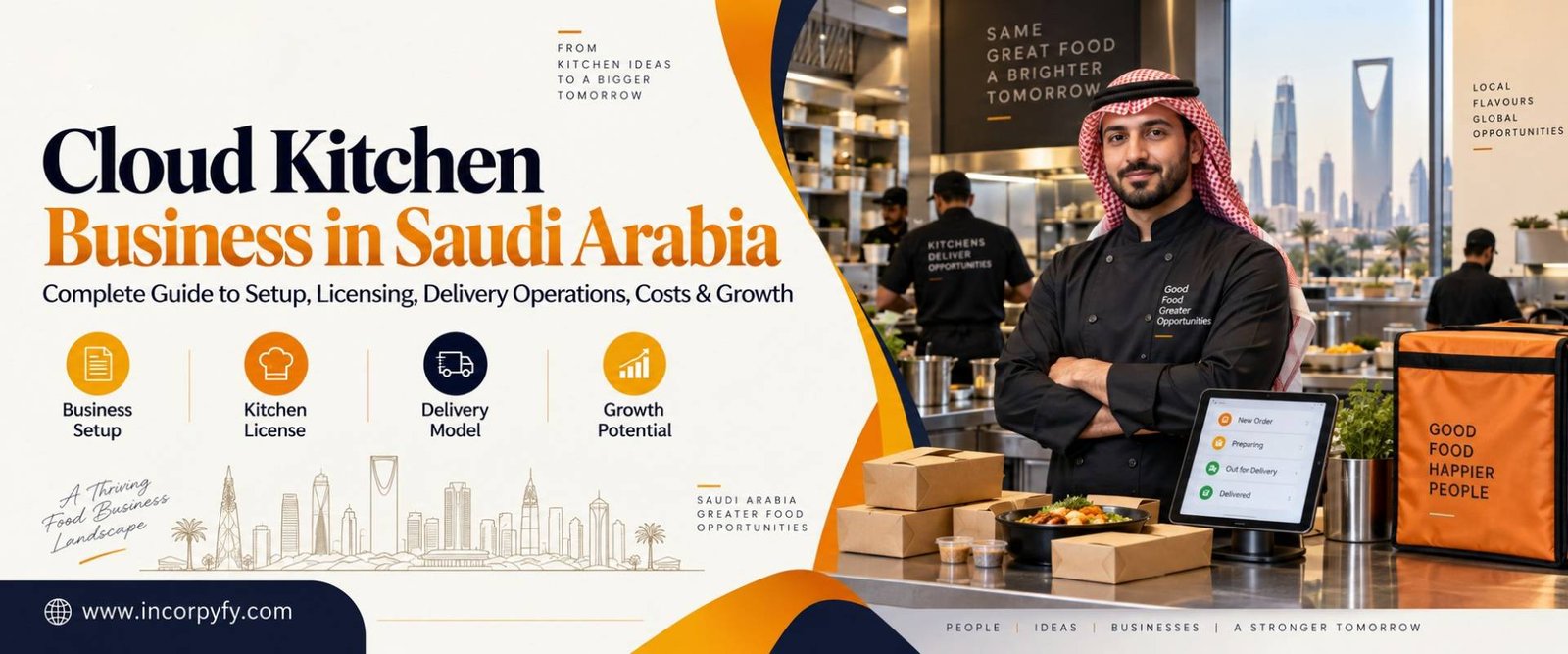
In recent years, the cloud kitchen business in Saudi Arabia has gained major attention from food entrepreneurs, investors, and even international chains. With rising demand for food delivery and the digital transformation of the F&B industry, Saudi Arabia has become one of the most promising markets for launching virtual kitchen businesses. This guide explains everything you need to know to set up and succeed in this growing sector, including the ownership rules that a fair amount of existing content still describes inaccurately.
A meaningful share of guides on this topic still frame foreign ownership as conditional on finding a local sponsor, a picture that hasn’t matched Saudi Arabia’s actual investment framework for some time now. Getting this detail right matters early, since it shapes how you structure the business from day one rather than something to revisit after registration is already underway.
What Is a Cloud Kitchen?
A cloud kitchen, also known as a ghost kitchen or virtual kitchen, is a food business model that focuses solely on online orders and deliveries. It operates without a dine-in facility, allowing operators to cut down on overhead costs like rent, front-of-house staff, and interior design that a traditional restaurant needs to budget for.
Why Cloud Kitchens Are Growing in Saudi Arabia
With the popularity of apps like Jahez, HungerStation, and Talabat, food delivery has become a genuine lifestyle habit in Saudi Arabia. High smartphone usage, busy work schedules, and the convenience of ordering from home combine to create a genuinely strong environment for cloud kitchens to thrive, particularly in dense urban centers like Riyadh, Jeddah, and Dammam.
Advantages of Starting a Cloud Kitchen in Saudi Arabia
- Lower startup costs: no need to rent premium dine-in space or invest heavily in interiors
- Scalable model: expand into new areas without setting up a full new restaurant each time
- Multiple brands under one roof: a single kitchen can run several food brands simultaneously, a strategy increasingly common among established operators
- Access to a tech-savvy market: most consumers already use food delivery apps regularly, reducing the customer education needed to launch
- Government support: Vision 2030 actively welcomes innovation and foreign investment in food services specifically
Foreign Ownership: What Actually Applies Today
This is worth clarifying directly, since a fair amount of existing content on this topic still frames a local sponsor as mandatory for foreign investors. Under Saudi Arabia’s current investment framework, administered through the Ministry of Investment of Saudi Arabia (MISA), 100% foreign ownership is generally permitted for food and beverage activities, including cloud kitchens, provided the business isn’t on the limited negative list of restricted sectors. MISA replaced the former SAGIA, so any guide still referencing SAGIA or framing a Saudi partner as a default requirement is describing an outdated process rather than the current one.
This doesn’t mean a local partner is never useful. Plenty of foreign-owned cloud kitchen brands still bring on Saudi partners for market knowledge, supplier relationships, or access to specific commercial opportunities, but that’s a strategic choice made on its own merits, not a legal precondition for operating in the sector.
Steps to Start a Cloud Kitchen in Saudi Arabia
Step 1: Research the Market
Understand your customer base. Look at which cuisines are in demand, what price points work, and what competitors are already doing. Pay attention to areas with high delivery demand but fewer dine-in restaurants, since that gap is often where a new cloud kitchen brand finds its fastest traction.
Step 2: Choose the Right Business Structure
Registering your cloud kitchen is mandatory. Options include a sole proprietorship, a Limited Liability Company (LLC), or a branch of a foreign company if you’re an established international operator. Working with licensed setup experts to choose the structure matching your ownership and growth plans avoids a costly restructure later.
Step 3: Legal Registration and Licensing
To start legally, you’ll need:
- Commercial Registration (CR) from the Ministry of Commerce
- MISA investment registration, for foreign investors, completed before Commercial Registration
- Municipality license for operating your kitchen premises
- Food license from the Saudi Food and Drug Authority (SFDA), covering kitchen hygiene, storage, and food handling standards
- Civil Defence approval, confirming your facility meets fire and safety standards
All documents must be complete and approved before you begin operations, and sequencing these correctly, rather than assuming they can run fully in parallel, keeps your timeline realistic.
Step 4: Select a Kitchen Location
Choose a strategic location central to your delivery routes. You can either lease space in a shared or commissary kitchen, which offers pre-approved facilities and equipment, or set up a private kitchen if you want full operational control. Either way, confirm the space meets health, safety, and zoning regulations before signing a lease, since retrofitting a space that wasn’t designed for commercial food preparation adds real unplanned cost.
Technology and Logistics Integration
Technology is the backbone of every cloud kitchen business. You’ll need a POS system to track orders and sales, order management platforms integrated with delivery apps, inventory management software, and fleet management tools if you’re running your own delivery drivers rather than relying purely on aggregators. Most successful cloud kitchens use third-party aggregators like Jahez or HungerStation for initial volume but increasingly build their own ordering apps to reduce commission dependency over time.
Menu Planning and Branding
In a cloud kitchen model, your food is judged by taste, delivery time, and online presence rather than ambiance, which changes the priorities compared to a traditional restaurant.
- Design a compact menu that’s easy to prepare consistently and travels well
- Optimize for delivery: avoid items that get soggy, separate, or lose quality during transit
- Build your brand online: strong photography, a memorable name, and a genuine digital presence matter more here than in a dine-in restaurant, since your storefront is entirely digital
Hiring and Staffing
You won’t need waiters or front-of-house staff, but you do need skilled cooks and kitchen support staff who can operate efficiently under delivery-driven time pressure. Hire people with experience in fast-paced kitchen environments and ensure everyone is properly trained on food safety protocols required under your SFDA licensing.
Marketing Your Cloud Kitchen
Your entire customer journey is online, so your marketing strategy should be too:
- List on popular food apps for instant access to a large existing user base
- Use Google My Business to support visibility in local, location-based searches
- Promote on social media, particularly Instagram, TikTok, and Snapchat, which carry genuine weight in the Saudi consumer market
- Run paid ads, including Google Ads and influencer partnerships, to accelerate early traction beyond organic growth alone
Challenges in Running a Cloud Kitchen
- High competition: standing out requires genuine food quality and consistency, not just app visibility, since a saturated delivery app marketplace rewards repeat customers over one-time discovery
- Logistics management: late deliveries damage your reputation quickly, since a cloud kitchen’s entire customer experience hinges on delivery performance in a way a dine-in restaurant’s doesn’t
- Limited customer interaction: building loyalty is harder without face-to-face contact, requiring more deliberate brand-building through packaging, consistency, and digital engagement to compensate for the missing in-person relationship
- Dependence on delivery platforms: aggregator commissions meaningfully reduce margins, making a genuine strategy for reducing platform dependency over time worth planning from the start rather than treating as a later optimization once the business is already established and margin pressure is harder to address retroactively
Overcoming these challenges generally comes down to solid operational tools, consistent quality, and loyalty programs or bundling offers that give customers a reason to order directly rather than exclusively through a third-party app, gradually shifting your order mix toward channels that don’t carry a platform commission.
Shared Kitchen vs Private Kitchen: Which Fits Your Launch?
This decision shapes both your upfront cost and your operational flexibility more than almost any other early choice.
- Shared or commissary kitchens offer pre-approved facilities, shared equipment, and often a faster path to launch, since much of the compliance groundwork is already handled by the facility operator. This route suits first-time cloud kitchen founders testing a concept before committing to a larger investment
- Private kitchens give you full control over layout, equipment, and exclusive use of the space, which matters once you’re running multiple brands or need specific equipment a shared facility doesn’t offer. The tradeoff is a meaningfully higher upfront investment and the responsibility of managing your own compliance and maintenance from scratch
Many successful multi-brand operators start in a shared kitchen to validate demand, then transition to a private setup once volume justifies the additional investment, rather than committing to a large private kitchen build before proving the concept actually works in the local market.
Cost of Starting a Cloud Kitchen in Saudi Arabia
| Cost Item | Estimated Range (SAR) |
|---|---|
| Commercial Registration | 1,200 to 2,500 |
| MISA investment registration (foreign investors) | 12,000 to 15,000 in the first year |
| Municipality and SFDA licensing | 5,000 to 10,000 |
| Kitchen rental (shared/commissary space) | 30,000 to 80,000 annually |
| Kitchen rental (private setup) | 60,000 to 150,000+ annually |
| Equipment | 50,000 to 150,000, depending on menu complexity |
| Staffing (wages, insurance, training) | Varies by team size |
| Marketing and branding | 10,000 to 30,000 |
Total realistic setup cost: commonly SAR 150,000 to SAR 400,000, depending on kitchen type, menu scope, and whether you’re launching a single brand or multiple virtual brands from day one. Shared or commissary kitchen setups sit toward the lower end of this range, while a private, fully custom kitchen build pushes costs toward the top.
Cloud Kitchen Business for Foreign Investors
Saudi Arabia is genuinely open to foreign ownership in this sector. As a foreign investor, your path generally runs through:
- MISA investment registration, completed before Commercial Registration, allowing full ownership in most F&B activities rather than requiring a mandatory local partner
- Commercial Registration with the Ministry of Commerce once MISA approval is secured
- Full compliance with SFDA food safety standards and municipality zoning requirements, which apply identically regardless of ownership structure
Working with business setup experts who understand the current regulatory landscape, rather than an outdated sponsor-based model, genuinely speeds up the process and avoids structuring your ownership around a requirement that no longer applies to most F&B activities.
Conclusion
The cloud kitchen business in Saudi Arabia is more than a passing trend, it reflects a genuine, structural shift in how the Kingdom’s food and beverage industry operates. Rising food delivery demand, supportive government reform, and a young, digital-first population make Saudi Arabia a genuinely strong place to launch a virtual food brand. From licensing to technology integration, success depends on getting the fundamentals right from day one, including an accurate understanding of current foreign ownership rules rather than an outdated sponsor requirement. If you’re serious about starting your own cloud kitchen, our business setup services in Saudi Arabia team can guide you through MISA registration, licensing, and the full setup process. Explore our broader Saudi Arabia company formation services or visit Incorpyfy to get started.
FAQs
Is a cloud kitchen legal in Saudi Arabia?
Yes. As long as you obtain the proper licenses from SFDA, the Ministry of Commerce, and Civil Defence, operating a cloud kitchen is fully legal.
Can foreigners open a cloud kitchen in Saudi Arabia?
Yes. Foreign investors register through MISA, and 100% foreign ownership is generally permitted for food and beverage activities including cloud kitchens, rather than requiring a mandatory Saudi sponsor.
How much does it cost to start a cloud kitchen in Saudi Arabia?
Total realistic setup cost commonly runs SAR 150,000 to SAR 400,000, covering Commercial Registration, SFDA and municipality approvals, kitchen setup, equipment, and initial marketing, with foreign-owned businesses budgeting an additional SAR 12,000 to SAR 15,000 for MISA registration.
Do I need a local sponsor to open a cloud kitchen in Saudi Arabia?
Not necessarily. Most F&B activities now permit full foreign ownership through MISA registration, a meaningful shift from the joint-venture model that applied more broadly in the past.
What food performs best for cloud kitchens in Saudi Arabia?
Fast food, healthy bowls, grilled meats, and desserts all perform well, and the market genuinely welcomes diverse cuisines, though consistent quality and reliable delivery timing matter more to repeat business than the specific cuisine chosen.
How long does it take to license a cloud kitchen in Saudi Arabia?
Most straightforward applications with complete documentation clear within a few weeks, though timelines extend if kitchen inspections flag corrections or if MISA and Commercial Registration steps aren’t properly sequenced.
Can I run multiple food brands from one cloud kitchen?
Yes, this is one of the model’s genuine advantages. A single licensed kitchen can operate several virtual brands simultaneously, provided each brand’s activity and menu fits within your registered licensing scope.
Do I need SFDA approval if I only sell through delivery apps?
Yes. SFDA food safety approval applies to your kitchen and food handling practices regardless of whether customers order through your own channel or a third-party delivery platform.
Should I start with a shared kitchen or build a private one?
A shared or commissary kitchen generally offers a faster, lower-cost path to launch and validate demand, while a private kitchen suits operators ready to run multiple brands or needing equipment a shared facility doesn’t provide. Many operators start shared and transition to private once volume justifies the investment.
What happens if a delivery platform commission structure changes after I launch?
Building your own direct ordering channel alongside aggregator listings from the start gives you a buffer against commission changes, since a business entirely dependent on third-party platforms has less room to absorb a sudden fee increase than one with an established direct-order customer base.