


Summary
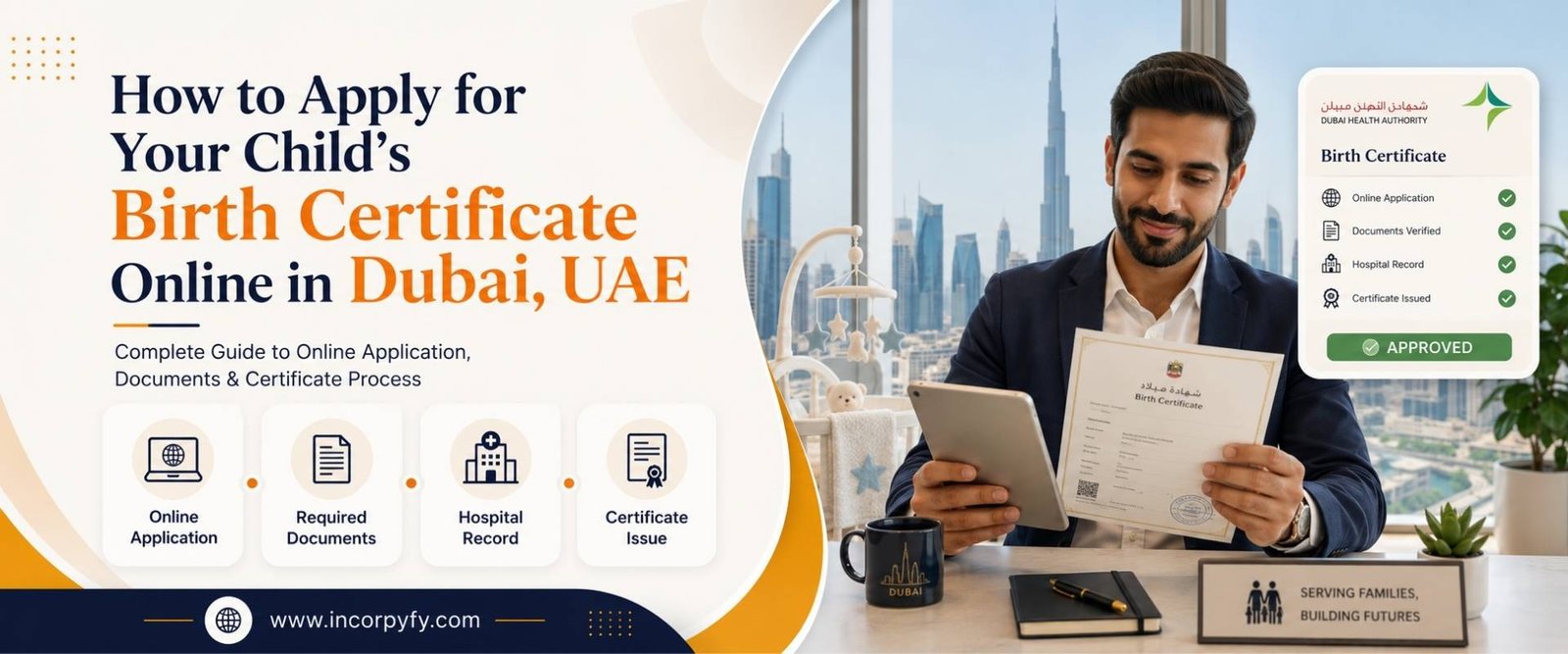
Registering your child’s birth certificate in Dubai is now a fully digital process through the Dubai Health Authority, since hospitals submit the birth notification electronically and parents complete the rest online via UAE Pass. Certificates are issued in Arabic, English, and Urdu, typically within one working day, for a standard fee of AED 50 to 75. Registration is legally required within 30 days of birth. This guide covers the real process, documents, costs, and common mistakes that delay approval.
A birth certificate is your child’s first official document, and in Dubai, registering it online has become genuinely fast and largely paperless, provided you know the current process rather than an older, more manual version of it that still circulates in a lot of guides on this topic. This guide walks through exactly how it works now, what you’ll need, what it costs, and what to do if your situation falls outside the standard case, like a home birth or a delayed registration.
Why the Birth Certificate Matters and Why Timing Counts
A birth certificate confirms your child’s name, date and place of birth, and parentage, it’s the foundational document behind a residency visa, passport application, and school enrolment later on. In Dubai, you’re legally required to register your child’s birth within 30 days of the birth occurring inside the UAE. Missing this window doesn’t make registration impossible, but it does add complications and, in some cases, penalties, so treat it as a genuine deadline rather than a loose guideline you can revisit once things settle down after a busy first few weeks with a newborn.
Who Can Apply
Either parent, mother or father, can typically initiate the application, and legal guardians or authorised representatives can apply in specific circumstances. The process is broadly the same for Emirati nationals and expatriate residents, though the exact documents required differ slightly by nationality and residency status.
Which Authority Handles Your Application: DHA or MOHAP
This depends on where your child was born, not a free choice between the two. Births at Dubai Health Authority-regulated hospitals, which now includes most major public and private hospitals across the emirate, are registered through DHA’s digital system. Births at facilities falling under the Ministry of Health and Prevention’s jurisdiction, more relevant outside Dubai or at specific federal facilities, go through MOHAP instead. Check with your hospital directly if you’re unsure which applies, since this determines your portal, not your personal preference, and starting the wrong application wastes time you don’t need to lose during an already busy period.
Documents You’ll Need
- Hospital-issued birth notification, which the hospital now typically submits directly into the electronic system rather than handing you a paper copy to re-upload yourself
- Valid Emirates ID for both parents (or passport with residency visa page for newly arrived residents)
- Attested marriage certificate, translated into Arabic if issued in another language, or an official document confirming the child’s lineage
- For UAE citizens specifically: family book alongside Emirates ID
Having clear, high-quality digital copies ready before you start speeds up the process meaningfully, since blurry or incomplete uploads are one of the most common causes of delay.
Step-by-Step: How the Online Process Actually Works
- The hospital submits the birth notification electronically. This happens automatically once your baby is born at a DHA-regulated facility, you don’t need to collect a paper form and deliver it anywhere yourself.
- Log in via UAE Pass on the DHA portal to access the birth certificate service.
- Complete the online application, confirming your child’s full name, date and time of birth, nationality, and parents’ details exactly as they appear on the hospital notification.
- Upload supporting documents: Emirates IDs, marriage certificate, and any additional documentation specific to your residency status.
- Select your certificate language(s) and copy count. Certificates are available in Arabic, English, and Urdu, and you can request multiple copies at this stage rather than applying again later.
- Pay the applicable fee online and submit.
- Receive your certificate, typically within one working day, delivered via email or accessible through the portal, with an optional courier delivery for a physical printed copy.
Real Costs
- Standard certificate fee: approximately AED 50 to 75, varying slightly by hospital and issuing authority.
- Additional copies: a smaller per-copy fee if you need more than the standard issuance.
- Urgent processing: where available, at a modestly higher fee for faster turnaround.
- Translation and attestation (if your marriage certificate or other documents need this): budget separately, since this isn’t included in the certificate fee itself.
Processing Time
Most applications are completed within one working day once submitted with complete documentation, a meaningful improvement over the older, more manual process this service replaced. Certificates are delivered digitally by default, with a courier option for a physical copy if your situation requires one, for school registration purposes, for instance, where an original hard copy is sometimes specifically requested.
Common Mistakes That Cause Delays
- Name and date discrepancies. The details you enter must match the hospital’s birth notification exactly; small spelling differences between systems are one of the most common causes of processing delay, and worth double-checking before you submit rather than after a rejection notice.
- Unattested or informally translated marriage certificates. Documents in a language other than Arabic need proper attestation, not just a translation you’ve arranged privately, however accurate that translation might genuinely be.
- Incomplete document uploads. Missing a required file resubmits your entire application for review rather than just the missing piece, so a quick checklist review before submitting saves a real delay.
- Assuming a home birth follows the same process. If your child wasn’t born in a hospital, additional documentation and likely an in-person DHA visit are required, covered below.
- Waiting too long to start. With a 30-day legal window, starting the process promptly, even amid the general chaos of a newborn’s first weeks, avoids the complications that come with a late registration.
What If the Birth Wasn’t in a Hospital?
Home births or deliveries outside a DHA-regulated facility require additional documentation and typically an in-person visit to DHA for verification, since the automatic hospital-to-system submission that makes the standard process fast simply isn’t available in this scenario. If this applies to you, budget more time and consider professional support to avoid delays at this stage specifically.
What Comes Next: Visa and Family Considerations
Once your child’s birth certificate is issued, it becomes the foundation for their residency visa application and, eventually, other documentation like a passport. If you’re navigating broader family visa questions alongside this, our guides to UAE family visa cost and requirements and checking your Emirates ID status cover the related steps that typically follow birth registration.
When to Get Professional Help
If you missed the 30-day window, had a home birth without standard hospital documentation, or need document attestation and translation handled properly, a PRO service or business consultant familiar with UAE government processes can meaningfully reduce back-and-forth, particularly for expat families navigating this for the first time.
Frequently Asked Questions
How soon after birth should I apply for the certificate?
Within 30 days of the birth, as required by UAE law. Delays can complicate visa and passport processing for your child.
Can I apply for the birth certificate if my child was born at home?
Yes, but you’ll need additional documentation and typically an in-person visit to DHA for verification, since the automatic hospital submission used in the standard process isn’t available.
Is the online birth certificate valid for all government uses?
Yes, it’s accepted for visa applications, passport processing, and school enrolment.
Do I need to translate my marriage certificate into Arabic?
Yes, if it was issued in another language, it needs both translation and formal attestation, not an informal translation alone.
What languages is the birth certificate available in?
Arabic, English, and Urdu.
How do I log in to apply?
Through UAE Pass, linked to the DHA portal for the birth certificate service.
How long does it take to receive the certificate?
Typically within one working day once your application and documents are complete.
Can I get extra copies of the birth certificate?
Yes, additional copies can be requested during the initial application or afterward through the portal, for a small additional fee.
Getting Support With Your Child’s Birth Registration
Registering your child’s birth online in Dubai is genuinely straightforward once you know the current process, largely digital, hospital-initiated, and typically resolved within a day. Getting the details right the first time, names, dates, and document attestation, avoids the small errors that most commonly cause delays.
For broader support navigating UAE government services and documentation as your family settles in Dubai, Incorpyfy offers PRO services in Dubai alongside business setup services for expat entrepreneurs building their life and business in the city together.