


Summary
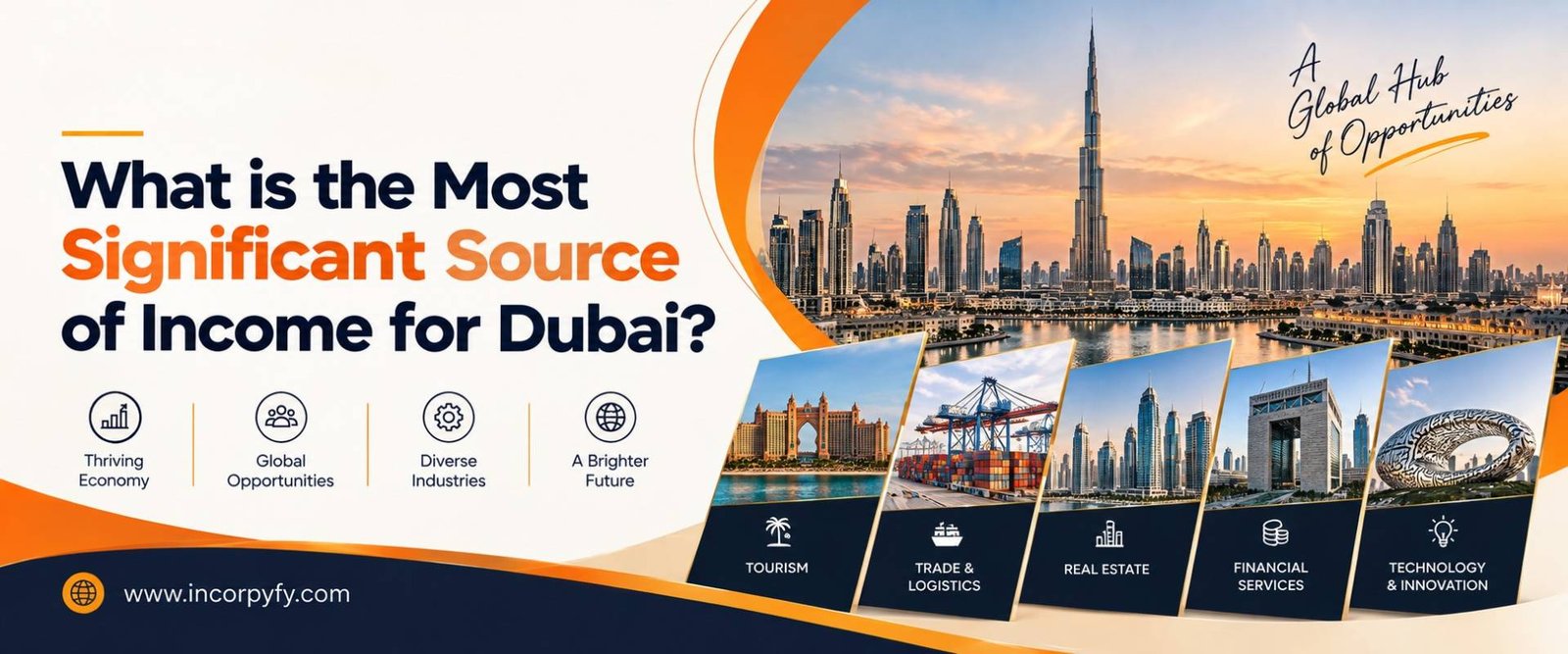
Contrary to a common assumption, oil is not Dubai’s most significant source of income. Wholesale and retail trade is consistently the emirate’s largest contributor to GDP, at roughly 22 to 25 percent, with financial services, real estate, and tourism-linked sectors close behind. Oil and gas now account for well under 2 percent of Dubai’s economy, down from around half in the early 1980s.
Dubai is routinely assumed to be an oil economy simply because it sits in the Gulf and shares a country with Abu Dhabi, which does hold substantial oil reserves. The reality of Dubai’s own economy looks nothing like that assumption, and hasn’t for decades. It’s one of the more persistent economic myths about the region, repeated often enough that even some business content still gets the basic fact backwards.
This guide walks through what actually drives Dubai’s income today, using current GDP data by sector, and explains why the oil myth persists even though the numbers have told a different story for a very long time.
The Real Answer: Trade, Not Oil, Leads Dubai’s Economy
According to Dubai’s Department of Economy and Tourism, wholesale and retail trade has consistently been the emirate’s largest single contributor to GDP, typically accounting for 22 to 25 percent of total output in recent reporting periods. This sector covers everything from Dubai’s position as a global re-export hub to its retail and wholesale distribution networks connecting Asia, Europe, and Africa.
Financial and insurance activities generally rank second, contributing around 13 to 14 percent of GDP, followed by real estate at roughly 8 to 11 percent and construction at around 7 to 8 percent, figures that shift modestly from quarter to quarter but have held this general ranking consistently.
Why the Oil Myth Persists
The confusion is understandable. Oil revenue genuinely built much of the infrastructure, roads, ports, and airports, that later enabled Dubai’s diversified economy to flourish. But GDP measures what an economy actually produces today, not the historical origin of the capital that built it decades ago. Oil funded the platform; trade, finance, tourism, and logistics are what actually run on it now.
Government officials have periodically confirmed just how far this shift has gone. Oil’s share of Dubai’s GDP fell from around 54 percent in the early 1980s to below 7 percent by the mid-2000s, and international analysis has placed it at under 1 percent by 2009. The most recent official GDP tables assign the broader “mining and quarrying” category, which includes more than crude oil alone, at roughly 2 percent or less of total output. Dubai, in short, stopped being meaningfully dependent on oil a very long time before most casual observers assume.
Dubai’s GDP by Sector: The Real Breakdown
Based on recent Dubai Department of Economy and Tourism reporting, the approximate sector contribution to GDP looks like this:
| Sector | Approximate Share of GDP |
|---|---|
| Wholesale and retail trade | 22 to 25% |
| Financial and insurance activities | 13 to 14% |
| Real estate activities | 8 to 11% |
| Construction | 7 to 8% |
| Manufacturing | 8 to 9% |
| Transportation and storage | 3 to 10%, varies by period |
| Information and communication | 5% |
| Accommodation and food services (tourism-linked) | 4% |
| Administrative and support services | 4 to 5% |
| Mining and quarrying (including oil) | Under 2% |
These figures move somewhat from quarter to quarter as different sectors grow at different rates, but the overall ranking, trade first, followed by finance and real estate, has remained stable across recent reporting periods.
Wholesale and Retail Trade: Dubai’s Largest Sector
Dubai’s position as a re-export and distribution hub, connecting manufacturers in Asia with markets across the Middle East, Africa, and beyond, is the single biggest driver of its economy. Jebel Ali Port, one of the world’s largest man-made harbors, alongside Dubai International Airport’s cargo operations, gives the emirate genuine physical infrastructure to back up this trading role rather than a purely service-based claim to the title.
Financial Services: The Second Pillar
Dubai’s financial sector has grown steadily, anchored by the Dubai International Financial Centre (DIFC), an independent common law jurisdiction that has attracted global banks, asset managers, and increasingly fintech and virtual asset businesses. Favorable tax treatment, a stable regulatory environment, and DIFC’s own courts have made this sector a genuine second pillar of the economy rather than a supporting player. Growth in financial and insurance activities has regularly outpaced the overall economy in recent reporting periods, reflecting both new entrants setting up regional headquarters in Dubai and existing institutions expanding their local operations.
Real Estate and Construction
Real estate and construction together typically contribute close to a fifth of Dubai’s GDP when combined, reflecting both ongoing development and a genuinely active property investment market that draws buyers from across the world. Major districts, from Downtown Dubai to Dubai Creek Harbour and Dubai South, continue to add both residential and commercial supply, with strong transaction volumes feeding directly into this sector’s GDP contribution. Foreign ownership rules that permit full freehold ownership in designated areas have played a meaningful role in sustaining this demand, drawing investors who might otherwise have looked exclusively at more established property markets elsewhere.
Tourism’s Real Role in Dubai’s Economy
Tourism doesn’t appear as a single, large standalone line in Dubai’s GDP tables the way trade or finance do, since visitor spending flows through several sectors at once, accommodation and food services, retail, transport, and entertainment among them. That doesn’t make tourism’s role smaller; it makes its contribution harder to isolate into one number. Dubai’s hotels, retail destinations, and major attractions collectively support demand across multiple GDP categories simultaneously, which is arguably a stronger sign of genuine diversification than a single dominant tourism line item would be.
Transport, Logistics, and Aviation
Dubai’s position at the crossroads of East-West trade routes, combined with Emirates and flydubai’s global route networks and Jebel Ali’s port capacity, makes transportation and logistics a consistently significant contributor. This sector’s GDP share fluctuates more than trade or finance depending on global shipping and aviation cycles, but its strategic importance to the wider economy, enabling the trade sector above it, extends well beyond its own direct GDP contribution. Every container that moves through Jebel Ali or every shipment that transits through Dubai International Airport’s cargo terminal effectively supports the wholesale and retail trade figures that top the GDP table, which is part of why isolating any single sector’s “true” contribution to Dubai’s income slightly understates how interconnected these sectors actually are.
How Dubai Diversified Away From Oil
Dubai’s own oil reserves were always modest compared to Abu Dhabi’s, which holds the vast majority of the UAE’s proven reserves. Rather than treating this as a limitation, Dubai’s leadership used early oil revenue deliberately to build infrastructure, Jebel Ali Port, Dubai International Airport, and free zones including JAFZA and DMCC, that would outlast the oil itself. This proactive diversification, sustained across multiple decades and economic plans including the Dubai Economic Agenda D33, is genuinely the more remarkable story than the oil figure itself, and it’s the reason Dubai’s economy looks structurally different from other Gulf oil producers today.
The scale of the shift is worth sitting with for a moment. A government official confirmed in 2004 that oil’s share of Dubai’s GDP had already fallen to below 7 percent, itself a dramatic drop from the roughly 54 percent it represented in the early 1980s. By 2009, international analysis placed the figure below 1 percent. Very few economies anywhere in the world have restructured this fundamentally, this quickly, without the kind of economic disruption that usually accompanies losing a dominant industry. Dubai managed the transition by building alternative sectors ahead of the decline rather than scrambling to replace oil income after the fact, which is arguably the more instructive lesson for other resource-dependent economies watching Dubai’s model.
Why This Matters for Businesses Considering Dubai
Understanding what actually drives Dubai’s economy matters beyond trivia. It signals where genuine opportunity concentrates: trade and re-export, financial and professional services, real estate, logistics, and tourism-linked hospitality are where Dubai’s infrastructure, regulation, and talent pool are most developed, not oil-adjacent industries. Businesses entering trading, e-commerce, financial services, consulting, or hospitality are stepping into sectors the emirate has spent decades actively building for, backed by dedicated free zones like DMCC for trade and commodities, DIFC for finance, and streamlined mainland licensing through business setup services in Dubai for companies serving the local market directly.
This also explains why Dubai’s regulatory environment, banking infrastructure, and professional services ecosystem feel noticeably more mature in these specific sectors compared to industries with a smaller footprint in the local economy. A trading company or a financial services firm setting up in Dubai benefits from decades of accumulated institutional knowledge, established supply chains, and a genuinely deep talent pool, advantages that took deliberate, sustained investment to build rather than simply following from geography or oil wealth.
GDP Growth and Economic Outlook
Dubai’s full-year GDP reached approximately AED 541 billion in 2024, growing 5.8 percent at current prices, and the emirate has continued posting solid growth through 2025 and into 2026, with first-quarter 2026 GDP reaching roughly AED 232 billion, up 2.4 percent year-on-year. Growth has been broad-based across trade, real estate, financial services, construction, and healthcare rather than concentrated in a single sector, which is itself a reflection of how genuinely diversified the underlying economy has become. Healthcare in particular posted the fastest growth rate of any sector in early 2026, a reminder that Dubai’s diversification story is still actively unfolding rather than a fixed, completed project from decades past. Dubai’s Department of Economy and Tourism continues to publish quarterly GDP breakdowns, worth checking directly for the most current sector-by-sector figures given how frequently the exact percentages shift from one reporting period to the next.
Common Misconceptions About Dubai’s Economy
- “Dubai is an oil economy”: incorrect. Oil and related mining activity contributes under 2 percent of GDP, with trade, finance, and real estate driving the vast majority of output. This is genuinely one of the most common misconceptions about the emirate, repeated often enough in casual conversation and even some published content that the actual figures come as a surprise to many
- “Dubai and Abu Dhabi have the same economic base”: incorrect. Abu Dhabi holds the vast majority of the UAE’s oil reserves and remains far more oil-dependent than Dubai, which diversified deliberately starting in the 1980s and 1990s. The two emirates, despite sharing a federal government, run genuinely different economic profiles
- “Tourism is Dubai’s single biggest earner”: not quite accurate as a standalone claim, since tourism spending is distributed across several GDP categories rather than appearing as one dominant line item, even though its overall economic footprint is genuinely large
- “Dubai’s wealth came entirely from oil money”: partially true only in a historical sense. Early oil revenue helped fund infrastructure, but decades of deliberate, sustained diversification, not ongoing oil income, explain the economy’s current shape
Conclusion
Dubai’s most significant source of income today is wholesale and retail trade, not oil, a fact that surprises people who associate the entire UAE with the oil wealth more accurately attributed to Abu Dhabi. Financial services, real estate, and tourism-linked sectors round out an economy that has spent more than four decades deliberately building itself away from hydrocarbon dependence. For businesses considering an entry into this market, understanding where Dubai’s real economic strength lies, trade, finance, and services, points toward where opportunity is genuinely concentrated. Explore our company formation services in Dubai or visit Incorpyfy to learn how to establish your business in one of the sectors actually driving Dubai’s growth.
FAQs
Is oil Dubai’s main source of income?
No. Oil and gas contribute under 2 percent of Dubai’s GDP today, down from roughly half in the early 1980s. Wholesale and retail trade is consistently the largest contributor, typically 22 to 25 percent of GDP.
What is Dubai’s largest economic sector?
Wholesale and retail trade, driven by Dubai’s role as a global re-export and distribution hub connecting Asia, Europe, Africa, and the Middle East.
Why do people think Dubai’s economy runs on oil?
Dubai shares a country with Abu Dhabi, which holds the vast majority of UAE oil reserves, and the historical association between the Gulf region and oil wealth has stuck even as Dubai’s own economy diversified away from it decades ago.
How much does tourism contribute to Dubai’s GDP?
Tourism doesn’t appear as one isolated GDP line item since visitor spending flows through accommodation, food services, retail, and transport sectors simultaneously, but its overall economic footprint across these combined categories is substantial.
What was Dubai’s GDP in the most recent reporting period?
Dubai’s full-year GDP reached approximately AED 541 billion in 2024, with first-quarter 2026 GDP at roughly AED 232 billion, reflecting continued broad-based growth across trade, finance, real estate, and construction.
Does Abu Dhabi rely more on oil than Dubai?
Yes, significantly. Abu Dhabi holds the vast majority of the UAE’s proven oil reserves and remains considerably more oil-dependent economically than Dubai, which pursued deliberate diversification starting in the 1980s.
What industries should businesses consider given Dubai’s real economic strengths?
Trade and re-export, financial and professional services, real estate, logistics, and tourism-linked hospitality align most closely with where Dubai’s infrastructure, free zones, and talent pool are most developed.
How did Dubai diversify its economy away from oil?
Early oil revenue funded infrastructure including Jebel Ali Port, Dubai International Airport, and free zones like JAFZA and DMCC, which then enabled trade, finance, tourism, and logistics to grow independently of ongoing oil income.
Is Dubai’s economy still growing?
Yes. Dubai’s GDP reached approximately AED 541 billion in 2024 with 5.8 percent growth, and growth has continued into 2025 and 2026, driven broadly across trade, real estate, financial services, construction, and healthcare rather than any single sector.
Which free zones are most relevant to Dubai’s strongest sectors?
DMCC is closely tied to trade and commodities, the sector that tops Dubai’s GDP table, while DIFC anchors the financial services sector specifically. Businesses in either category often find these zones’ ecosystems, regulations, and networks more developed than in generalist free zones.